Table of Contents (click to expand)
The Sargasso Sea is a roughly 2 million-square-mile region of the North Atlantic Ocean that is defined entirely by ocean currents (the Gulf Stream, the North Atlantic Current, the Canary Current and the North Atlantic Equatorial Current) rather than coastlines. That makes it the only sea on Earth without a land boundary. It’s named for the rafts of free-floating Sargassum seaweed that drift on its famously calm, clear, blue surface.
If you scan a map of the world’s oceans, almost every body of water has at least one stretch of coastline holding it in place. The Sargasso Sea is the strange exception: a sea that floats inside an ocean, fenced in only by rivers of moving water.
You might recall from your high school geography classes that of the planet’s oceans, most world records, i.e., the deepest, biggest, densest etc., belong to the Pacific Ocean. It’s the biggest ocean in the world, or you can say that its water content is greater than any other ocean on the planet. It’s also the deepest ocean; the deepest part of the world’s oceans – the Mariana Trench – is located in the western Pacific ocean.

Although the Pacific might have a lot of records to its name, it doesn’t have them all. One of those records is being a sea without a land boundary.
That record belongs to the Sargasso Sea.
What Is The Sargasso Sea?
The Sargasso Sea is an area within the North Atlantic ocean that is surrounded by water on all sides. Although it’s classified as a sea, unlike ‘regular’ seas, it doesn’t have any land boundaries. Instead, it’s surrounded by ocean currents.
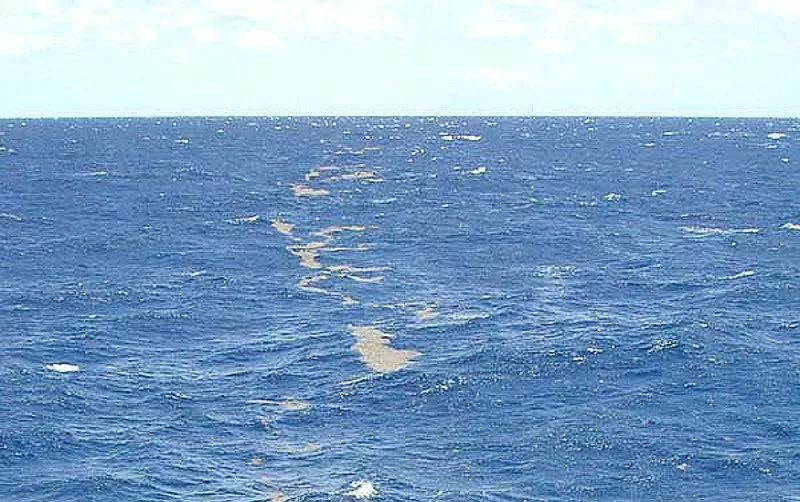
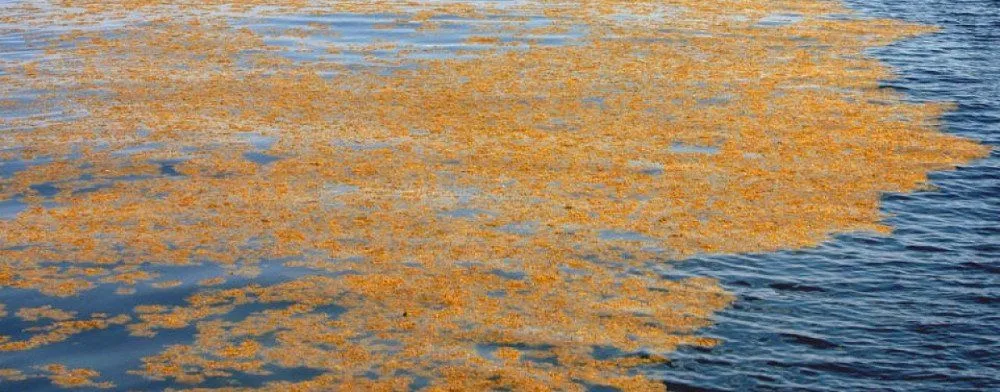
Sure, it lies ‘within’ an ocean, but it’s easily identifiable in the humongous water body, thanks to the characteristic brown Sargassum seaweed that floats on the surface and its relatively calm, blue waters.
Where Is The Sargasso Sea Located?
The Sargasso sea lies within the North Atlantic ocean, surrounded by four currents that form an ocean gyre. For the uninitiated, an ocean gyre is a huge system of circulating ocean currents that are formed due to global wind patterns and the effects of Earth’s rotation (Coriolis effect).
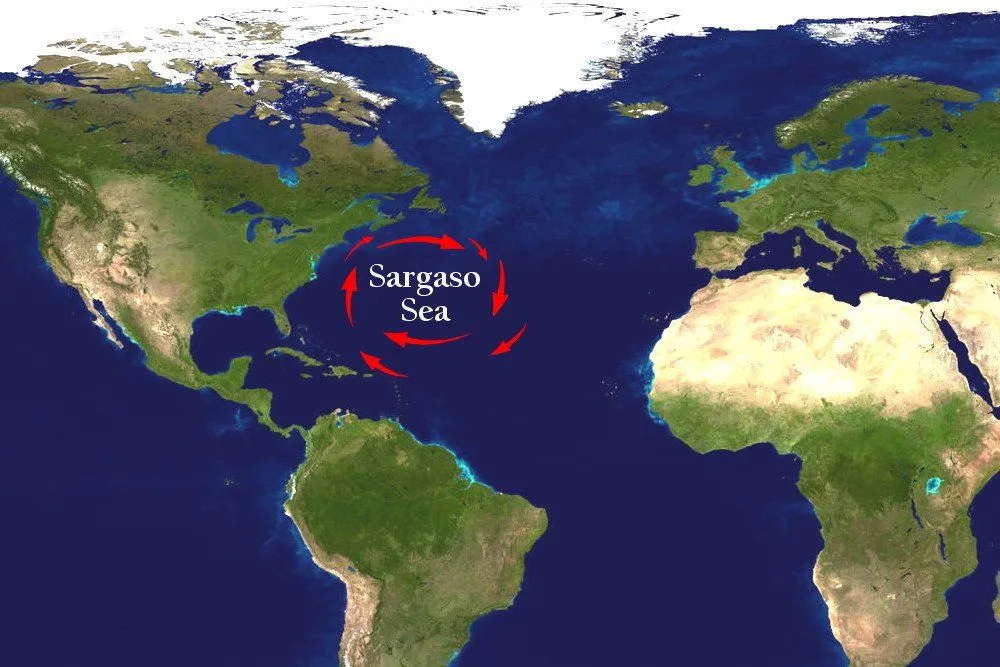
The movement of the major ocean gyres of the world helps drive thermohaline circulation (commonly known as the ‘ocean conveyor belt’), which circulates ocean water all over the planet. This circulation is crucial for the regulation of salinity, temperature and nutrient flow throughout the world’s oceans.
While every other ocean of the world is defined, at least in part, by land boundaries, the Sargasso Sea is an exception to that rule, as it’s only defined by ocean currents. It’s bounded by the North Atlantic Current in the north, the North Atlantic Equatorial Current in the south, the Gulf Stream in the west and the Canary Current in the east.
How Did The Sargasso Sea Get Its Name?
The Sargasso sea gets its name from a genus of free-floating seaweed called Sargassum. A seaweed is an umbrella term for countless species (both macroscopic and microscopic) of marine algae and plants that grow in the oceans (and in other water bodies).
Sargassum
Sargassum is a kind of brown (sometimes dark green) colored macroalgae, whose many species are found in tropical and temperate oceans. The genus of Sargassum is mostly known to inhabit coral reefs and shallow waters, and they’re particularly well known for having free-floating (planktonic) species.
A noteworthy point about some species of Sargassum (the ones present in the Sargasso sea) is that, unlike other seaweeds, which reproduce attached to the ocean floor, they are holopelagic, meaning they live and reproduce vegetatively in the open ocean, floating on the surface for their entire life cycle. Mats of these Sargassum species represent a habitat for numerous marine creatures, including but not limited to crab, fish, shrimp and turtle hatchlings, among others.
What’s So Special About The Sargasso Sea?
As mentioned earlier, the most prominent aspect of its existence is its unique geographical location. The fact that it’s the only sea bounded by water on all sides makes it quite special in the ranks of seas. Furthermore, the Sargasso Sea is known for its exceptionally clear blue and calm waters. The water in the sea is so clear that you can see underwater for more than 50 meters!
Most importantly, the Sargasso Sea hosts a lot of marine life. It is the only known spawning ground for European eels (Anguilla anguilla, listed by the IUCN as Critically Endangered) and American eels (Anguilla rostrata, listed as Endangered), and it is also a vital breeding and nursery habitat for porbeagle shark, white marlin and dolphinfish. (Source) Humpback whales, tuna and migratory seabirds pass through the Sargasso Sea and rely heavily on it for food along their journeys.
Since around 2011, satellite imagery has also tracked a separate phenomenon called the Great Atlantic Sargassum Belt, a recurring bloom of pelagic Sargassum that stretches across the tropical Atlantic between West Africa and the Gulf of Mexico. It’s separate from the historic Sargasso Sea but ecologically linked, and in big years (2018, 2023 and 2025 all set new mass records) it dumps tens of thousands of tonnes of decomposing seaweed onto Caribbean, Mexican and Florida beaches, releasing hydrogen sulfide and disrupting tourism and reef health.
References (click to expand)
- What is the Sargasso Sea? NOAA Ocean Service.
- Sargasso Sea. Encyclopaedia Britannica.
- The Sargasso Sea. Sargasso Sea Commission.
- A Sargasso Sea Study of Ocean Productivity Under Global Warming. Princeton High Meadows Environmental Institute.
- Notes from the Field: Life in the Sargasso Sea. NASA Earth Observatory.
- Venter, J. C., Remington, K., Heidelberg, J. F., et al. (2004). Environmental Genome Shotgun Sequencing of the Sargasso Sea. Science, 304(5667), 66–74.