Table of Contents (click to expand)
Yes, in a sense. Deep in the Earth’s mantle, in a layer 410 to 660 km (255 to 410 mi) down called the “transition zone,” water is locked inside a blue mineral called ringwoodite. It isn’t a sloshing ocean but water bound into rock, and it could hold up to three times as much water as all the surface oceans combined.
Is it possible that human beings have missed out on an entire ocean? And no, I don’t mean an ocean hidden by the government because it holds some secret alien base. Let’s leave the conspiracy theories to the Illuminati lovers. In fact, I mean an actual entire ocean that is unbeknownst to us.

As it turns out, it’s totally possible! Are you wondering how we could have possibly missed it, despite having hundreds of satellites mapping and studying the Earth at all times? Well, it’s a good question. The thing is, this ocean has an incredible strategy to continue to evade our observation. Believe it or not, this ocean is so well hidden… because it’s situated under the ground!
Inside The Earth
What lies inside of our planet has been the subject of serious geological speculation for centuries. Most of us have at least a general perception of what lies beneath our feet, but there is still a great deal that we don’t know.
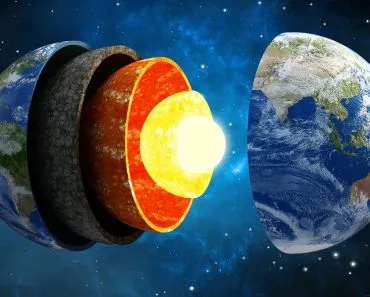
First of all, there is the Earth’s crust, which is extremely thin. In fact, if the Earth were the size of an apple, the crust would be thinner than the apple peel! This thin crust that makes up less than 1% of the Earth’s weight, ‘floats’ on the mantle below it. The mantle is largely solid in terms of its natural state, but if we consider its properties over vast geological time periods, we see that it actually acts like a viscous fluid, enabling the movement of the tectonic plates of the crust. The mantle is by far the heftiest layer, accounting for roughly two-thirds (about 67%) of the Earth’s mass. Beneath the mantle lies the outer core, which wraps around the solid inner core, the part that generates the planet’s magnetic field.
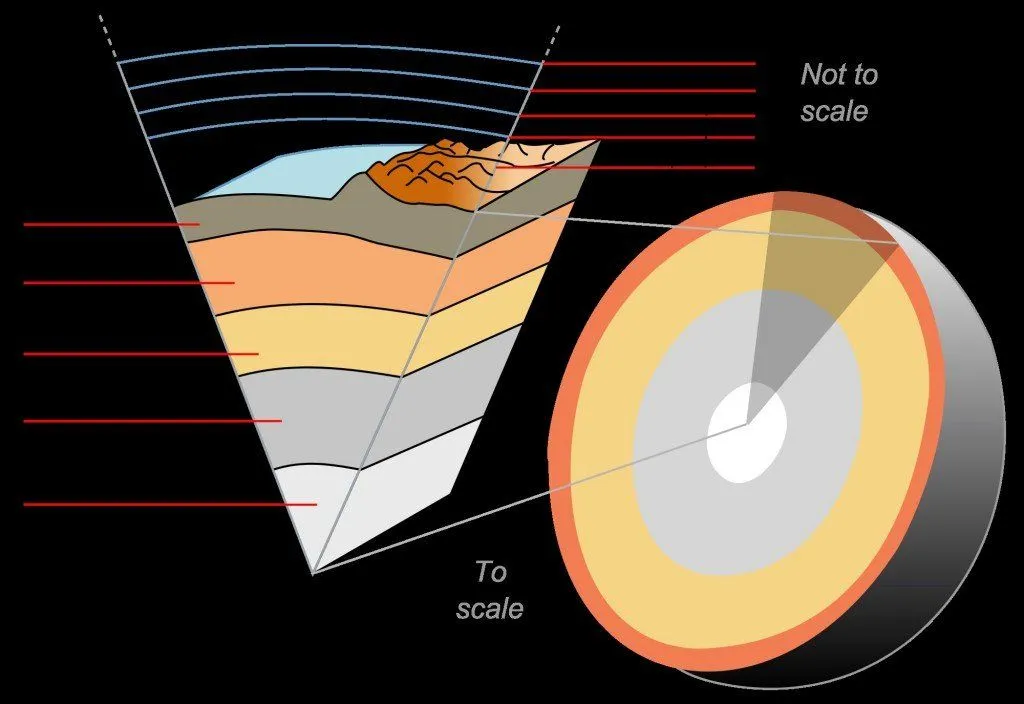
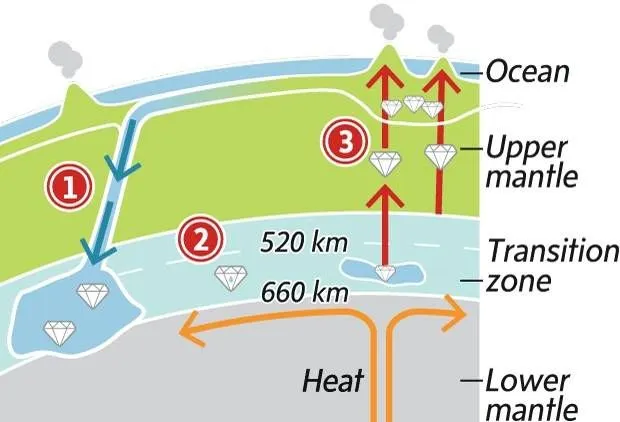
However, our search for this secret ocean doesn’t take us that deep inside the Earth’s innards. It ends in a layer of the mantle called the “transition zone,” which sits between roughly 410 and 660 km (255 to 410 mi) down. The transition zone wraps the whole globe, but the clearest evidence for water there has so far come from beneath the North American continent.
Underground Water
Northwestern University’s geophysicist Steve Jacobsen and University of New Mexico’s seismologist Brandon Schmandt found pockets of magma deep within the mantle. This is usually a sign of the presence of water at those depths. Scientists had long speculated about water lurking in the rocky layers between the upper and lower mantle, but in 2014 Jacobsen and Schmandt pulled together seismic readings and lab experiments that pointed to it on a continent-wide scale. Their study appeared in the journal Science, the same year a separate team led by Graham Pearson reported the actual mineral evidence (more on that diamond shortly) in Nature.
The question is, how would water persist under such great pressure? Jacobsen explains that water can survive at such depths precisely because it isn’t there in its familiar liquid form, nor as a solid (ice), nor as a gas (water vapor). Instead, it hides in a fourth guise entirely: stowed away inside the rock itself!
This fourth form is water trapped within the molecular structure of a mineral called ringwoodite. The immense pressure and the high temperatures cause water molecules to split up and form a hydroxyl radical (OH), which then binds itself to the mineral’s crystalline structure.
Ringwoodite Discovered
Ringwoodite itself wasn’t new to science. It was first identified back in 1969 in a meteorite that slammed into Australia, and it had long been predicted to be a major ingredient of the deep mantle. What nobody had ever held was a piece born inside our own planet. That changed in 2014, when a tiny crystal of ringwoodite turned up trapped inside a diamond from Juína, Brazil. The diamond had been ferried up from the deep mantle by ancient volcanic activity, and the speck of ringwoodite locked inside it was carrying an astonishingly large amount of water! Of course, scientists couldn’t help but be intrigued by the first sample of this mineral ever recovered from within the Earth.
“The ringwoodite is like a sponge, soaking up water,” Jacobsen said. “There is something very special about the crystal structure of ringwoodite that allows it to attract hydrogen and trap water. This mineral can contain a lot of water under conditions of the deep mantle.”
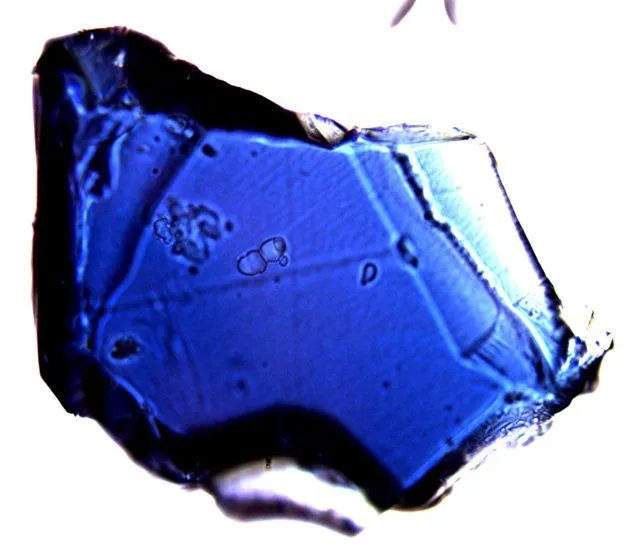
To test this hypothesis, Jacobsen and his associates managed to synthesize ringwoodite in laboratory conditions and mimicked the high temperatures and pressures that it would undergo in the transition zone. By studying how this artificial ringwoodite functions, combined with years of research studying seismic activities, they came to the conclusion that there must definitely be a stable water reservoir deep within the mantle.
Not only is it stable, but it’s also really huge! In fact, if just 1% of the weight of mantle rock located in the transition zone is H2O, that would be equivalent to nearly three times the amount of water in our oceans!

Why Is This Discovery Relevant?
This new discovery changes everything we know about the early stages of life on Earth! As we all know, water is the key to life, and trying to understand how oceans developed is the critical core of studying how life began on our planet. For the longest time, scientists theorized that water was brought to Earth by icy comets and meteorites crashing into the forming planet. However, with this discovery, the evidence seems to point in a new direction.
It now seems quite plausible that at least some of our water was actually born inside the Earth itself, then coaxed up to the surface as gas. “The surface water we have now came from degassing of molten rock. It came from the original rock ingredients of Earth,” Schmandt said. To be clear, this doesn’t throw the comet-and-asteroid theory in the bin. Most scientists now think Earth got its water from more than one source, and the deep reservoir simply adds a homegrown contributor to the mix. Better still, the water in the transition zone seems to swap back and forth with the surface over geological time, hinting at a slow, deep water cycle that researchers are only beginning to map.

The truth is, we know hardly anything at all about what goes on deep inside the Earth. We speculate, yes, but the more we study this planet, the more outrageous it seems to be! Fortunately, geologists are a tireless bunch that know better than to quit in the face of adversity!
References (click to expand)
- Pearson, D. G., et al. Hydrous mantle transition zone indicated by ringwoodite included within diamond. Nature (2014)
- Schmandt, B., Jacobsen, S. D., et al. Dehydration melting at the top of the lower mantle. Science (2014). PubMed, NCBI
- New Evidence for Oceans of Water Deep in the Earth. Northwestern University
- Ringwoodite. Encyclopaedia Britannica