Huddling is a protection strategy for the penguins of Antarctica. This behavior protects them against the icy-cold winds and extremely cold weather of the region.
Animals have evolved different mechanisms to brave the conditions of the habitat in which they live. Camels have hump(s) that can store food that sustains them for days, weeks, or months. Polar bears have fur covering their body to provide insulation. Whales have blubber (a layer of fat under the skin) to survive in frigid waters.
And the list goes on… Meanwhile, our friends from Antarctica have another way to keep themselves warm. I am talking, of course, about penguins! The mechanism they use is particularly interesting: huddling.
What Is Huddling?
The Collins dictionary defines huddling as “sitting, standing or lying close to others, especially when frightened or feeling cold.”
This is exactly what the Emperor penguins of the Antarctic do to stay alive. At first glance, it looks like the penguins are discussing some important agenda item in a massive congregate meeting.
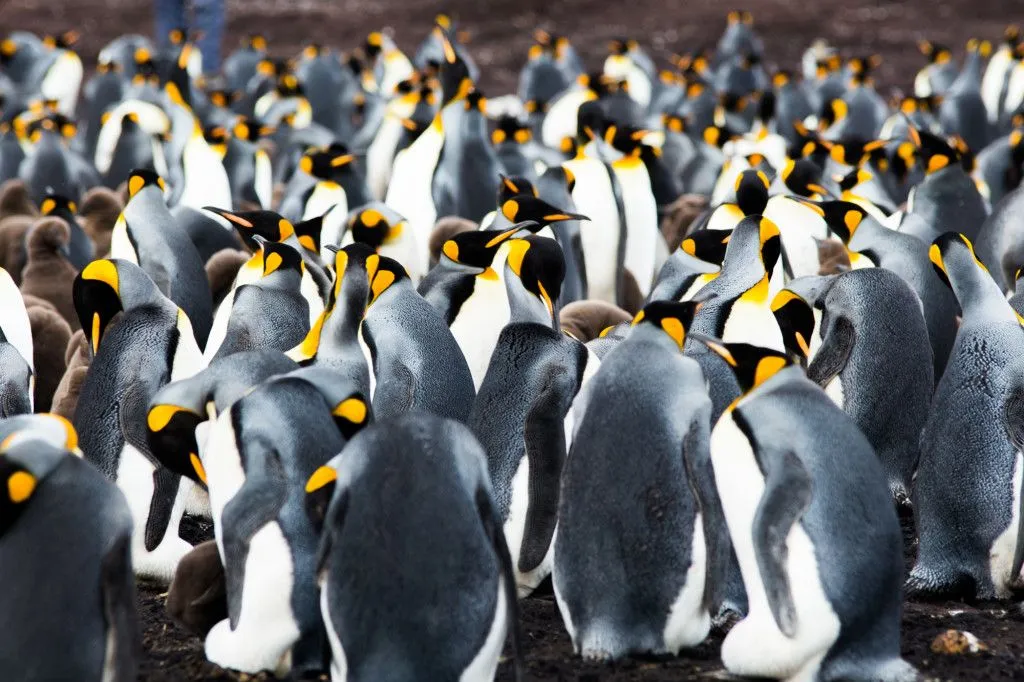
On some days, the penguins collect around each other in a large group and stay that way for some time. They pack themselves as close as physically possible. However, they do not remain still. The penguins on the outer edge of the formation change their positions every so often, while maintaining the overall shape of the group. The question is, why do they do that?
Reason For Huddling
Social thermoregulation. This is a pretty simple, self-explanatory phenomenon. It typically implies generating warmth through skin-to-skin touch. All the members of a group work collectively to conserve body heat.
To define it more properly, “Social thermoregulation is a cooperative strategy in which animals actively aggregate to benefit from the warmth of conspecifics in response to low ambient temperatures.”
Interestingly, social thermoregulation isn’t just seen in penguins. Certain species of reptiles, birds, and mammals also use it to get through cold weather. Penguin huddles can last anywhere from a few minutes to a few hours, depending on the weather conditions.

Penguin huddles can grow to encompass hundreds of penguins, all standing close together in their black and white uniforms. Huddles are a primary strategy to protect themselves from the chilly winds and the sub-zero temperatures of Antarctica.
Through huddles, penguins decrease their collective surface area to volume ratio. The lower this ratio is, the less heat will be lost.
Emperor penguins, which inhabit Antarctica, incubate eggs without nests in the harsh weather of their habitat. The male penguins take up this responsibility. Since the eggs lack nests, they cannot be left unobserved, so males have to fast for long durations.
During this breeding period, conserving body heat becomes a great challenge without food. Huddles come to the rescue in such situations. More often than not, the male penguins are at the center of the huddle, where the temperatures are the highest.
How Warm Can It Get Through Huddles?
Research has found that the ambient temperatures of the huddles reach at least 20°C. Unbelievable, right? From ambient temperatures as low as -60°C to 20°C above zero! Even more impressive, the center of the huddles may reach a temperature of 37.5°C (close to a penguin’s preferred body temperature).
Essentially, sharing and caring is the penguin mantra! Care for other individuals by sharing their body heat. Conserving body heat in this way, the penguins can lower their body temperature and metabolic costs to benefit their survival during their fasting season. With a fasting season that can last as long as 120 days, this becomes essential.

Penguins spend about 90% of their time either packed up in a huddle or in regions that have relatively higher temperatures, like the coasts (-10°C). To preserve their heat and prevent rapid heat transfer, penguins have first-rate insulation from their feathers, skin, down, and trapped air.
It can get so warm that penguins will eventually break off from their huddle. Just a few individual birds leaving the huddle can cause the entire huddle to break apart, only to reform later, once the need for warmth returns.
The energy savings for penguins due to huddling are quite impressive. Researchers have calculated that penguins in a huddle save 26% more energy than penguins in smaller groups. Not just this, when the penguins were exposed to wind speeds of 4.9 m/s, they saved 32% more energy than isolated penguins!
Just a 1°C fall in a penguin’s body temperature contributes about a 7-17% reduction in energy costs. Huddling reduces the exposed surface area of a penguin by a considerable 74%. Less exposed surface area means less effect from the cold winds, and an increase in the warmth being generated.
The Shape Of The Huddle
As mentioned earlier, these huddles aren’t motionless. The movement is slow but constant. Wind speed and direction have an obvious effect on its shape and movement. Slowly and steadily, the birds at the center of the huddle, nearly unexposed to the wind, are shifted to a more exposed position, while those on the outer edges move inward.

Mathematically, hexagonal shapes form the densest packing on a flat surface. As it turns out, that is the shape that penguin huddles assume as well! Do penguins also study mathematics?
Initially, the huddles are irregular in shape, but as the penguins on the windward side move towards the leeward side, the huddle assumes the shape of a hexagon. There is also evidence showing that huddles move back and forth depending on the direction of the dominant winds.
Wind, solar radiation, and environmental temperature are the main factors that contribute to the formation of a penguin huddle. Analysis has also shown that penguins prefer to join huddles and leave their looser aggregations. This also contributes to the continuous movement in and around the huddles.
A 2025 study published in Physics of Fluids went further, showing that the slow churn of penguins between the cold edge and the warm centre behaves like thermal convection in a fluid. Once a huddle gets large enough, vortex-like motion sets in spontaneously, redistributing heat between birds much like a heated pot of water, a striking example of a flock self-organizing according to the same physics that governs gases and liquids.
Besides Huddling, How Else Do Penguins Stay Warm?
Huddling is the headline act, but it would not work without some impressive equipment underneath. So what else keeps a penguin warm?

The first line of defense is the coat. Emperor penguins wear up to four overlapping layers of short, scale-like feathers, and this plumage supplies more than 80% of the bird's total insulation. A fluffy layer of down underneath traps a blanket of still air against the skin, while a layer of fat (blubber) beneath that adds extra padding, much like the insulation that keeps polar bears cozy.
Then there is a neat plumbing trick. In a penguin's feet, flippers, and bill, the arteries carrying warm blood outward run right alongside the veins carrying cold blood back. Heat passes from the outgoing blood to the returning blood, so warmth is recycled into the body instead of leaking out through the extremities. This counter-current heat exchanger keeps a penguin's feet just a degree or two above freezing, which is enough to avoid frostbite while wasting almost no heat.
Here is the part that sounds impossible: the outer surface of an emperor's feathers can actually be colder than the air around it. One study measured the backs of incubating emperors at roughly -23°C (-9°F) while the surrounding air was about -18°C (0°F). The feathers radiate heat away to the icy Antarctic sky, yet the bird's core stays a toasty 37°C (99°F), because that 80%-plus of insulation simply will not let the cold reach the skin.
Do Penguins Hibernate?
If Antarctic winters are so brutal, why don't penguins simply sleep through them the way a bear or a ground squirrel does? It is a fair question, and the answer is no, penguins do not hibernate.

Hibernation involves letting the body temperature and metabolism crash for weeks or months at a stretch. Penguins do the opposite. They hold their core temperature close to 37°C (99°F) all winter long and stay very much awake, shuffling around the huddle, swapping positions, and tending to their eggs. Emperor penguins don't even leave. While many Antarctic animals retreat north for the winter, emperors are the only birds that breed during the Antarctic winter, riding it out on the sea ice in temperatures that can dip below -60°C (-76°F).
Instead of shutting down, they get through the lean months on stored fuel. Adults arrive at the colony carrying large reserves of body fat, keep their activity level low to conserve it, and lean on the huddle to slash heat loss. A male emperor may fast for around 120 days while incubating his egg, living entirely off that fat. Hibernation would actually make things worse here, because a dormant, cooling penguin could freeze. Staying warm, fueled from within, and packed shoulder to shoulder is the winning strategy.
Do Penguins Sweat?
With all that fat, down, and feather insulation, you might wonder how a penguin ever cools down. And what about sweating? Birds, penguins included, have no sweat glands at all, so a penguin can never sweat the way we do.

That is rarely a problem in Antarctica, but plenty of penguins live in much warmer places. The African and Humboldt penguins bask on sunny beaches where overheating is a genuine risk, and their world-class insulation suddenly works against them. So how do they shed heat?
They use a few clever tricks. Poorly insulated, blood-rich areas like the flippers and feet act as thermal windows. When a penguin is too warm, it holds its flippers out from its body and widens the blood vessels there, flushing the skin pink and dumping heat into the air. Warm-climate species such as the African penguin go a step further, with bare patches of skin above the eyes; the hotter the bird gets, the more blood it sends to those bare patches to be cooled by the surrounding air. Penguins can also pant, breathing rapidly to lose heat as moisture evaporates from their airways. Sweating may be off the menu, but penguins are far from defenseless against a warm day.
Conclusion
Penguins face some of the harshest weather conditions in the world. Apart from the insulation provided from their subcutaneous layer of fat and feathers, huddling helps them a lot during the cold and fasting season. So, the next time you come across a large group of penguins, remember that they haven’t gathered to share gossip amongst themselves, but to help conserve heat!
This behaviour is becoming all the more important as their habitat shrinks. In April 2026, the IUCN uplisted the Emperor penguin to Endangered, citing the early break-up of Antarctic sea ice and a projected 50% population decline within the next 50 years. The huddle, an ancient solution to the cold, may soon be tested by an environment changing faster than evolution can keep up.
And for those of you assuming that penguins are devoid of knees, here is an article you might want to read!
References (click to expand)
- Phillips, K. (2008, January 1). How Huddles Help Penguins Weather Winter. Journal of Experimental Biology. The Company of Biologists.
- Ancel, A., Gilbert, C., Poulin, N., Beaulieu, M., & Thierry, B. (2015, December). New insights into the huddling dynamics of emperor penguins. Animal Behaviour. Elsevier BV.
- Waters, A., Blanchette, F., & Kim, A. D. (2012, November 16). Modeling Huddling Penguins. (Y. Ropert-Coudert, Ed.), PLoS ONE. Public Library of Science (PLoS).
- Heat Transfer in Penguin Huddles - ecommons.cornell.edu
- McCafferty, D. J., Gilbert, C., Thierry, A.-M., Currie, J., Le Maho, Y., & Ancel, A. (2013). Emperor penguin body surfaces cool below air temperature. Biology Letters. The Royal Society.
- Antarctic animals adapting to the cold. Australian Antarctic Program.
- Emperor penguin. Australian Antarctic Program.
- African Penguin. San Diego Zoo Animals & Plants.