Table of Contents (click to expand)
Avogadro’s law states that, at constant temperature and pressure, the volume of an ideal gas is directly proportional to the number of moles: V ∝ n, or V/n = k. A consequence is that equal volumes of any two gases at the same temperature and pressure contain the same number of molecules. Real gases deviate slightly. One mole contains exactly 6.02214076 × 10²³ particles (Avogadro’s constant), and one mole of an ideal gas occupies about 22.4 L at standard temperature and pressure.
The modern definition of Avogadro’s law is that for a particular mass of an ideal gas, the amount (number of moles) and volume of the gas are directly proportional, provided the temperature and pressure conditions are constant.
Avogadro’s Law Formula
Avogadro’s law’s mathematical formula can be written as:
V ∝ n or V/n = k
Where “V” is the volume of the gas, “n” is the amount of the gas (number of moles of the gas) and “k” is a constant for a given pressure and temperature.
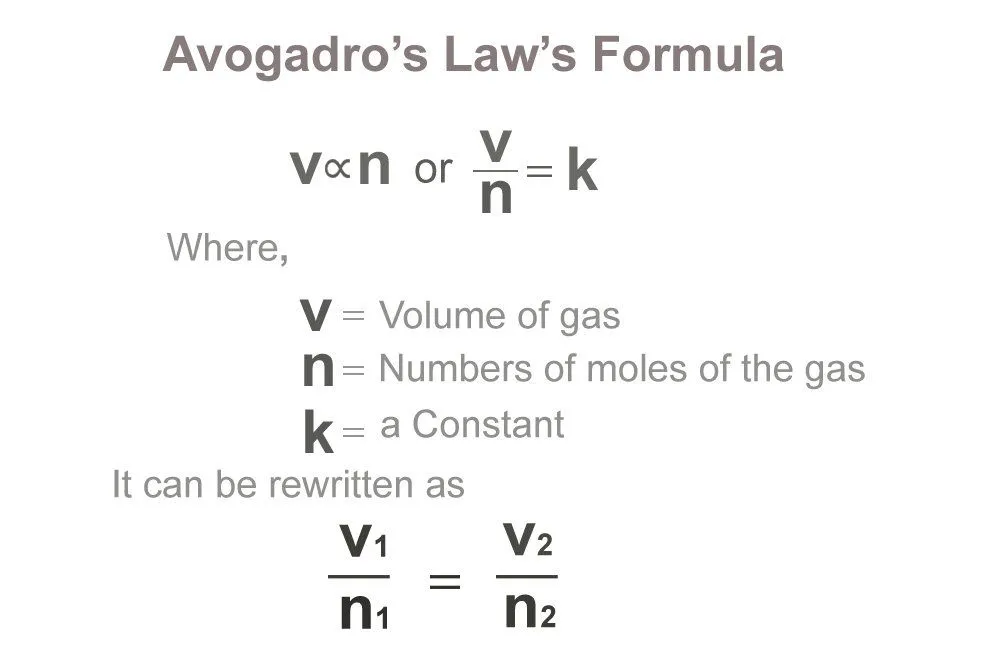
Avogadro’s law formula describes how equal volumes of all gases contain the same number of molecules, under the same conditions of pressure and temperature. In other words, it describes that equal volumes of two different gases will have the same number of molecules as long as the temperature and pressure are the same.
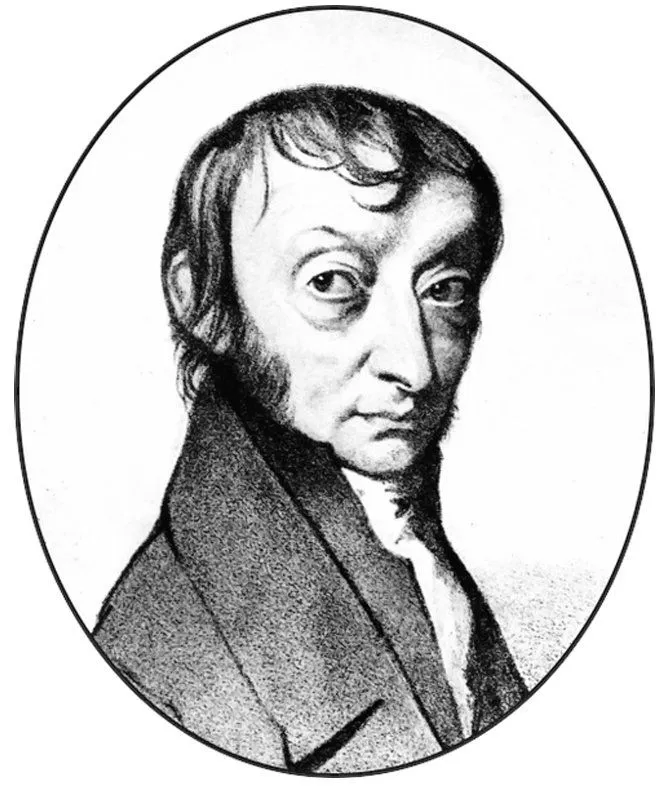
Amadeo Avogadro was an Italian scientist of the 19th century. He is known for making major contributions to chemistry, when it was just becoming a separate science field. His work came around the same as that of Jacques Charles (Charles Law), Robert Boyle (Boyle’s Law), etc. In fact, Avogadro’s Law, the hypothesis set by him, was among the laws on which the Ideal Gas Law is based.
An ideal gas can be defined as one in which the collisions between the molecules of the gas are elastic – i.e. there is no loss of kinetic or of momentum, and the molecules don’t have any intermolecular forces of attraction, i.e. they don’t have any interactions between them with the exceptions of the randomized collisions.
Before we get into understanding his work however, let us go over some basics.
A mole is a measure of the amount of a substance. Until 2019 it was defined as the number of atoms in 12 grams of carbon-12; since the 2019 redefinition of SI base units, the mole is defined exactly as 6.02214076 × 10²³ elementary entities (atoms, molecules, ions, electrons, etc.). The two definitions agree to within experimental precision—the new definition simply fixes Avogadro’s constant to an exact value.
Another thing to remember is that a lot of these laws use STP or standard temperature and pressure. For STP, the value of temperature is 273.15 K (which is 0℃) while the value of pressure is 1atm or 760mmHg
Avogadro’s Number
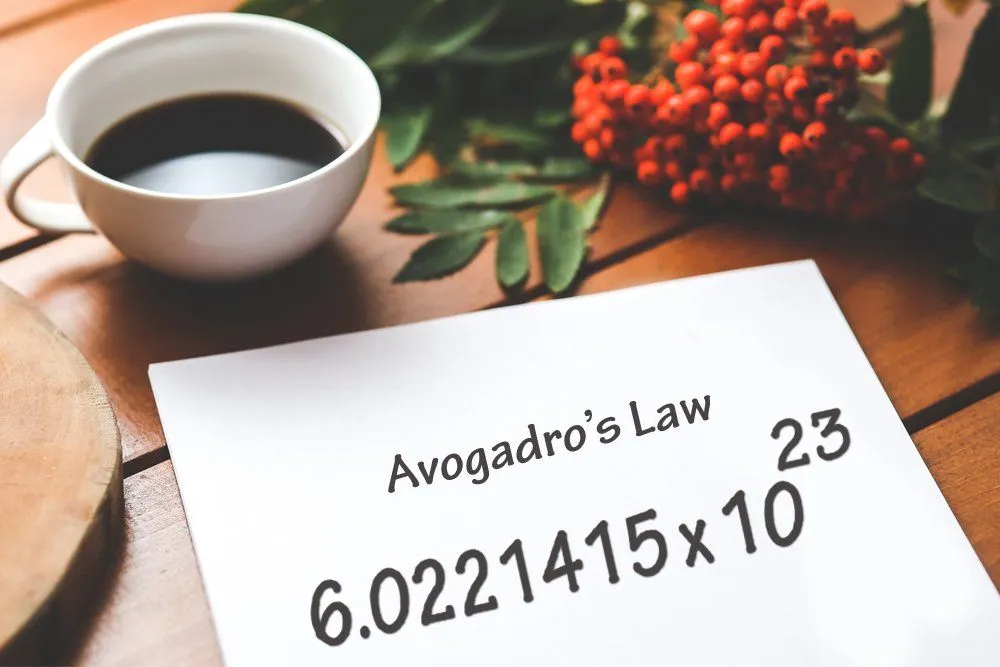
Avogadro’s number is the number of elementary entities (atoms, molecules, ions, etc.) in one mole. Since the 2019 SI redefinition, this number is defined exactly as 6.02214076 × 10²³—it’s no longer measured, but fixed by definition. The unit of Avogadro’s constant is mol⁻¹, and it’s usually symbolised by NA.
It’s interesting to note that contrary to popular belief, Avogadro’s number was not discovered by Amedeo Avogadro. The concept of mole and the determination of the value of Avogadro’s number happened after Avogadro’s death. In fact, Avogadro’s number is so called in honour of his discovery and his work.

The first person to calculate the total number of particles present in a substance was an Austrian high school teacher called Josef Loschmidt, who, after a few years, became a professor at the University of Vienna.
Using kinetic molecular theory, Loschmidt was able to estimate the number of particles present in one cubic centimeter of gas at standard conditions of pressure and temperature. The value he calculated back in 1865 is known as the Loschmidt constant today, and its value is 2.6867773 x 1025 m-3.
The term ‘Avogadro’s number’ was first used by Jean Baptiste Perrin – a French physicist. He reported an estimate of the Avogadro’s number in 1909 based on his work on Brownian motion. For the uninitiated, Brownian motion is the random, haphazard movement of microscopic particles suspended in a gas/liquid.
Accurate determination of the Avogadro’s number only became possible for the first time when Robert Millikan – an American physicist – successfully measured the charge on an electron. Prior to this, the charge on a mole of electrons was already known (it’s a constant called ‘Faraday’, which is equal to 96,485.3383 coulombs per mole of electrons).
Certain parallels have been drawn to convey how humongous this number is. One of the easiest: if you spread that many unpopped kernels of popcorn across the area of the United States, after popping, the popcorn would cover the country to a depth of about 9 miles (for reference, the area of the United States is roughly 3.8 million square miles).
For most of its history the number was a measured quantity—each method (Brownian motion, X-ray crystallography of silicon, watt-balance comparisons) refined the value slightly. Since the 2019 SI redefinition, Avogadro’s constant is no longer measured at all: it is fixed by definition at 6.02214076 × 10²³ mol⁻¹. The first person to estimate it experimentally, however, was Loschmidt in 1865.
Moles To Grams
Moles can be converted to grams, which is another very popular measurement of quantity, and vice versa, by the following formula
Moles = grams/molar mass
To calculate the molar mass of a substance, one has to employ the use of the ever efficient periodic table. It be calculated by simply adding the mass number of the individual atoms in the substance. For instance, if one has to calculate the molar mass of NaCl –
Mass number of Na = 22.99 g/mol
Mass number of Cl = 35.45 g/mol
Therefore molar mass of NaCl is 22.99 + 35.45 = 58.44 g/mol
Avogadro’s number has a lot of applications in chemistry and physics. Certain generalization’s have also been drawn. For instance, the volume of 1 mole of a gas at STP is 22.4L. These are very handy in calculations. Avogadro’s number is an entity used by chemists worldwide. Although he may not have determined it, his work was the precedence for these calculations.
Avogadro’s Law Example (Solved Problem)
Because the ratio of volume to moles stays constant as long as temperature and pressure are held fixed, Avogadro’s law is usually rewritten in a two-state form that compares a gas before and after the amount changes:
V1/n1 = V2/n2
Here V1 and n1 are the starting volume and number of moles, while V2 and n2 are the values after gas is added or removed. This is the form you actually reach for when solving numerical problems.
Let us work through a typical one. Suppose a balloon is filled to a volume of 1.90 L with 0.0920 mol of helium gas. If another 0.0210 mol of helium is pumped in while the temperature and pressure are kept constant, what is the new volume of the balloon?
First, find the new number of moles: n2 = 0.0920 mol + 0.0210 mol = 0.1130 mol. Then rearrange the formula to solve for V2:
V2 = (V1 × n2) / n1 = (1.90 L × 0.1130 mol) / 0.0920 mol = 2.33 L
Adding about 23% more helium increases the volume by about 23%, exactly as the direct proportionality predicts. Notice that the answer never depends on which gas you use. Helium, oxygen or carbon dioxide would all give the same result, because Avogadro’s law counts molecules, not their identity.
Real-Life Examples Of Avogadro’s Law
Avogadro’s law is not just a textbook relationship. You can watch it happen any time the amount of gas inside a flexible container changes while the temperature and pressure stay roughly the same.

Breathing. Every breath is a small demonstration of the law. When you inhale, air flows into your lungs and they expand; when you exhale, gas leaves and they shrink. Because your body temperature and the surrounding pressure stay nearly constant, the volume of your lungs rises and falls in step with the number of gas molecules they hold.
Inflating a balloon. Blowing up a balloon adds moles of gas, and the balloon grows to make room for them. Roughly double the amount of air you push in and you roughly double the volume, which is the proportionality of the law made visible. Let the air back out and the balloon shrinks.
Pumping up a tire. As you add air to a car or bicycle tire, more gas molecules push the walls outward and the tire firms up. Release the air and the number of moles drops, so the volume falls and the tire goes flat. The same idea is at work in an inflating air mattress or a hospital oxygen tank feeding gas into a flexible bag.
References (click to expand)
- Ideal Gas Law. The University of Oregon
- avogadro. The University of Kentucky
- Avogadro's Number. The University of California, Berkeley
- Moles to Grams Conversion Formula - Softschools.com. softschools.com
- Avogadro’s Law: Volume and Moles. Chemistry LibreTexts
- Avogadro’s Law - Definition, Formula, Examples. Science Notes
- Ideal Gas Law. The University of Oregon