Table of Contents (click to expand)
There’s no oxygen in space because Earth’s gravity holds the atmosphere close to the surface. Beyond a certain altitude, gravity is too weak to retain air molecules and they thin out into a near-vacuum. Scientists figured this out long before spaceflight: Torricelli’s mercury barometer (1644) showed air has weight, Pascal’s Puy de Dôme experiment (1648) showed atmospheric pressure drops with altitude, and Newton’s law of universal gravitation (1687) explained why.
Now, before we take this trip down memory lane and discover who helped us figure out there’s no oxygen in space, think back to the times you may have gone out on a mountain hike. Fun, right? Waking up early in the morning, packing food and accessories for the hike, and the scenic ride to the base. Think of all that fresh air you are able to enjoy.
However, once you’ve reached the top, you noticed others finding it a bit difficult to breathe. The next thing you know, you start having difficulty breathing too!
As you may have guessed, the difficulty you had in breathing atop a mountain has a lot to do with the discovery of oxygen’s absence in space?
Scientific Contributions
The debate over whether truly empty space (a vacuum) could even exist goes all the way back to ancient Greece. Around 350 BC, Aristotle famously declared that nature abhors a vacuum, the idea later known as horror vacui, meaning a true void was impossible and any empty space would immediately be filled by surrounding matter. The earlier Atomists (Democritus, Leucippus) had argued the opposite, that atoms move through a real void, but Aristotle’s view dominated for nearly two thousand years. It wasn’t until the 1600s that experimentalists actually settled the matter and showed that the high atmosphere thins into something very close to a vacuum.
Have you ever heard of a barometer? It is an instrument used to measure air pressure. The barometer was created by an Italian physicist named Evangelista Torricelli, who served as Galileo’s assistant during the final months of the great astronomer’s life. Galileo had been performing many different experiments on air. He knew that air had weight and some force that resisted the formation of a vacuum. In 1643, the year after Galileo’s death, Torricelli successfully completed the famous mercury-tube experiment and produced the first sustained partial vacuum, the space at the top of the sealed tube, now called a Torricellian vacuum.
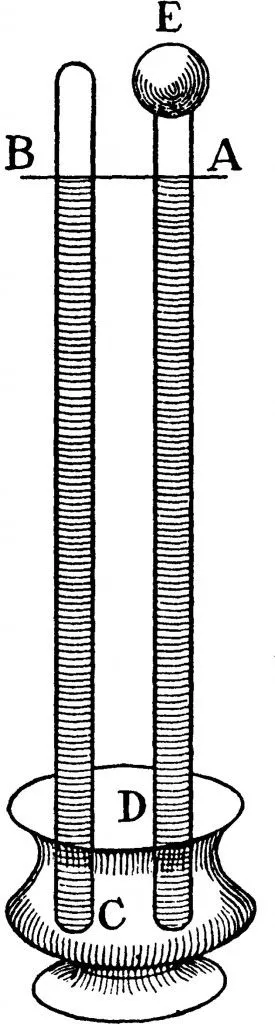
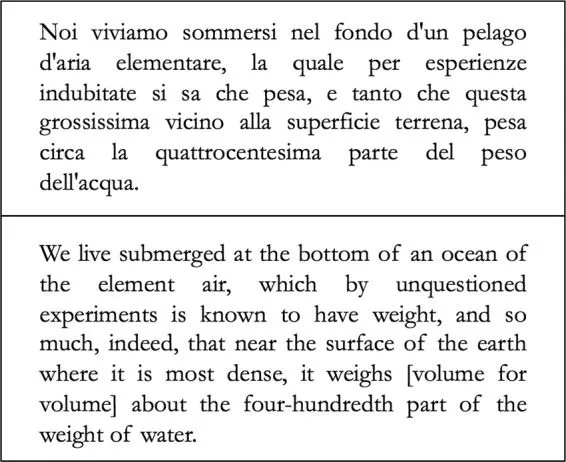
After performing many more studies, around 1644, Torricelli concluded that air or atmosphere exerts pressure because it’s being pulled or pushed down by something to the Earth’s surface. His exact words read, “We live submerged at the bottom of an ocean of the element air, which by unquestioned experiments is known to have weight.”
A few years later, in 1646, Blaise Pascal (who would later co-found probability theory and give his name to the SI unit of pressure) ran his own experiments and confirmed that real vacuums can exist above the mercury column. On 19 September 1648, Pascal convinced his brother-in-law Florin Périer to carry a mercury barometer up the Puy de Dôme, a 1,465 m volcanic peak in central France. The mercury column stood at about 711 mm in the town below but only 627 mm at the summit, confirming that atmospheric pressure decreases with altitude. The deeper question, why pressure drops as you climb, was still unanswered.
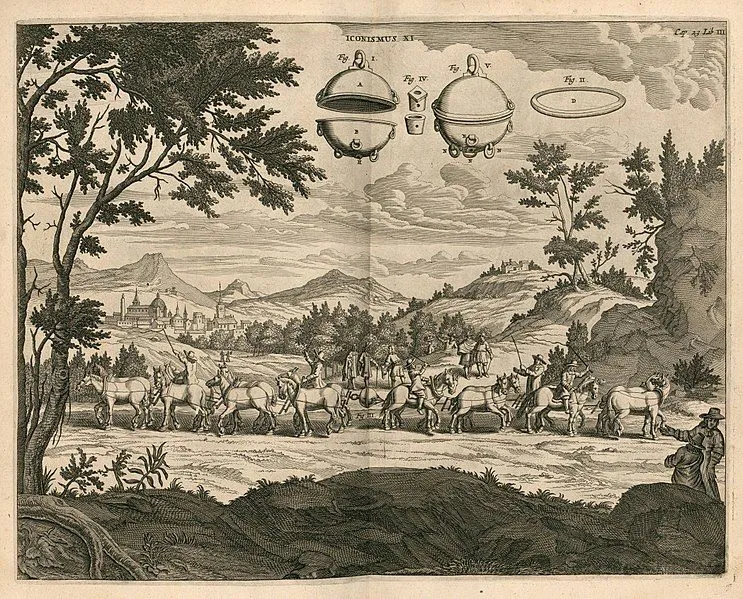
A German scientist named Otto von Guericke built the first practical vacuum pump around 1650. In 1654, in his famous Magdeburg hemispheres demonstration before Emperor Ferdinand III at Regensburg, he pumped the air out of two tightly fitted copper hemispheres and showed that two teams of horses could not pull them apart. The surrounding atmosphere was pressing them together that hard. Guericke also reasoned that Earth’s atmosphere surrounds the planet like a shell, gradually thinning with altitude, and that beyond a certain height there must be a near-vacuum.
In 1687, one of the most influential scientists in history, Sir Isaac Newton, laid down his theory of Universal Gravitation in The Mathematical Principles of Natural Philosophy.
Thank God for that apple! Otherwise, we might have never come to know about Gravity. If you aren’t yet aware, the reason we humans stay grounded on Earth is gravity. If there were no gravity, we would all just be floating around. Not only that, but gravity plays an important role in many other natural phenomena aside from keeping us on Earth’s surface.
Why Is There No Oxygen In Space?
Now, before we continue digging through the history books, let’s consider something… If Earth has gravity and gravity is what keeps everything attached to the surface, is it possible that gravity is why we experience atmospheric pressure? Indeed it is! Gravity pulls the atmosphere (or air) towards Earth’s surface, causing atmospheric pressure.
If that’s the case, why does atmospheric pressure decrease as we go higher up? Well, as we go higher up into the atmosphere, we are moving further away from the Earth’s core, and thus moving away from the Earth’s gravitational field. The pulling effect of gravity decreases as we go higher, so at a certain height or distance above the Earth, gravity stops acting on the bodies and they will simply drift away into space.
This is exactly what happens with oxygen. Oxygen is concentrated in the lower areas of the atmosphere and becomes more scarce as we go higher. That’s why mountaineers and trekkers have difficulty breathing at the summit, as there is very little oxygen present there. The air gets thinner the higher we go.
After a point where gravity is no longer acting forcefully, the air molecules (oxygen) are no longer attracted to Earth. Thus, the molecules are further away from each other, often so far apart, in fact, that we say that there is “No Air present” or label it a “Vacuum”.

This is how scientists, physicists, and astronomers came to this realization about there not being any oxygen in space: logical reasoning and some basic experiments.
Of course, it wasn’t quite as simple for them to discover this as it was for us to talk our way through the issue. Many great minds were involved and extensive experiments had to be performed before this conclusion could be reached.
Between the 1600s and 1800s, many theories and laws were articulated regarding the behavior of air with respect to pressure, temperature, molecules, etc. Some of these laws include Boyle’s Law, Charles’s Law, Avogadro’s Law, the Ideal Gas Law and many more. All the laws and theories played a huge role in the discovery of space’s empty nature.
For example, the high-altitude balloon flights pioneered by the Montgolfier brothers in the 1780s helped confirm that air (and thus oxygen) keeps thinning as you move away from Earth’s surface. There’s nothing better than reaching excellent scientific conclusions while enjoying a great view!
Is There Any Oxygen In Space At All?
Here’s a twist that surprises most people: space is not actually free of oxygen. Oxygen is the third most abundant element in the entire universe, after hydrogen and helium. The catch is that almost none of it floats around as the breathable molecule we depend on, the two-atom O2 in the air at sea level.

Out among the stars, oxygen mostly turns up locked inside other things: as single atomic oxygen, as oxygen ions, as part of water (H2O), and bound up with silicon and metals in the mineral grains of interstellar dust. Even free O2 exists out there, just in tiny amounts. It was so hard to find that astronomers did not confirm molecular oxygen in interstellar space until 2007, when Sweden’s Odin satellite spotted it in the Rho Ophiuchi cloud, roughly 500 light-years away.
You don’t even need to travel that far. In the thin upper fringe of our own atmosphere, the thermosphere, what little oxygen remains takes a strange form. Up where the vacuum of space begins, ultraviolet sunlight rips O2 apart, so about 96% of the oxygen in low Earth orbit drifts as lone, highly reactive atoms. Those atoms slam into satellites and the International Space Station at orbital speed, around 4.5 electronvolts of energy per hit, slowly eroding exposed plastics and coatings. That same atomic oxygen is what makes the faint green airglow astronauts photograph along Earth’s curved edge. So oxygen is genuinely present in space. It just isn’t there as the gentle, pressurized O2 your lungs are built for.
How Do We Know We Can’t Breathe In Space?
If there are still a few stray oxygen atoms up there, why can’t an astronaut just take a deep breath? The answer comes down to pressure, not only the amount of oxygen. Your lungs don’t suck air in by force; they rely on the surrounding atmosphere pushing it in. In the near-vacuum of space the air is so spread out that there is essentially nothing to push, so even pure oxygen at that pressure would never reach your bloodstream.

We didn’t just reason this out, we have seen it happen. Sudden exposure to a near-vacuum leaves you only a handful of seconds of time of useful consciousness, the brief window in which the oxygen already circulating in your blood keeps the brain working. At airliner-cruise altitudes that window is roughly 9 to 12 seconds, and it shrinks to just 6 to 8 seconds for the kind of extreme decompression you would face in space. After that, hypoxia takes over and you black out. There is also ebullism: once the surrounding pressure drops below about 47 mmHg (6.3 kPa), the altitude known as Armstrong’s line near 19 km (63,000 ft), the water in your tissues can begin to boil at body temperature. The body’s skin and tissues are elastic enough that you would not pop like in the movies, but the loss of pressure, the boiling of body fluids, and the lack of usable oxygen together make unprotected exposure quickly fatal.
This is exactly why a spacesuit is really a tiny one-person spacecraft. It seals you inside an Earth-like bubble, supplies oxygen, and most importantly holds that oxygen at a high enough pressure for your lungs to use it. Step outside that bubble and the problem is twofold: there is almost no oxygen, and there is almost no pressure to deliver it. For more on what your body would actually go through, see our deeper look at what happens to a human exposed to the vacuum of space.
References (click to expand)
- Horror vacui (philosophy) - Wikipedia
- Nature Abhors A Vacuum - Our Daily Bread. Our Daily Bread
- West, J. B. (2013, March). Torricelli and the Ocean of Air: The First Measurement of Barometric Pressure. Physiology. American Physiological Society.
- Airglow Over the Indian Ocean. NASA Earth Observatory.
- Banks, B. A. et al. Low Earth Orbital Atomic Oxygen Interactions With Spacecraft Materials. NASA Technical Reports Server (NTRS).
- First Detection of Molecular Oxygen in the Interstellar Medium (Odin satellite). Observatoire de Paris - PSL.
- Physiologic Changes, Injuries, and Forensic Considerations Associated with Human Spaceflight: A Reference Guide. NASA.
- Time of Useful Consciousness - Wikipedia.