Henry’s Law states that, at a constant temperature, the amount of a gas that dissolves in a liquid is directly proportional to the partial pressure of that gas above the liquid. Written as an equation, the dissolved concentration equals the partial pressure divided by Henry’s law constant, so higher pressure means more dissolved gas, while higher temperature means less.
It’s true that equations about mathematics can turn out to be extremely dry and mundane. They can sometimes lead to such a high level of abstractive thinking that these concepts and equations lose any kind of correlation to the real world. This is especially true of Henry’s Law, as it is highly abstractive. However, there is a reason it is called a ‘Law’, namely because it explains the phenomena of nature in the most scientific and mathematically precise way. Now, let’s try to establish a basic understanding of Henry’s Law.
Theoretical Understanding
When gas comes in contact with the surface of a liquid, the amount of gas that will go into the solution is proportional to the partial pressure of that gas. For analysis, let’s assume some gas and the liquid to be water. The amount of the gas that dissolves at a particular temperature depends on the partial pressure that the gas exerts on the liquid. One simple thing we must remember is that the dissolved gas and the undissolved gas are in equilibrium. A simpler rationale for Henry’s Law is that if the partial pressure of a gas is twice as high, then on average, twice the number of gaseous molecules will hit the surface of the water. For a gas mixture, Henry’s law helps to predict the amount of gas (or even multiple numbers of gases) that will go into solution, but different gases have different solubility levels, which also affects the rate.
The Equation
Now that we have an understanding of a single broad application of Henry’s Law, let’s take a more rigorous mathematical approach to the understanding of Henry’s Law. A gas and a liquid will reach some equilibrium relationship.
Liquid ⇔ Gas
CsHe = Pi
The different elements are symbolized by the following abbreviations:
Cs = saturation concentration
He = Henry’s law coefficient
Pi= partial pressure of the gas
The standard unit for the Henry’s Law Coefficient (He) is expressed in terms of atm⋅m3/mole; P is in terms of atm, and for the saturation content, Cs is in mole/m3. The greater the Henry’s Law coefficient, the greater the volatility and the lower the solubility. It is valid for dilute solutions and non-reacting gases at near-ambient pressure and temperature. Ionic strength increases Henry’s coefficient and decreases gas solubility.
Dissolved Oxygen In The Water And Equilibrium
We will consider a very practical example, so that we can understand the physical relation of the above-mentioned equation with the real world. Let’s take a specific case of oxygen dissolving in water. Now, the oxygen that is dissolved has come into existence primarily for two reasons. The first reason is that it is the byproduct of photosynthesis of aquatic plants. The second is through direct absorption from the atmosphere.
For the oxygen concentration of water to be in equilibrium with the atmosphere, the concentration can be calculated with Henry’s Law. At 25 °C (77 °F), Henry’s law constant for O2 in water is about 769 L⋅atm/mole when it is written as partial pressure divided by concentration. Flip that around and it says the same thing the other way: roughly 0.0013 moles of oxygen dissolve in each liter of water for every atmosphere of oxygen partial pressure. Either number applies only at the surface of the water. Water below the air/water interface is not necessarily in equilibrium with oxygen in the atmosphere, so its dissolved oxygen can differ from what this surface value indicates. It is a known fact that the oxygen concentration at the surface of lakes and oceans is higher than at greater depths. An important thing to know about the oxygen/water relation is the percentage saturation. Percentage saturation is the amount of oxygen that one liter of water can hold relative to the total amount of oxygen that water can hold at that temperature.
Running water in shallow streams has a better concentration of oxygen than still water, as it can mix well with the air. There is also a strong dependence between temperature and oxygen concentration. Atmospheric pressure is lower at higher altitudes, so water at higher elevations holds less dissolved oxygen than the water at sea level. The amount of dissolved oxygen is highest during the day time, as this is when photosynthetic organisms produce oxygen. As the temperature of water rises, its ability to dissolve oxygen into itself becomes more difficult. This can especially prove dangerous for aquatic animals, as oxygen levels drop to their lowest just before dawn (when respiration has been depleting oxygen all night without any photosynthesis to replenish it) and during hot summer days, which is exactly when fish kills tend to happen. There are other applications of Henry’s Law, such as carbon dioxide saturation in water, and even calculations of oxygen in the human bloodstream. Henry’s Law proves that even the most abstract concepts have the most basic practical applications.
What Does The Graph Of Henry’s Law Look Like?

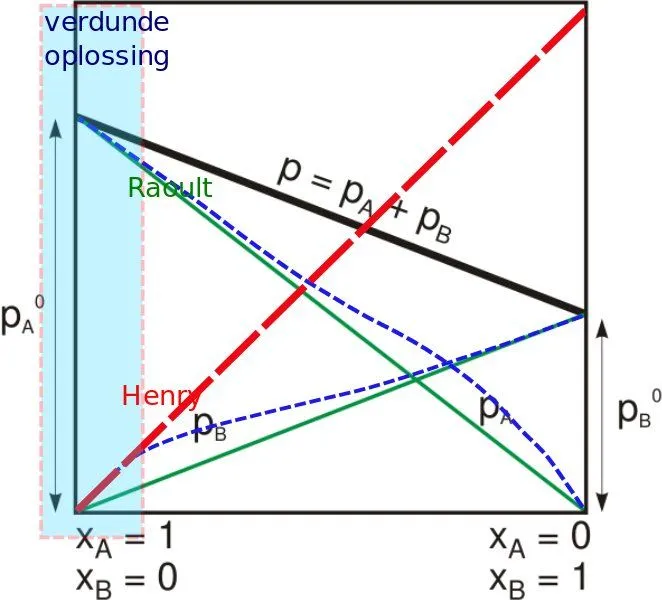
Henry’s Law is one of those rules that becomes obvious the moment you draw it. Plot the amount of gas dissolved in the liquid on one axis and the partial pressure of that gas above the liquid on the other, and at a fixed temperature you get a straight line that passes through the origin. The proportionality the law describes is, quite literally, the slope of that line. Double the partial pressure and you double the dissolved concentration; halve it and the concentration halves. The line starts at the origin because zero pressure of a gas above the liquid means none of it is being driven into solution.
Which quantity you put on which axis decides what the slope represents. If you graph dissolved concentration (vertical) against partial pressure (horizontal), the slope equals the solubility form of Henry’s constant, the amount of gas dissolved per unit of pressure. Flip the axes and the slope becomes the reciprocal volatility form instead. Either way, the shape is the same simple, sloped, straight-through-zero line.
One caveat keeps the graph honest: it only stays straight while the solution is dilute. At low concentration the dissolved molecules barely interact, so the relationship is cleanly linear and Henry’s Law holds. As the liquid becomes crowded with solute and moves toward a concentrated or nearly pure mixture, the line bends away and the system gradually follows a different limiting law (Raoult’s Law) instead. For the gases dissolving in water that we care about here, though, we are firmly in the dilute, straight-line regime.
The Mathematical Forms Of Henry’s Law
The equation above (CsHe = Pi) is one way to write Henry’s Law, but textbooks state it in a few equivalent forms, and the differences trip people up more than the physics does. The most common chemistry-class version simply rearranges things so the concentration sits by itself:
C = k · Pgas
Here C is the solubility (the dissolved concentration), Pgas is the partial pressure of that gas above the liquid, and k is Henry’s Law constant. In this layout k is the solubility constant: how much gas dissolves per unit of pressure, with units like mol/(L·atm).
The catch is that the constant comes in two reciprocal conventions, and that is why two perfectly correct sources can quote “Henry’s constant” values that look like opposites of each other. The solubility form writes the constant as concentration divided by pressure (a larger value means the gas dissolves more readily). The volatility form, which is the one used in our CsHe = Pi equation above, writes it as pressure divided by concentration (a larger value means the gas escapes more readily and dissolves less). They are simply inverses of one another, so a gas with a small solubility constant has a large volatility constant. Whenever you compare two numbers for the same gas, the first thing to check is which convention, and therefore which units, each one is quoting.
A handy way to remember the law without any constant at all is the ratio form: P1/A1 = P2/A2, where A is the amount of dissolved gas at partial pressure P. Because the ratio of pressure to dissolved amount stays fixed at a given temperature, if you know the dissolved amount at one pressure you can scale directly to any other pressure.
Everyday Examples Of Henry’s Law

The most familiar demonstration of Henry’s Law is sitting in your refrigerator. A carbonated drink is bottled under a high partial pressure of carbon dioxide, which forces a large amount of CO2 into solution. The instant you twist off the cap, the gas pressure above the liquid drops to roughly atmospheric, the solubility collapses to match, and the excess dissolved carbon dioxide escapes as the familiar hiss and rush of bubbles. That is precisely why a soda fizzes when opened.
The same physics turns dangerous underwater. As a scuba diver descends, the surrounding water pressure rises, and following Henry’s Law more nitrogen from the breathing gas dissolves into the blood and tissues. As long as the diver ascends slowly, that nitrogen has time to be carried back to the lungs and breathed out. Ascend too quickly, though, and the pressure falls faster than the gas can leave: the nitrogen comes out of solution as bubbles inside the body, much like the soda bottle, and those bubbles can block blood vessels and damage tissue. This is decompression sickness, commonly called “the bends.”
Henry’s Law also governs the gases we breathe. The exchange of oxygen and carbon dioxide between the air in your lungs and your bloodstream depends on each gas dissolving in proportion to its partial pressure. It is the same reason aircraft and high-altitude breathing gas are oxygen-enriched: at altitude the partial pressure of oxygen falls, so less of it dissolves into the blood, and topping up the oxygen concentration keeps the dissolved amount where the body needs it. From a soda can to a diver’s bloodstream, the rule never changes: more pressure above the liquid means more gas dissolved within it.
References (click to expand)
- Gas Transfer. UCLA Samueli School of Engineering.
- Dissolving Gases In Liquids, Henry’s Law. Chemistry LibreTexts.
- Dissolved Oxygen for Fish Production. University of Florida IFAS Extension.
- Henry’s Law. StatPearls. NCBI Bookshelf.
- Henry’s Law. Chemistry LibreTexts.
- Oxygen, Henry’s Law data. NIST Chemistry WebBook.