Table of Contents (click to expand)
- The Versatility Of ‘Matter’
- What Determines The State Of Matter?
- Understanding The Effect Of Temperature On The States Of Matter
- Understanding The Effect Of Pressure On The States Of Matter
- Boyle’s Law Governs The States Of Matter
- What Actually Causes The Pressure Of A Gas?
- When Pressure Increases, What Happens To The Temperature?
- What Happens If You Put A Gas Under Extreme Pressure?
- How Is Dry Ice Formed?
- Conclusions
When the pressure on a gas is increased at constant temperature, its volume shrinks proportionally, this is Boyle’s law. The molecules are squeezed closer together, intermolecular forces grow, and with enough pressure the gas can be compressed into a liquid (and even a solid). If the volume is held fixed instead, raising the pressure also raises the temperature, as described by Gay-Lussac’s law.
How cool is it to change your state?
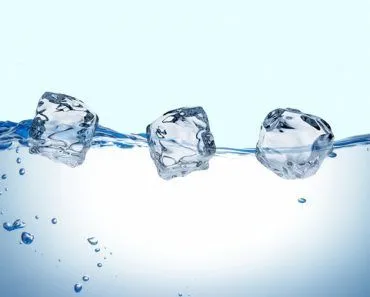
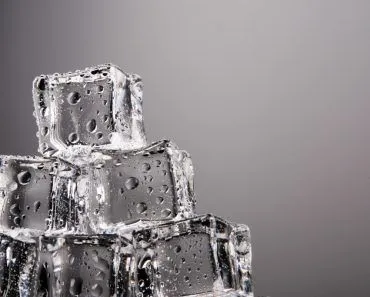
Freeze me; I am ice.
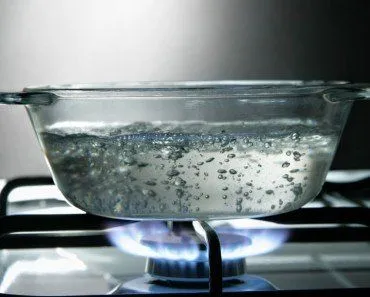
Heat me; I am water.
Boil me; I am steam.
I have different forms and states: I am Matter!
The Versatility Of ‘Matter’
Simply put, the definition of matter is something that carries mass and occupies space.
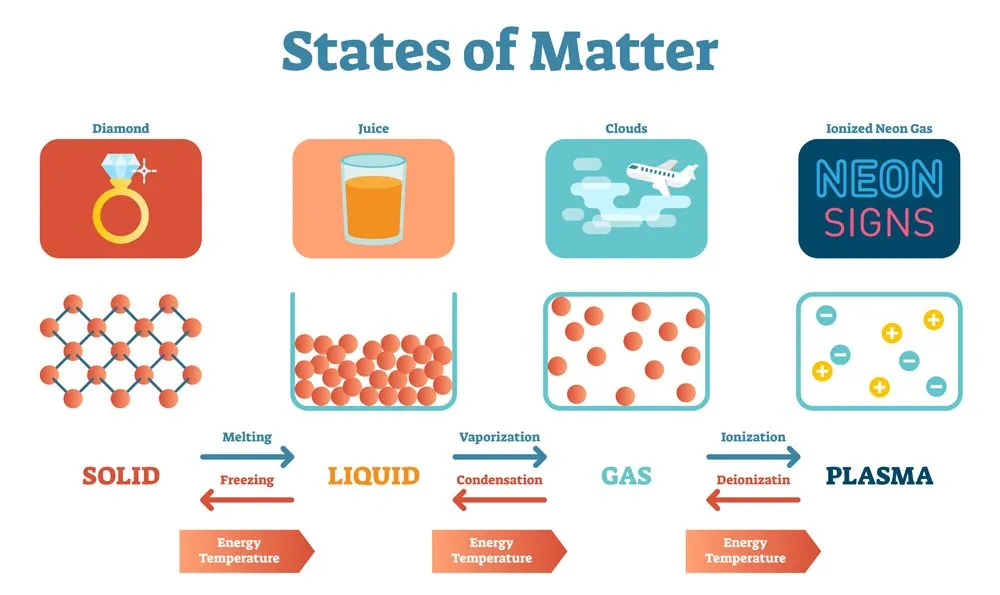
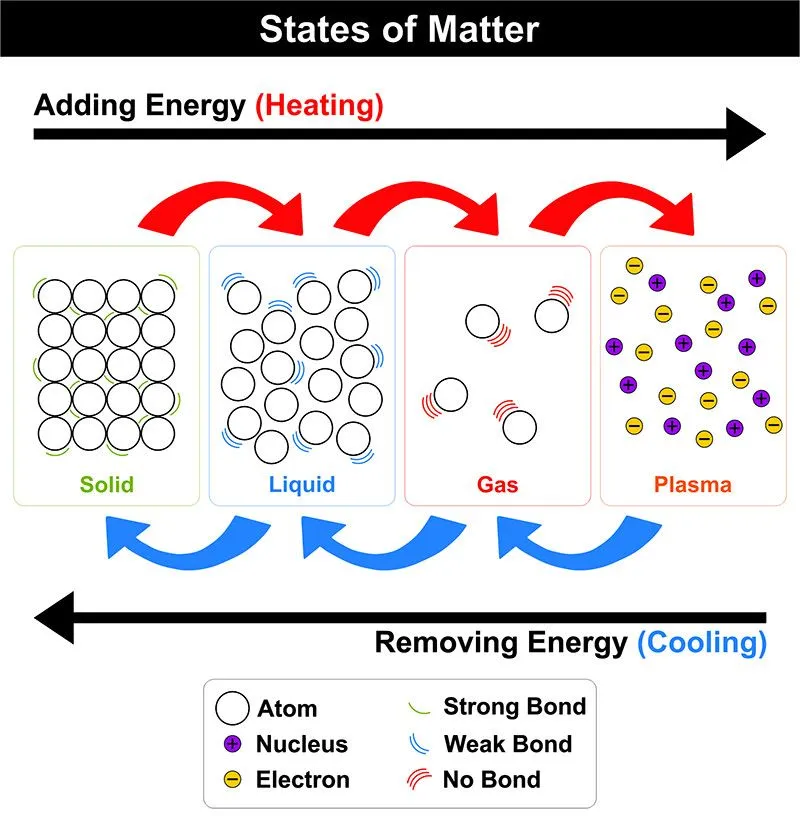
There are four fundamental states of matter: Solid, Liquid, Gas, and Plasma.
Solids:
These are rigid and incompressible with a definite shape and volume. Strong inter-molecular forces hold the molecules together with no or negligible inter-molecular spaces. The molecules in solids have low kinetic energy and low vibrational energy. Solids can exist in two forms: crystalline or amorphous.
Solid carbon exists in a crystalline form as diamond, and in amorphous form as charcoal.
Liquids:
These are fluidic, have a definite volume, no definite shape (takes the shape of the container), and are incompressible. Moderate intermolecular forces hold the molecules together with weak intermolecular spaces. The molecules in liquid move with moderate kinetic energy. Liquids possess properties of capillary action, viscosity, and surface tension.
Gases:
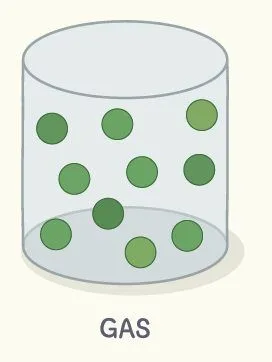
These are also highly fluidic, have indefinite shape and volume, and are easily compressible. The intermolecular forces in a gas are very weak and the intermolecular distances are large. Thus, gases are free-flowing, and the molecules in a gas move with high kinetic energy.
Plasma:
The most abundant state of ordinary (visible) matter in the universe is plasma. By many estimates, more than 99% of the visible matter in the universe, the stuff in stars, nebulae and the diffuse interstellar medium, is in the plasma state. When energy is passed through neutral gas, the electrons are removed to form both positively and negatively charged ions. It has neither shape nor volume. Plasma makes up the sun and stars.

What Determines The State Of Matter?
Matter has a specific state at a given temperature and pressure. The two factors that regulate its state are:
- Temperature (explained by Charles’ Law)
- Pressure (explained by Boyles’ Law)
Understanding The Effect Of Temperature On The States Of Matter
At atmospheric pressure, water exists as a liquid at temperatures between 0ᵒC to 100ᵒC, as water vapor (gas) beyond 100ᵒC, and as ice (solid) at 0ᵒC and below. The temperature ranges in which substances exist in a particular state vary for each substance.
We know that water has three states, but what about other elements and compounds? Do iron, oxygen, and calcium chloride exist in three states?
The emphatic answer is: “All matter exists in different states, depending on the temperature and pressure”.
From the above, oxygen is a gas at > -182ᵒC, while iron is a gas at 2860ᵒC. All matter can exist in the three states, but the temperatures at which they attain each state vary broadly.
Charles’s Law Governs The States Of Matter
Charles’s Law states that the volume of a fixed amount of gas is directly proportional to its absolute temperature if the pressure remains constant.
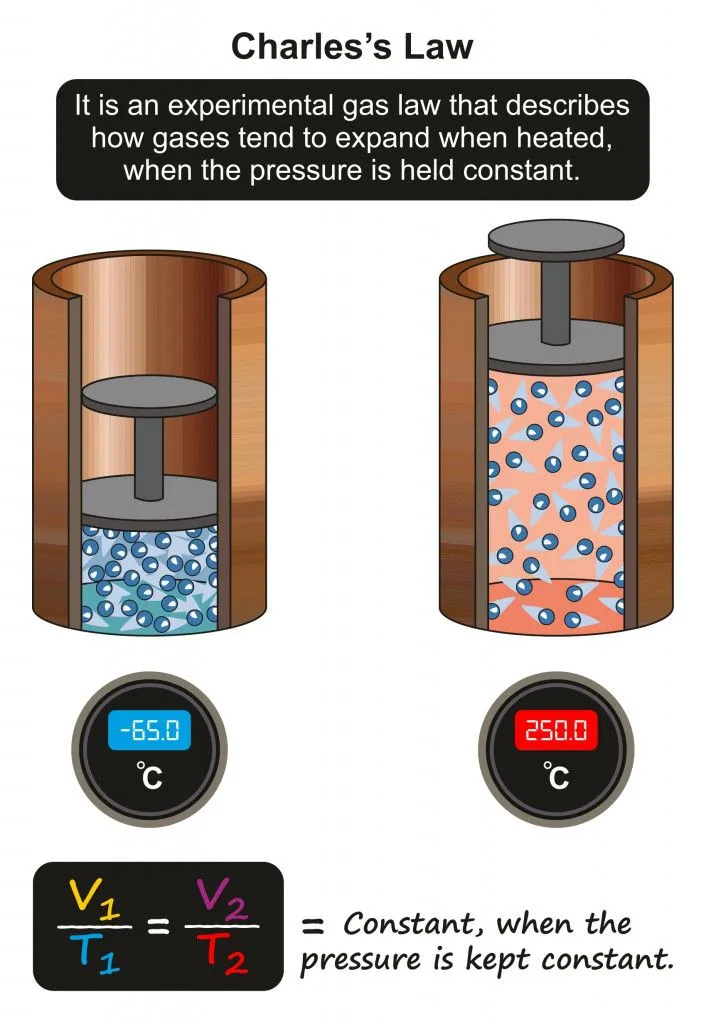
At constant pressure, if the temperature of a solid (i.e., ice) is increased, its volume correspondingly increases. With the increased volume, molecules move farther, increasing the inter-molecular distance, and thereby decreasing the intermolecular forces. When this happens, the solid ice slowly undergoes a phase transition to liquid water.
A further increase in temperature will proportionally increase the volume, making the molecules move farther away from each other. This increases the intermolecular distance, and decreases the intermolecular force of attraction, thus causing the shift from water (liquid) to steam (gas).
Understanding The Effect Of Pressure On The States Of Matter
As mentioned earlier, pressure is another critical factor that determines the state of matter. This principle is used in the manufacture of liquid N2 and dry ice (solid carbon dioxide). Gaseous Nitrogen will become a liquid when sufficient pressure is applied.
On the other hand, you can make water boil at room temperature by decreasing the pressure enough.
In other words, raising the pressure raises a substance’s boiling point, while lowering the pressure lowers it. Liquid N2 and dry ice are manufactured by applying pressure on the gases N2 and CO2 to change their state from gas to liquid and gas to solid, respectively.

Boyle’s Law Governs The States Of Matter
As mentioned earlier, there is an inverse relationship between the pressure and volume of a gas at constant temperature, which is governed by Boyle’s law. According to the law, the volume of a gas increases as the pressure decreases, at a constant temperature.
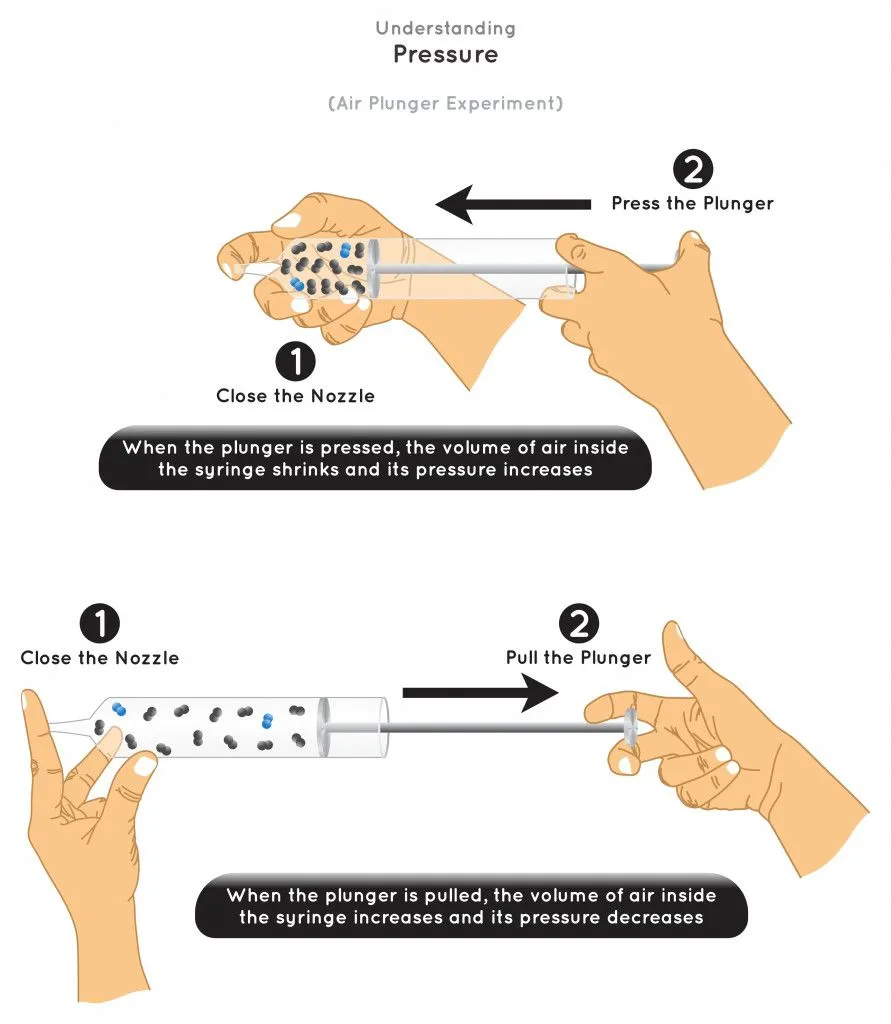
From the above illustration, we observe that the pressure and volume of a gas are inversely proportional.
When the pressure is increased, the volume decreases, bringing the molecules closer together. This increases the intermolecular force of attraction and decreases the intermolecular distance. This will promote the transition from a gaseous to a liquid state.
A further increase in pressure reduces the volume even more, thus transiting liquids into solids.
What Actually Causes The Pressure Of A Gas?
We keep talking about increasing the pressure on a gas, but what is that pressure in the first place? A gas is made up of an enormous number of tiny molecules in constant, random motion. They zip around, bump into one another, and slam into the walls of whatever container holds them. Every time a molecule strikes a wall, it gives it a tiny push. Add up the force of these countless collisions across the whole surface and divide by the area, and you have what we call pressure. Gas pressure, in other words, is simply the combined drumbeat of molecules hammering on the container walls.

This picture, known as the kinetic theory of gases, explains why squeezing a gas raises its pressure. When you shrink the volume, the same number of molecules now share a smaller space, so they strike the walls more often. More collisions every second on each patch of wall means higher pressure. Heating the gas does something similar: the molecules move faster, so they hit harder and more frequently. So whenever you read that the pressure of a gas has gone up, you can picture more (or more forceful) molecular collisions happening every second.
When Pressure Increases, What Happens To The Temperature?
Boyle’s law keeps the temperature steady, but what if you hold the volume fixed instead and let pressure and temperature change together? Seal a gas inside a rigid container that cannot expand, and you will find that its pressure climbs in step with its absolute temperature. This is Gay-Lussac’s law: at constant volume, the pressure of a fixed amount of gas is directly proportional to its temperature on the Kelvin scale, or P1/T1 = P2/T2. Heat the trapped gas and its faster molecules strike the rigid walls harder and more often, so the pressure rises; cool it and the pressure falls.
This is exactly why an aerosol can carries a warning never to throw it into a fire. Picture a can holding gas at 3.00 atm (44 psi) and 25 °C (77 °F, or 298 K). Heat it to 845 °C (1,553 °F, or 1,118 K) and the pressure climbs to roughly 11.3 atm, almost four times the starting value and more than enough to rupture the can. The same effect, in a far gentler form, raises the pressure inside your car tires on a hot day or after a long drive. The extra pressure did not appear from nowhere; the gas simply got hotter while its volume stayed put.
What Happens If You Put A Gas Under Extreme Pressure?
We have seen that enough pressure can turn a gas into a liquid, but push past a certain point and something stranger happens. Every substance has a critical point, a particular temperature and pressure above which the distinction between gas and liquid simply disappears. Compress a gas that is hotter than its critical temperature and it will never settle into an ordinary liquid, no matter how hard you squeeze. Instead it becomes a supercritical fluid, a single phase that flows and fills its container like a gas yet dissolves substances like a liquid. For carbon dioxide the critical point sits at 31.0 °C (88 °F) and 73.8 atm (about 1,080 psi). Supercritical CO2 is safe and selective enough to be used to decaffeinate coffee and as a clean solvent in food processing.

Crank the pressure higher still and even the atoms can be forced to rearrange. Squeeze hydrogen gas hard enough and physicists have long predicted that it should turn into a metal. In 2017, Harvard researchers Isaac Silvera and Ranga Dias reported doing just that, pressing a speck of hydrogen between two diamond tips until, at around 495 gigapascals (a pressure greater than that found at the center of the Earth), it shifted from transparent, to black, to a shiny, reflective metal. The claim is still debated among physicists, but it captures the lesson of this article taken to its limit: with enough pressure, even a humble gas can be transformed almost beyond recognition.
How Is Dry Ice Formed?
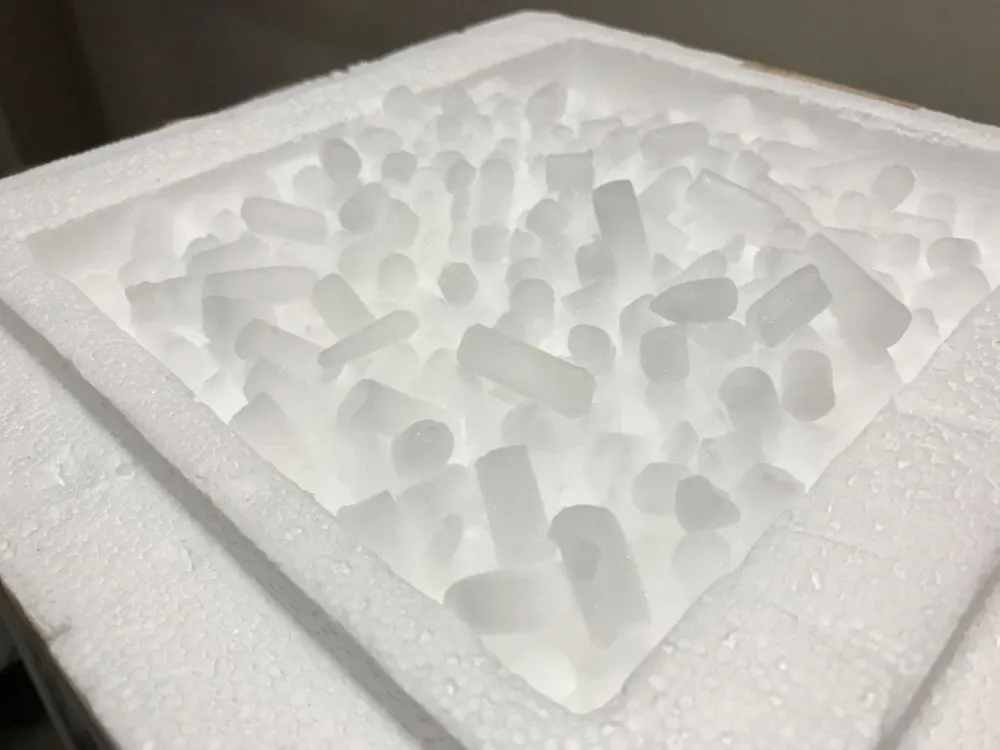
Industrially, dry ice is made by first compressing CO2 gas to high pressure (around 60 atm), turning it into liquid CO2. This liquid is then released rapidly to atmospheric pressure. As it expands, it cools dramatically, well below CO2’s sublimation point of −78.5ᵒC at 1 atm, and a portion freezes directly into solid CO2 snow, which is then compacted into the familiar blocks. The triple point of CO2 sits at 5.11 atm and −56.6ᵒC, the unique conditions at which solid, liquid and gaseous CO2 can coexist in equilibrium.
The specific temperature and pressure at which three states of any matter are in equilibrium is called its triple point.
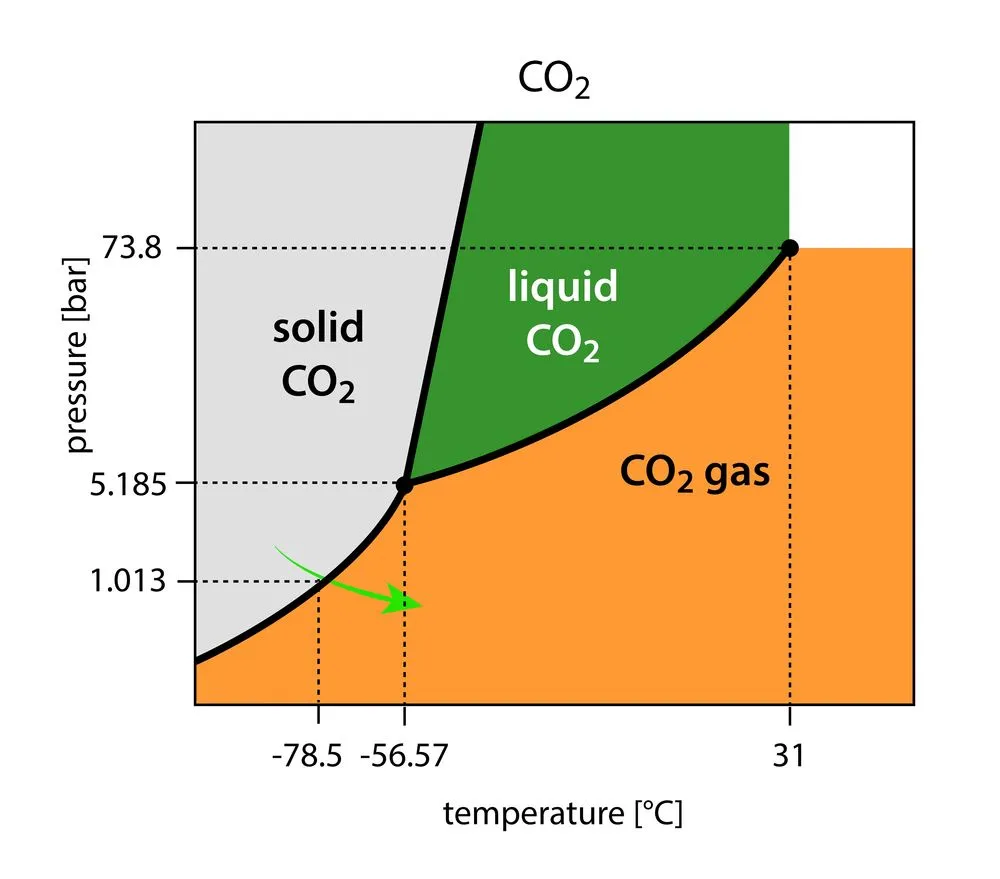
A slight decrease in temperature will phase transform gaseous CO2 to solid CO2.
Conclusions
The states of matter are continuously recycled, and temperature and pressure control the phase transitions. The temperature and pressure at which all the states coexist is called the triple point. A finely orchestrated process between temperature, volume, and pressure determines the state of any matter.
References (click to expand)
- The Race to Turn Gassy Hydrogen into Solid Metal. Scientific American
- Strange New State of Hydrogen Created - Scientific American. Scientific American
- Gas Pressure. NASA Glenn Research Center
- Gay-Lussac’s Law. Chemistry LibreTexts
- Phase Diagrams. Chemistry LibreTexts
- A Breakthrough In High-Pressure Physics. The Harvard Gazette