A returning boomerang comes back because of gyroscopic precession. The two wings of a boomerang are shaped like airfoils, and because the boomerang spins as it flies, the top wing always moves faster through the air than the bottom one. That difference creates uneven lift, which produces a torque that slowly tilts the spinning boomerang into a circular path, sending it right back to the thrower. (Note: most boomerangs in history were the non-returning kind, used for hunting.)
I was watching Justin Timberlake’s song “What Goes Around… Comes Around” on Youtube, and there was something about those words that made me drift off. The first thing my mind drifted to was a boomerang! I guess it makes sense somehow, but most people are probably already questioning my sanity, so I’ll just plead the 5th. I’ll be the first to admit that my brain is a bit weird.
Coming back to the point, boomerangs are wonderful objects. A person with a boomerang in his hand must feel like Thor with his hammer. You throw your boomerang in the air and then just stand there with your arms extended; eventually, the boomerang will return to your hand. Then, you simply turn around to the gracious round of applause from all the people who were watching you in awe.
Throwing a boomerang and making it come back to your hand still takes some skill, and not everyone can do it. However, did you know that boomerangs were never meant to return! In fact, there are two types of boomerangs: returning boomerangs and non-returning boomerangs.
History Of Boomerangs
Non-returning boomerangs have been used by humans for tens of thousands of years. The oldest one ever discovered, unearthed at Obłazowa Cave in southern Poland, was carved from a mammoth’s tusk. It was long thought to be around 18,000 years old, but a 2025 study that re-dated the surrounding cave layers pushed its age all the way back to roughly 40,000 years (a calibrated range of 42,290–39,280 years before present), which makes this 72 cm (28 in) curved tool one of the oldest known boomerangs on Earth.
Non-returning boomerangs were mainly used by aboriginal Australians, but they also found use with ancient Egyptians and many other cultures. They were used as a weapon primarily for hunting. They were carved in such a way that they would stay in the air for the longest possible time and would travel in a straight line, so when thrown accurately, a hunter could hit an animal with the boomerang from a distance, and be able to put dinner on the table… err, ground.
The Return Of The Boomerang
Basically, boomerangs were just really good throwing sticks that were used for hunting purposes. As it turns out, the “return” of the boomerang was a complete accident: one fine day when someone was carving his non-returning boomerang, he unknowingly carved it in such a way that when thrown correctly it returned back to the owner. Wow!
That guy might not have been so popular with his hunting buddies when his weapon simply returned to his hand, but it was still a pretty cool invention!
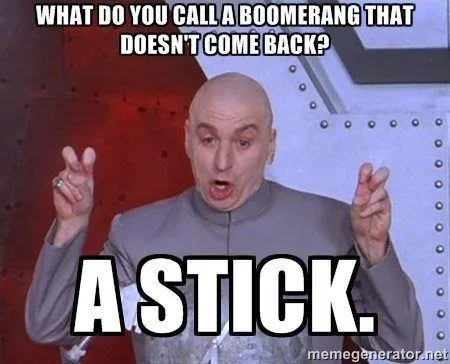
Returning boomerangs were not particularly useful for hunting purposes. They were difficult to aim accurately, and even if one did hit a target, it would not come back anyway. They were instead used for sport, ceremony and recreation, a tradition that continues today with competitive boomerang throwing. Their non-returning hunting cousins, often called kylies in Aboriginal Australian traditions, are still made and revered as cultural artifacts.
How Does A Boomerang Work
Boomerangs are some of the first man-made flying machines. A boomerang has two wings that are joined together in a ‘V’ shape; the wings of the boomerang are in the shape of an airfoil (like an airplane’s wings). An airfoil is practically flat at one end and curved at the other end, with one edge being thicker than the other. When a boomerang is thrown correctly, the airfoil provides the necessary lift for the boomerang to stay in the air.
The reason why a boomerang comes back is due to a phenomenon known as gyroscopic precession.
When a boomerang is thrown, the top wing is moving faster through the air as compared to the bottom wing, because the top wing is moving in the direction of the throw, while the bottom wing is moving in the opposite direction. As a result, the top wing will generate more lift than the bottom wing. The difference in the lift between the top and the bottom wing creates a torque. It is this torque that makes the boomerang tilt and gradually return to the thrower.

Making a boomerang return to you takes a lot of practice before you can actually make it return accurately.
The right way of throwing a boomerang is by holding it vertically, tilted at an angle of 10-20 degrees with the ‘V’ direction pointed towards you. Boomeranging is a difficult skill to master, but with practice, you can make your boomerang return right to your hand. It might take you some time, but once you have mastered it, the feeling when a boomerang returns to your hand is simply awesome!
So, what are you waiting for! Get out there and start boomeranging!
What Are Boomerangs Actually Used For?
Here is the part that surprises most people: the returning boomerang you picture flying back into your hand was almost never about putting food on the table. The real workhorse was the heavier, straighter non-returning boomerang, and its job was hunting and fighting. At a range of about 100 m (330 ft), a 2 kg (4.4 lb) hunting stick could deliver a mortal injury to a large animal, and expert throwers are said to have struck targets as far as 160 m (520 ft) away. These weapons were used not only by Aboriginal Australians but also by the ancient Egyptians, by Native American groups in California and Arizona, and in parts of southern India for taking down birds and small game.

But hunting was only the headline use. A sturdy boomerang doubled as a battle club, a digging stick for prying root vegetables out of the ground, and even a fire-starter, since dragging its sharp edge along softwood can generate enough heat to catch a spark. Some were used as percussion instruments, clapped together to keep rhythm, and others as decoys to spook flocks of waterfowl toward waiting nets. So when you ask, what is the point of a boomerang?, the honest answer is that it was one of the most versatile tools our ancestors ever carried. The returning version, the one we all think of, was largely reserved for sport, ceremony and play, a tradition that survives today as competitive boomerang throwing.
How Do You Throw A Returning Boomerang?
Throwing a returning boomerang is genuinely a skill, and the single biggest beginner mistake is treating it like a Frisbee. You do not throw it flat. Hold it almost vertically, inclined outward only about 10 to 30 degrees from upright (the stronger the wind, the closer to vertical you keep it), with the curved or decorated side facing you and the elbow of the "V" pointing forward.

The other essential is spin. Grip a tip between your thumb and fingers, bring it back behind your shoulder, and snap your wrist hard as you release, the way you would crack a whip. That fast rotation is what lets the differences in aerodynamic lift across the spinning wings turn into the gentle, curving return flight described above. Wind matters too: a light breeze of a few km/h is ideal, and you aim to the right of the wind (to the left if you are left-handed) so the air helps carry the boomerang home. Skip windy days, since a strong gust will balloon the flight and send it drifting dangerously off course. When it comes back, do not snatch at it. The safe catch is to clap it flat between both palms. It can take plenty of practice, but the first time one loops out, arcs around and settles back into your hands, it feels like a small miracle.
References (click to expand)
- Boomerang - Wikipedia. Wikipedia
- Boomerang - Hyperphysics. Georgia State University
- What Makes Boomerangs Come Back? - UCI Math. The University of California, Irvine
- Boomerang: Ancient Weaponry & Modern Sport. Encyclopaedia Britannica
- Boomerang and bones: Refining the chronology of the Early Upper Paleolithic at Obłazowa Cave, Poland. PLOS ONE (2025)