Table of Contents (click to expand)
A helicopter has a tail rotor to counter the torque produced by its main rotor. By Newton’s third law, the spinning main rotor tries to twist the fuselage the opposite way, so the helicopter would spin in circles without a counterforce. The tail rotor pushes sideways to cancel that torque and lets the pilot steer the nose left or right.
I am sure that even someone who knows absolutely nothing about helicopters understands that the rotors sitting on top of helicopters are there to make them fly. The sound of those rotors chopping through wind has become universally associated with an imminent chopper arrival. The rotors are so big and noisy, it’s actually hard to not notice their presence.
However, many other folks probably miss the ‘other’ rotor, which is installed at the rear of the helicopter: the tail rotor. Why is it there? More specifically, what good could it possibly do sitting at the tail-end of the helicopter?
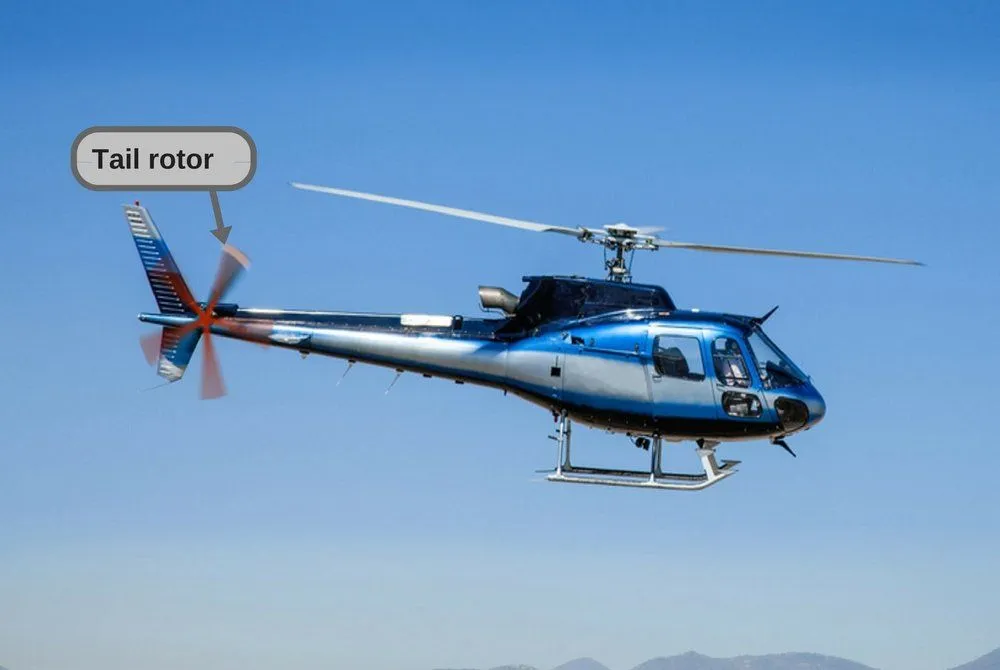
Short answer: The tail rotor is there to make sure that the helicopter doesn’t simply fly in circles. Yes, it also helps to turn the helicopter.
Flight Of A Helicopter
A helicopter flies/hovers by generating lift with its main rotors. The rotating blades push the air down, which in turn pushes the helicopter up, keeping the entire craft airborne. However, there’s one important catch here…
When The Fuselage Starts To Rotate…
According to Newton’s third law of motion, for every action, there is an equal and opposite reaction. What this means is that when you apply a force on a body in a given direction, that body applies an equal amount of force on you, and in the direction opposite to your application of force. There are numerous practical examples of this phenomenon: the recoil of a gun, the launch of a rocket, how that same rocket turns in space, lifting heavy weights… the list is endless.
Torque
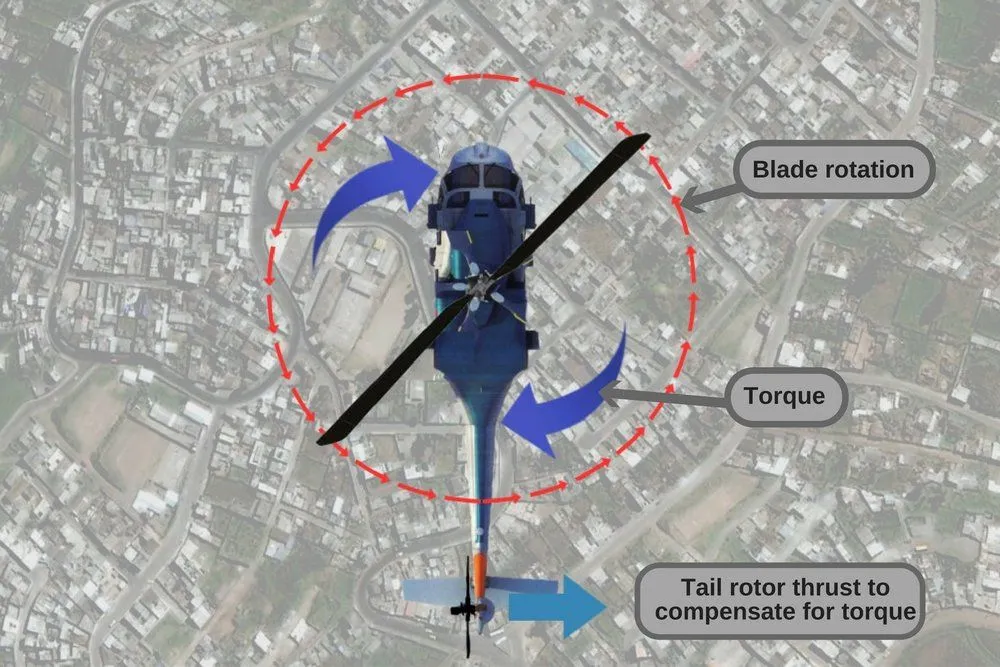
Applying the third law of motion to the case of helicopter rotors, you would see that since the main rotors turn, say, counter-clockwise, the fuselage (the body of the chopper) would be pushed in a clockwise direction. Simply put, the helicopter would turn in circles in the opposite direction of the blades’ rotation.
Let me illustrate this with an example: sit in a swivel chair and don’t let your feet touch the ground. Now, try to rotate the chair counter-clockwise. You would notice two things: one, it’s much more difficult than you first imagined; and two, you’d be turning clockwise, despite trying to turn in the opposite direction.
Essentially, the same thing happens with a helicopter, where the main rotors, while turning in one direction, push the fuselage the opposite way. Looking at a helicopter that’s turning in circles (some sight that would be!), a physicist would immediately note that it’s rotating due to ‘torque’, a twisting force that causes an object to rotate.
The Role Of The Tail Rotor
Countering The Torque
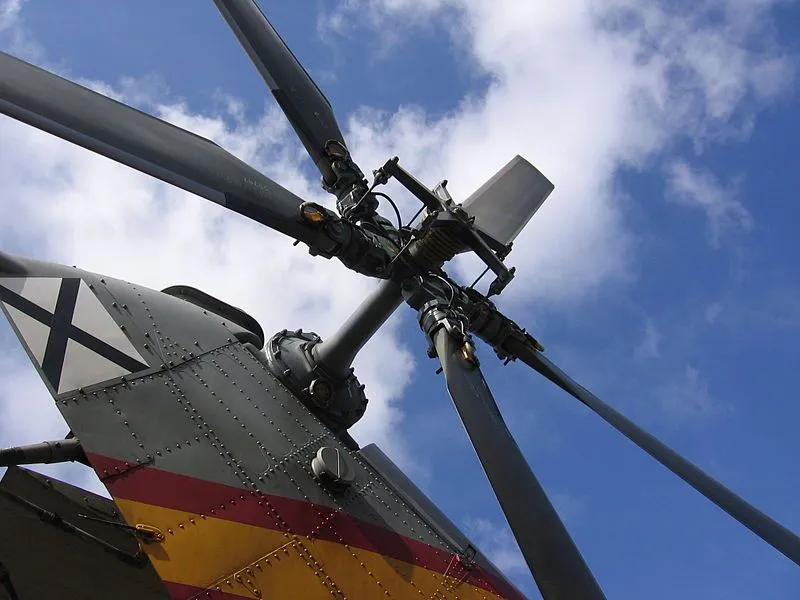
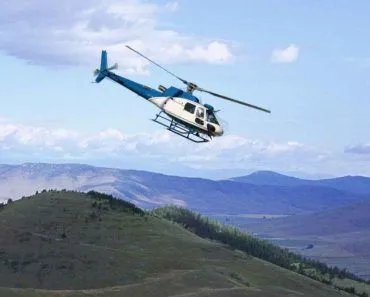
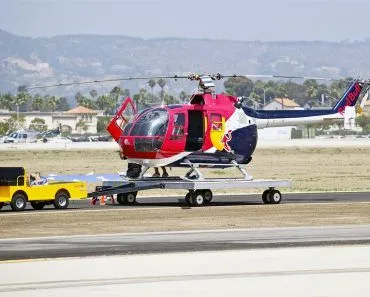
The tail rotor is a vertical (or near-vertical) set of blades mounted at the end of the tail of the chopper. It ensures that the torque produced by the main rotors is properly compensated for by ‘pushing’ the chopper in the opposite direction of the torque. By doing this, it ensures that the chopper doesn’t wobble and remains stable in flight. This is why a helicopter is in serious trouble if its tail rotor is damaged.
The tail rotor sits far behind the center of gravity, so even a modest sideways push acts on a long lever arm and produces plenty of yaw-countering force. Critically, that thrust is horizontal (sideways), pushing the tail against the direction the fuselage is being twisted, which is what keeps the nose pointing where the pilot wants it.
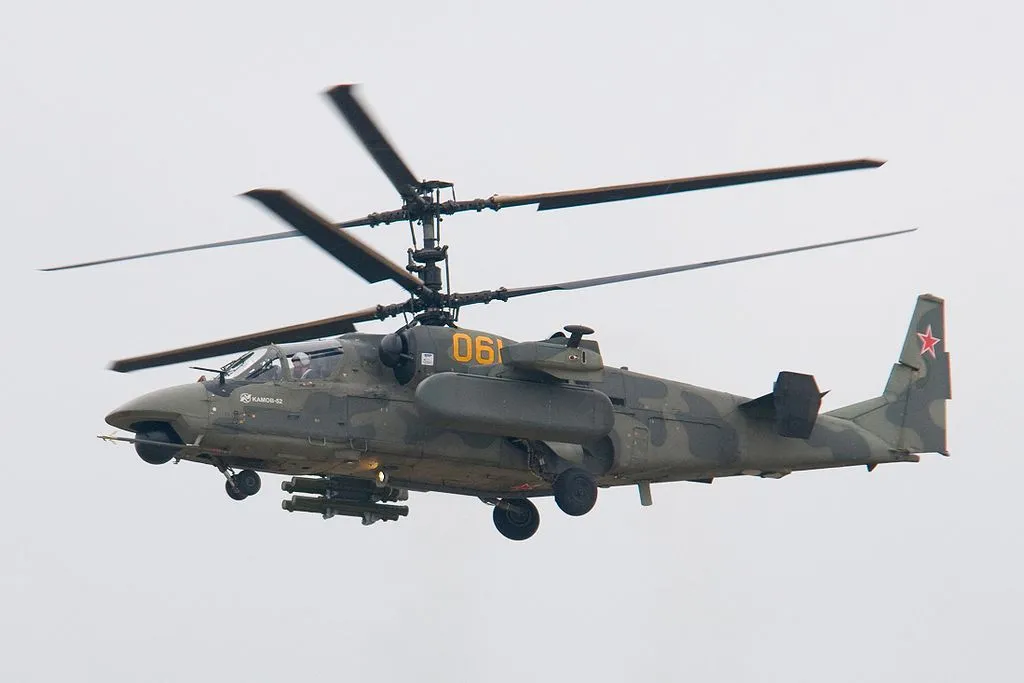
It should be noted that using a tail rotor is not the only way to compensate for the torque; coaxial rotors can also achieve the same thing.
Turning The Chopper
In addition to counteracting the torque produced by the main rotor, the tail rotor can also be used to turn the chopper in a desired direction by altering the pitch angle of the rotor blades. Directional control is achieved when the pilot changes the pitch of the blades using the anti-torque pedals, which are installed in the cockpit.
There are certain drawbacks of tail rotors, such as making the chopper louder and using up some of the available engine power that could be used to generate lift. While both of these problems are accounted for in choppers with coaxial rotors, those variants have their own disadvantages too. In effect, whether you want to use a conventional helicopter with a tail rotor or a chopper with multiple rotors depends entirely on your operational requirements. Either way, be safe up there!
What Other Ways Can A Helicopter Cancel Torque?
A tail rotor is the most common fix, but it is not the only one. Any design that cancels the main rotor's torque without letting the fuselage spin is fair game, and engineers have come up with several. This is also why some of the helicopters you see have no tail rotor at all, and why a few of them sport not one but two big rotors on top.

The trick behind the two-rotor machines is simple: if you have two main rotors turning in opposite directions, the torque each one produces is equal and opposite, so they cancel out. Coaxial rotors stack the two rotors one above the other on the same shaft, spinning opposite ways, which is the layout on the Russian Kamov Ka-52. Tandem rotors place one rotor at the front and one at the back, again turning opposite ways, as on the heavy-lifting Boeing CH-47 Chinook. There are even intermeshing rotors, where two angled, counter-rotating rotors mesh together like an eggbeater, used on the Kaman K-MAX. In every case, the power that a tail rotor would have eaten up goes into lift instead.
If a single main rotor is kept, the torque still has to go somewhere, but the anti-torque device can be tidied up. The fenestron (a trademark of Airbus Helicopters, first flown on the SA 340 Gazelle in 1968) tucks a many-bladed fan inside a duct in the tail fin. With 7 to 18 blades, often unevenly spaced to spread the noise across frequencies, it is quieter than an open rotor and far safer for ground crew, who can't walk into spinning blades they can't see. The NOTAR system (literally "no tail rotor", developed by McDonnell Douglas) goes further and ditches the exposed rotor entirely: a fan inside the tail boom blows air through slots so that the main rotor's downwash clings to the curved boom (the Coanda effect) and pushes the tail sideways, with a steerable jet at the end handling the rest of the yaw control. NOTAR-equipped helicopters such as the MD 520N are among the quietest certified by the US Federal Aviation Administration.
Why Do Helicopters Make That Chopping Sound?
We started this article with that unmistakable whop-whop-whop that announces an incoming chopper. So where does it actually come from? It is not the engine, and it is not simply the blades being big. The signature thumping is mostly down to a phenomenon called blade-vortex interaction (BVI).

Every spinning blade sheds a tight, fast-swirling tube of air off its tip, called a tip vortex. Because the rotor is turning so quickly, the next blade can come around and slice straight through the swirl left behind by the blade ahead of it. Each time a blade slaps into one of these vortices, the air pressure over its leading edge changes abruptly, and that sudden jolt of lift radiates outward as a sharp pulse of sound. String those pulses together, one per blade per revolution, and you get the rhythmic chopping that can carry for miles.
This is why the sound is loudest at certain moments rather than all the time. According to NASA research, BVI noise (sometimes called "blade slap") is strongest during slow, descending flight, for example on a landing approach, because in a descent the rotor effectively flies down into its own wake and the blades pass much closer to those trailing vortices. Cruising straight and level, the wake is swept away behind the helicopter and the slapping eases off. It is also why designers fight so hard to tame BVI: it is one of the loudest noises a helicopter makes, so quieter, unevenly spaced or specially shaped blades are aimed squarely at breaking up that blade-meets-vortex rhythm.
References (click to expand)
- Helicopter Flying Handbook. Federal Aviation Administration (FAA).
- Why do helicopters need a tail rotor and what is torque? Smithsonian National Air and Space Museum.
- Conservation of Momentum. NASA Glenn Research Center.
- Tail rotor. Wikipedia.
- Correlation of Helicopter Impulsive Noise from Blade-Vortex Interaction with Rotor Mean Inflow. NASA Technical Reports Server (NTRS).
- Fenestron. Wikipedia.
- NOTAR. Wikipedia.