Table of Contents (click to expand)
Archery is the sport of shooting arrows at a target with a bow. A drawn bow acts like a two-armed spring, storing potential energy; on release, that energy is converted into the kinetic energy of the arrow. The arrow then bends around the bow (the archer’s paradox) and straightens out in flight to hit the target.
In today’s modern world, few people have actually shot an arrow, but we see archery everywhere; in movies (like The Hunger Games), on TV (Arrow!) and most importantly, the real-life archers shooting for gold at the Olympics.
The skill looks simple enough. You take a bow and arrow, draw the arrow onto the bowstring, take aim, and launch it forward. Simple enough. As it happens, however, there are various forces that act on an arrow during its launch and subsequent flight, so archers need to keep these unpredictable forces in mind to achieve accuracy. The science behind archery is quite fascinating, so let’s take a closer look at what it involves.
The Launch
First, let’s take a look at the bow. We can think of a bow as a “two-armed spring” and, just like a spring, it is capable of storing a certain amount of potential energy when pulled back. This energy is now ready to be used to launch an arrow.
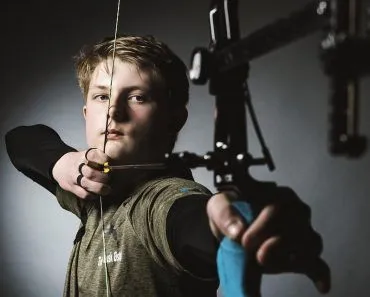
Now, once you “nock” an arrow onto the bowstring and pull it back, you’re ready to fire. Once the arrow is released, most of that potential energy stored up in the bow is converted into the kinetic energy of the traveling arrow (the rest is lost to limb and string movement, sound and vibration). Essentially, the greater the force with which you draw back the bowstring (known as the draw weight) and the further you draw it back (the draw length), the greater the potential energy the bow stores, and the faster the arrow launches.
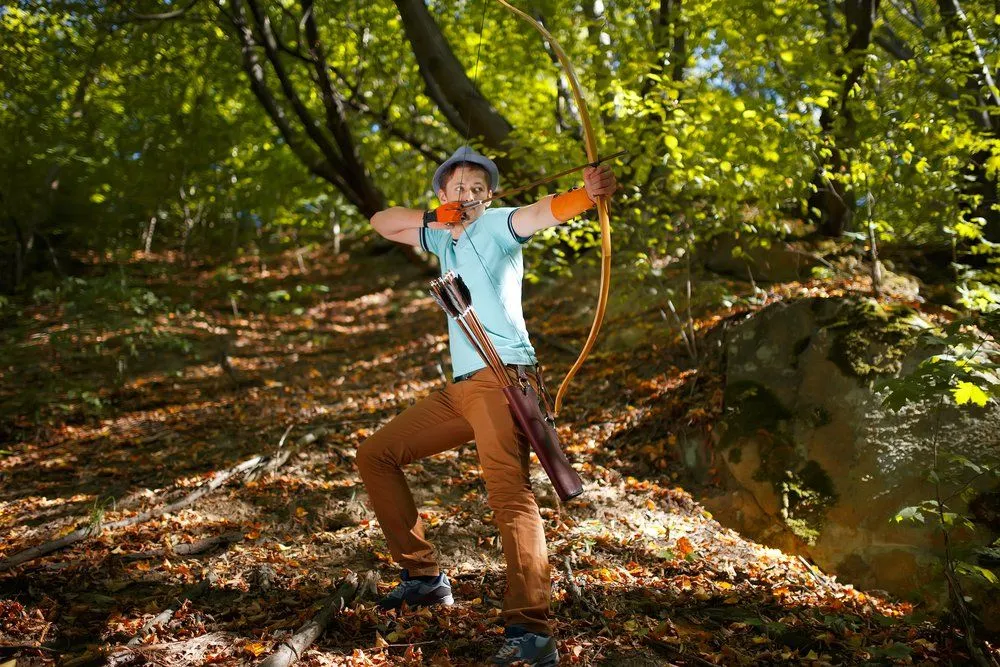
Keep in mind that there is a limit to how far one can draw back the bow before it breaks.
The chances of such a thing happening are unlikely though, as we can generally only manage to draw back the bow roughly 28 – 30 inches.
The Archer’s Paradox
Did you know that archers don’t actually aim their arrow straight at the target? This seemingly foolish practice is due to a fascinating phenomenon known as the Archer’s Paradox.
The rigid central part of a bow, the part the archer grips and the arrow rests against, is known as the riser (or handle); the bowstring is attached to the tips of the two limbs above and below it. When an arrow is nocked beside the riser, it is deliberately aimed slightly off-target. That is because the moment the string is released, the arrow flexes and bends around the riser rather than colliding with it, then straightens out once launched and ends up hitting the target straight on (if the archer is good, of course). How much the arrow bends depends on its spine, a measure of the shaft’s stiffness: a stiffer bow needs a stiffer arrow so it flexes by just the right amount and recovers cleanly.
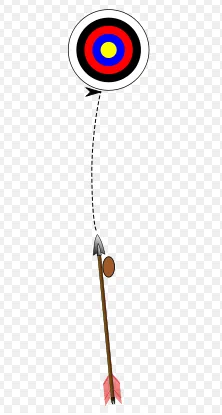
The arrow also oscillates once it is released, since a brief but large force has just been applied to it. When the rear of the arrow swings from side to side in flight, that wobble is known as “fishtailing” (an up-and-down version is called “porpoising”). A well-matched spine and properly tuned fletching damp these oscillations so the arrow settles onto a stable path.
What Forces Act on a Bow and Arrow?
So what is actually pushing and pulling on the arrow from the moment you start the draw to the instant it thuds into the target? It helps to split the shot into three stages, because a different cast of forces takes the stage in each one.
While you draw. As you pull the string back, the limbs of the bow behave like a stretched spring and push back against you. This is Hooke’s law in action: the force you feel (the draw weight) climbs roughly in proportion to how far you have pulled the string (the draw length), so the harder and further you draw, the more elastic potential energy the limbs store. That stored energy is the area under the bow’s force-versus-draw curve, and for an ideal spring it works out to 1⁄2 kx2, where k is the bow’s stiffness and x is the draw length.
At the loose. The moment you relax your fingers, the limbs snap back and the string drives the arrow forward. Most of that stored energy becomes the kinetic energy of the arrow, though no bow is 100% efficient; some energy stays behind as limb movement, string vibration, sound and heat. The force here points straight down the line of the shot, which is exactly why a clean, consistent release matters so much for accuracy.

In flight. Here is the part that surprises people: once the arrow leaves the string, nothing is pushing it forward anymore. Only two forces remain. Gravity pulls it steadily downward, bending its path into a curve called a trajectory; in the absence of air, that curve is a neat parabola, which is why archers aim slightly high and let the arrow arc down onto a distant target. The second force is air drag, the resistance of the air the arrow has to shoulder aside, which gradually bleeds off its speed. A target arrow leaves a modern bow at roughly 60 m/s (about 216 km/h, or 134 mph), and the vanes of the fletching at the tail keep its nose pointed forward so drag works with the arrow rather than tumbling it. So before the shot it is all spring force; after it, it is just gravity and air doing the rest.
Archery Terms, Explained
Archery has its own vocabulary, and a few of these words come up again and again. A person who shoots with a bow and arrow is, simply, an archer (an older, fancier word is toxophilite). The act of pulling the string back is the draw, and the position you reach when the string is pulled all the way and your hand is settled against your face is called full draw.
That spot where the drawing hand rests, usually the corner of the mouth, the chin or the jaw, is the anchor point. Hitting the same anchor point every single shot is one of the secrets to consistency, because it sets a repeatable starting line for the arrow. The notch at the back of the arrow that clips onto the string is the nock, and slotting an arrow onto the string is called nocking. The handle in the middle of the bow is the riser, the two flexible arms are the limbs, and the cord between them is the bowstring. Finally, releasing the string to send the arrow off is the loose (or release). Knowing these few terms makes the rest of the science of archery far easier to follow.
Now that you know those basic details, you essentially understand the scientific gist behind the fascinating and exciting sport of archery. It’s important to comprehend the complexity of archery and the various factors that an archer needs to keep in mind before the target can be hit successfully. Especially if you’re an aspiring archer yourself!
Now, for all your Hunger Games lovers out there, draw back your bows, take aim…and Fire!
References (click to expand)
- Archery. Encyclopaedia Britannica
- Archer’s paradox. Wikipedia
- Archery. Wikipedia
- Science of Sport: Archery. WIRED
- Bow Mechanics. Science Behind the Sport. West Virginia University
- Miyazaki et al. Aerodynamic properties of an archery arrow. Sports Engineering (Springer)
- Glossary of archery terms. Wikipedia