Table of Contents (click to expand)
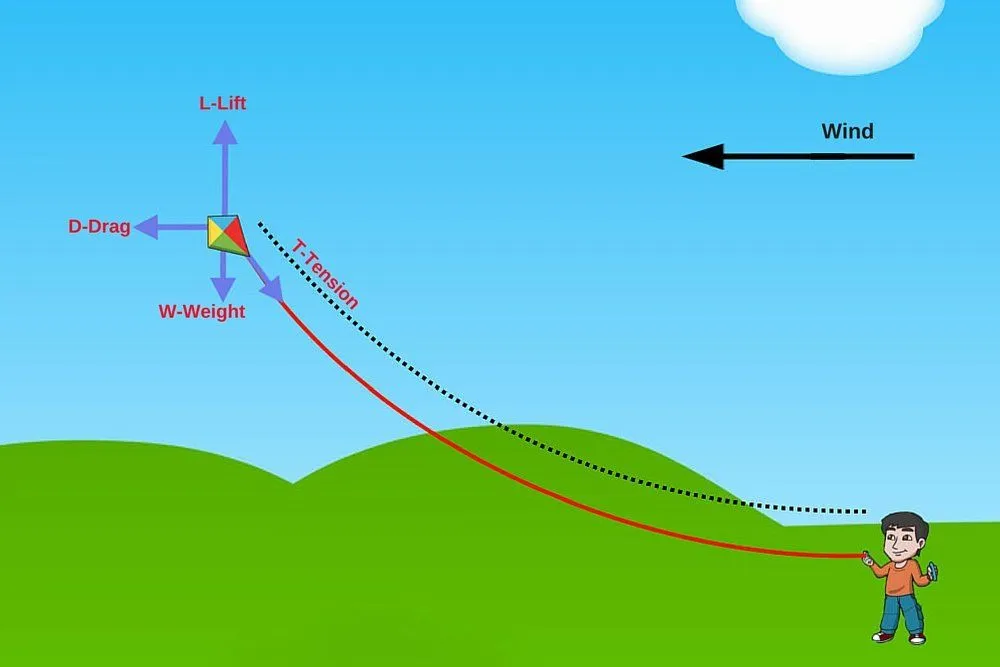
A kite flies because four forces stay balanced: lift (the wind deflecting off the tilted kite face, like a wing at an angle of attack), weight (gravity pulling the kite down), drag (air resistance pushing the kite downwind), and the tension in the string (which holds the kite in place so the wind keeps flowing over it). Unlike an airplane, a kite has no thrust of its own—the string is what stops it from being blown away.
If you’ve ever flown a kite, you would probably vouch for the fact that it’s not easy the first time. In fact, even after you’ve got yourself acquainted with flying kites, it takes a great deal of skill to keep a kite airborne in changing wind patterns and perform maneuvers like rapid climbs, quick dives and cutting others’ kites.
In this article, we will introduce you to the science of flying a kite, in the hope that the knowledge of various physical forces involved in kite-flying may give you a head start in acquiring this unique skill.
Forces Involved In Kite-flying
Anything that flies in the air for more than a few seconds is wrangling a set of physical forces. For an airplane those four forces are lift, drag, weight, and thrust; for a kite the same physics applies, but with one key swap—a kite has no thrust of its own. Instead, the role normally played by an engine is played by the tension in the string, which holds the kite stationary against the wind so air keeps flowing across its face. Balance lift against weight plus the downward component of string tension, and balance drag against the upwind pull of the string, and the kite hovers.
The lift itself comes from the kite being tilted at an angle of attack to the oncoming wind. The kite face deflects incoming air downward, and by Newton’s third law the air pushes the kite up (with a slight downwind component). This is also why a kite stalls if it lies flat or if the wind drops—no angle of attack means no deflection means no lift.
Many of us (except physics nerds) may not have realized that, just like rockets and airplanes, there are different phases of flying a kite too. These different stages are release, launch, climb and cruise, although they aren’t as clearly defined as in the flight of airplanes or rockets.
Release And Launch
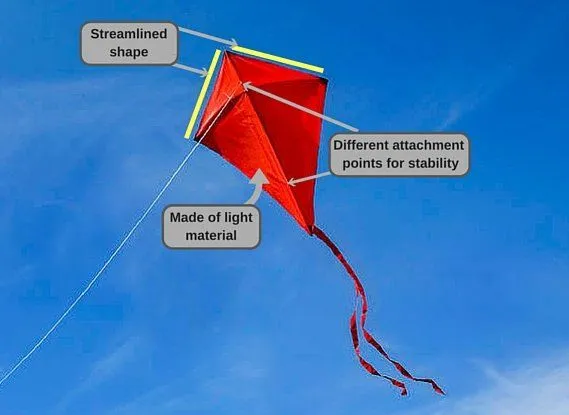
To get the kite airborne, first of all, you need to provide it with enough lift to counteract its own weight. Although there are numerous factors (e.g.,the shape of the kite, its motion in the air, quality of air, etc.) that affect the amount of lift produced in a kite, the principal contributor is the velocity of air that goes by the kite. The design of kites helps too; if you notice, they are made of a very light (but rigid) material and have minimal accessories (in the form of thin, wooden spokes) attached to them. Their shape is also streamlined (with a pointed leading corner) to help them split the oncoming air.
On a windy day, after telling your friend to hold the kite in the direction of the wind, you will give the kite some initial velocity before releasing it. Now, all you need to do is give the kite a little tug to lift it in the air. On non-windy days, though, your friend may have to move backwards a little to get the kite flying. Running with the kite also helps to create an ‘apparent wind’ that pushes the kite up. However, once released, you (and your pal) don’t necessarily need to run to impart velocity to the kite, as the velocity of wind usually increases with increasing altitude, which in turn provides enough lift to keep the kite rising in the air.
Climb And Cruise
After the kite has been successfully launched, it will continue to climb into the sky with the help of well-timed, skilled tugs of the string before cruising at a general altitude. For a kite to cruise, all the forces and torque acting on it should be balanced. If by any means (like, if you hand the control of the string to an inexperienced kite-flier, such as your dog/cat) that balance is disturbed, the kite will start moving, swooshing or dipping until the forces are re-balanced. For example, when you pull the control string, the velocity of the kite increases slightly, which boosts the lift, consequently making the kite climb. Similarly, when you let go of the string a bit, the kite loses altitude due to the increased weight of the string and dips until it’s pulled back up by tugging at the string.
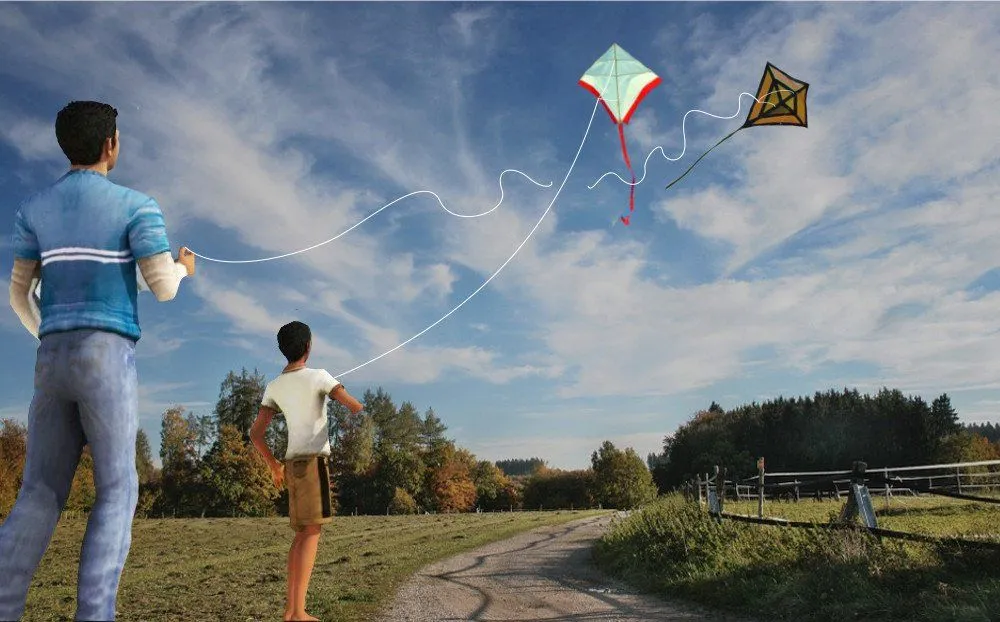
In some countries (like India), people play a game of ‘downing’ others’ kites by cutting their control strings with theirs. To do that, a person first brings his own kite in proximity to someone else’s so that both of their control strings touch, and then rapidly pull at his own control string to cut the other’s string, thereby ‘downing’ their kite. Note that the string used in such kite-contests is not ordinary kite string, but is instead made of highly abrasive materials and is therefore not safe for use by children.
Flying a kite can be really fun, I can tell you that. However, I won’t give you any false hope by saying that the skill of flying kites is an easy one to master. That being said, some knowledge of the physics involved in flying a kite will definitely give you an edge while learning how to master this pleasant pastime.