Table of Contents (click to expand)
A human being is made up of atoms, and atoms have a lot of vacant space inside them. If we remove all the empty space from all the atoms in a human being, the resultant mass would be infinitesimally small. This means that the size of a human being, when considered in terms of the amount of space they occupy, is very small.
How much physical space do you occupy in your house? What about just in your own room? How many more people do you think could adjust to living in your house? When I say ‘adjust’, I mean how many people could you cram into your house until there’s not enough space left for a grain of sand. Can you venture a random guess?
What if I told you that the entire human race… yes, all 8.3 billion of us (as of 2026), don’t even require a space as large as your house? What if I told you that the entire human race could actually fit inside a sugar cube?
If you’re not aware of how this works, you will obviously find this claim to be totally absurd, if not profanely crazy. However, there is actually a valid explanation to this claim, but before we get into that, let’s go back to the basics.
Atoms: The Building Blocks Of Matter
What is matter?
Anything that has mass and occupies space is technically defined as “matter”. Every type of matter you can see or touch is made up of millions or billions of tiny particles called atoms. In other words, you can say that atoms are the building blocks of practically everything that has a certain mass and occupies a defined space.
Let’s consider the most basic element: Hydrogen. Hydrogen only has 1 electron in its shell, which makes it the simplest atom in the periodic table.
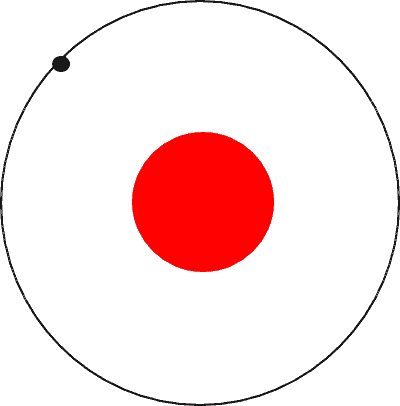
If you look at the diagram of a Hydrogen atom, you can see a spherical structure in the center and a ball-like object in a circular orbit around the spherical structure. The structure in the center is called the nucleus of the atom and the ball-like structure is the single electron.
You’ll also notice that there is a lot of vacant space inside the atom. This is the case with every atom; the nucleus occupies a very, very small space, and this is the space that we’re interested in, particularly for this discussion.
Humanity And The Sugar Cube
Every human being is made up of millions and millions of atoms. All of these atoms, as we just explained, have a lot of vacant space inside them (just to clarify, the diagram of the atom above is not to scale – not even close). Now, if we were to remove all that empty space from all of those atoms, the resultant mass of a human body would be infinitesimally small. It would be so small, in fact, that all of humanity would be equivalent to the size of a sugar cube. (Source)
Although it is only as large as a sugar cube, it would be inconceivably heavy, since it contains only the dense ‘matter’ of the human body. Here is the part people tend to get backwards: squeezing out the empty space does not create or destroy any mass. Almost all of an atom's mass already sits in its nucleus, so the lump would weigh exactly what humanity weighs right now. Take 8.3 billion people at a global average body mass of about 62 kg (137 lb), and that works out to roughly 5 x 10¹¹ kg, or around half a billion tonnes. That entire planetary mass, balanced on a fingertip.
Obviously, this comparison is just a way to explain this phenomenon in a relatable way, and is basically the manifestation of humanity’s natural curiosity. Also, a sugar cube is actually an exaggeration. In fact, the size of the entire human race could even be smaller than that.
Suppose we get our hands on one giant trash compactor that is large enough to house the entire human race! Again, this is purely hypothetical, but it’s amusing to consider. Since you have an unlimited ability to compress the matter, you would be able to smash down the human race even further, making it even smaller than a single sugar cube that you might drop in your coffee!
It’s just simple, scientific logic that presents us with such incredible theories. With this strange new perspective in mind, try being a bit more hospitable, as you now know that the human race, in its most basic form, takes up less space than something you could hold on the tip of your finger. Incredible!
Just How Empty Is An Atom?
"Mostly empty space" sounds like a figure of speech, so let's put a number on it. An atom is roughly 10-10 metres across, while its nucleus, where nearly all the mass lives, is around 10-15 metres across. That makes the nucleus about 100,000 times smaller in radius than the atom that surrounds it. In the words of the introductory chemistry texts, "if an atom were the size of a football stadium, the nucleus would be about the size of a marble" sitting at the centre, with the rest of the bowl essentially empty.
Crunch those numbers and the nucleus occupies something on the order of one quadrillionth of the atom's volume. Put the other way around, an atom is well over 99.99% empty space, with some textbooks quoting figures out to many more nines. Everything you think of as solid (this screen, your hand, the chair under you) is overwhelmingly nothing at all. What stops your hand passing straight through the desk is not a wall of packed matter but the electric repulsion between electron clouds and the rules of quantum mechanics, which forbid electrons from piling into the same state.
That is the whole trick behind the sugar-cube claim. The "size" of a person is set almost entirely by how far their electrons are held apart, not by how much actual stuff they contain. Strip out that buffer and you are left with just the nuclei, a fantastically tiny and fantastically dense residue. If you want a sense of how we ever worked any of this out without seeing an atom, we cover that in how we know so much about atoms when we can't see them.
How Big And Heavy Is A Real Sugar Cube?
Since the sugar cube is doing all the heavy lifting in this thought experiment, it is worth knowing what an actual one looks like. A standard sugar cube measures somewhere between 16 x 16 x 11 mm and 20 x 20 x 12 mm (about 0.6 to 0.8 inches per side) and weighs roughly 3 to 5 grams, the equivalent of about a level teaspoon of sugar. The classic version of this comparison rounds that to a tidy 1 cubic centimetre (1 cm3), which is handy because it lines up neatly with the densities physicists quote.

How heavy could a 1 cm3 cube get? The density of an atomic nucleus is about 2.3 x 10¹⁷ kg/m3. At that density, a single cubic centimetre of pure nuclear matter would weigh roughly 230 million tonnes, which is why a teaspoon of the stuff is often quoted as weighing "over a billion tonnes". Our half-a-billion-tonne human residue would therefore occupy a couple of cubic centimetres, comfortably in sugar-cube territory.
This is not just a chalkboard fantasy. Nature already builds objects out of nucleus-density matter: neutron stars, the collapsed cores of massive stars, are essentially a single giant atomic nucleus the size of a city, with densities of about 4 x 10¹⁷ kg/m3. A sugar-cube-sized scoop of a neutron star would outweigh a mountain. The one thing to remember is that ordinary atoms never collapse to this density on their own. The electron clouds (held apart by quantum degeneracy pressure) push back hard, which is exactly why you take up the space you do rather than fitting in a coffee cup.
References (click to expand)
- Top 4 Bonkers things about the universe | Latest Features | physics.org - www.physics.org
- 11 Of The Craziest Things About The Universe - HuffPost
- The Nuclear Atom - Chemistry LibreTexts
- Nuclear Density - The Fizzics Organization
- Neutron Stars - University of Maryland Department of Astronomy
- The weight of nations: an estimation of adult human biomass. BMC Public Health - PMC