Ant-Man can change his size in the MCU thanks to Pym particles. But take him out of the comic books and the laws of physics start picking him apart: if his mass really stayed the same as he shrank to ant size, every punch he threw would land with the energy of a bullet (and could rip DNA apart like radiation); if his mass scaled with size like the films suggest in Giant-Man mode, the square-cube law means his bones would shatter under his own weight, and dragging a shrunk-down 10-story building through town in a van would set off small earthquakes and crush every road he drove on.
The superhero genre pushes us to suspend our disbelief in order to enjoy the science-defying and out-of-this-world moments on the big screen. However, it is still fun to imagine what would happen if those moments that breach the “laws of nature” happened in the real world.
Ant-Man, rider of the great Ant-thony and Ant-thonio, is one such comic character whose actions in the Marvel Universe could give rise to some pretty fascinating outcomes when observed from our reality. Without getting too deep into the scientific accuracies and possibilities, let’s take a look at what would happen if Ant-Man were from our world.
Disclaimer: The following are hypothetical situations based on fundamental laws of science.
Mass Vs Volume
Pym particles can expand and shrink things by manipulating the spaces between atoms, without manipulating mass. Let’s assume that this is a fundamental law in the MCU and revisit certain Ant-Man moments in that context.
In the first Ant-Man movie, while training Scott Lang to be the next Ant-Man, Hope van Dyne mentions that a 200-pound man, when shrunk to 1/100 of an inch, can act as a bullet. This happens because the energy packed into a human-sized punch is now squeezed into a very tiny volume.
A very small area is being impacted by a very condensed form of energy, leading to greater damage.
If he goes subatomic, he can probably penetrate the body without even tearing the skin and easily rupture fundamental biomolecules, such as DNA, just like high-energy radioactive rays.
Now, consider that Ant-Man is an isolated system that follows the law of conservation of energy and mass. When he expands with the help of Pym particles, the energy from his punch now gets distributed over a much larger area. Although the punch is coming from the same 200-pound man, the impact would not be as deadly as a punch from an ant-sized Ant-Man.
We also know that denser materials have a higher strength. A 100 kg cinder block that hits something can cause some serious damage, but the same cannot be said if the same 100 kg is in the form of a giant balloon figure. Similarly, as Ant-Man expands into a giant, the density of matter in his body decreases dramatically, thereby reducing his strength. So, if you saw a huge angry Ant-Man charging towards you, don’t worry… he can’t hurl a bus at you or break the wings off an airplane.
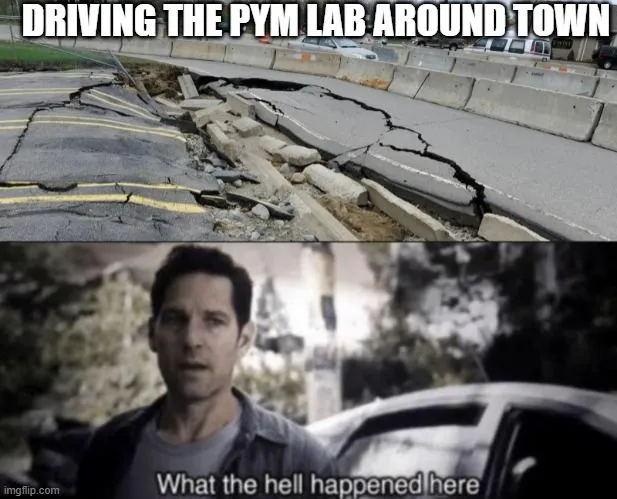
An instance that completely ignores the “not messing with the mass” law takes place in Ant-Man and the Wasp. Dr. Pym shrinks down an entire building that contains his lab into a rollable structure that was then moved around in a van. Let’s assume that the building and van are made of a super-strong material that came out of Pym’s lab, but the roads and the surroundings are made up of normal construction materials, right?
All of us are familiar with the feeling of a slight tremor in the ground when a very heavy vehicle passes by; this is known as traffic-induced vibrations. Now, imagine the same feeling, but for a van carrying a 10-story building that weighs tens of thousands of tons over normal roads. This could easily give rise to local seismic activity.
Also, dragging such highly dense matter in a van where the entire mass is supported by only four tires would crumble every part of the road it touched beneath its weight. In other words, there wouldn’t be any sneaking around and hiding from the FBI.
Does Ant-Man's Weight Change When He Shrinks Or Grows?
This is the question that trips up most viewers, and the films are surprisingly consistent about it: no, his weight does not change when he shrinks. Because Pym particles reduce the distance between Scott Lang's atoms without removing any of them, a shrunk-down Ant-Man keeps the mass he started with. If Scott weighs about 90 kg (roughly 200 pounds) at full height, he still weighs about 90 kg when he is the size of an ant.
That is the whole reason his tiny punches hit so hard. All the momentum of a grown adult gets funneled into a fist a fraction of a millimeter wide, which is exactly why an ant-sized Ant-Man can act like a bullet. It also means he is never truly “light” in his shrunken state, even though he looks it.
Here is where the logic bites back. Something that weighs 90 kg but stands only a few millimeters tall would be denser than any solid on Earth, so it could not perch on a flower, ride on the back of a flying ant, or get flicked harmlessly across a room. A real ant can haul many times its own body weight, but no ant is carrying a passenger who still tips the scales at 90 kg. So the same “constant mass” rule that keeps Ant-Man strong also quietly breaks nearly every scene where he behaves like something genuinely small and weightless. If you enjoy pulling this thread, we did exactly that in a closer look at whether you could shrink and grow without consequences.
Growing is a different story. When Scott balloons into Giant-Man, the movies let his weight climb along with his size, and that is precisely what sets up the square-cube trouble waiting in the next section.
The Square-Cube Law
Now, let’s consider (again) that the Pym particles can somehow safely remove and add mass to Ant-Man’s body as he shrinks and grows, without deforming the biological molecules. This is against the Pym particle laws of the MCU, but it’s the only plausible explanation for him being able to kick a bus with his leg and fling half a plane at Iron Man.
If his weight increases with his size, then the square-cube law might create some major problems for Mr. Lang.
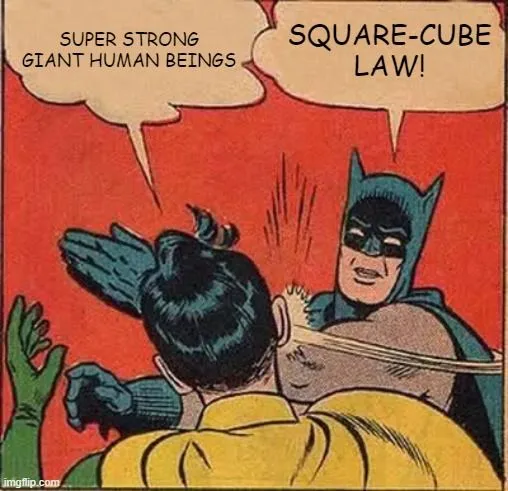
According to the square-cube law, if an object expands or shrinks, the volume of the object expands and shrinks faster than its surface area. This means when the size of an object increases/decreases by a factor x, its surface area changes by the factor x2, but its volume changes by the factor x3.
In Ant-Man and the Wasp, Scott Lang brags that the tallest he has ever been was 65 feet. If we consider him to be a 6-foot-tall man, then his giant version was approximately 10 times bigger than his actual size.
As a result, his total surface area increased by 100 times. This would give him 100 times more strength, as it is commonly believed that there is a direct relationship between the cross-sectional area of a bone or muscle and its strength (scientists are still working on this).
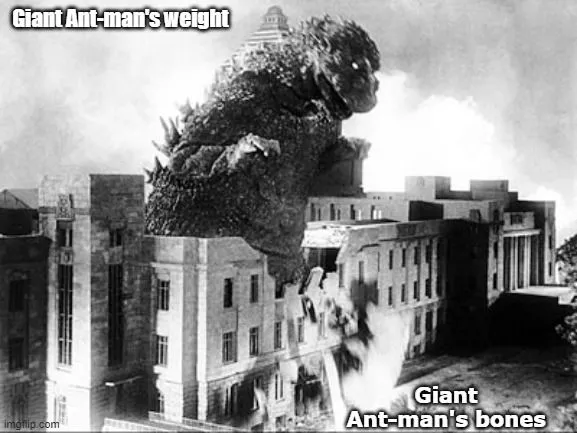
The surface area plays in Ant-Man’s favor, but the volume throws a curveball. As his body grows 10-fold in size, the volume increases by 1000-fold, as does his weight (as established earlier). He might be 100 times stronger, but also 1000 times heavier. His bones would no longer be able to hold his body straight and would turn into powder, being crushed under the weight of his colossally heavy body, turning him into a giant living blob.
Could Pym Particles Exist In Real Life?
Pym particles are the magic ingredient behind everything above, so it is worth asking whether anything like them could exist. The in-universe explanation, echoed by physicists asked to steelman it, is that the particles shrink an object by squeezing the empty space inside its atoms while leaving most of the mass intact. Wake Forest University physicist Jed Macosko has described the idea in exactly those terms: compress the electron orbitals, keep most of the matter, and the object gets smaller.

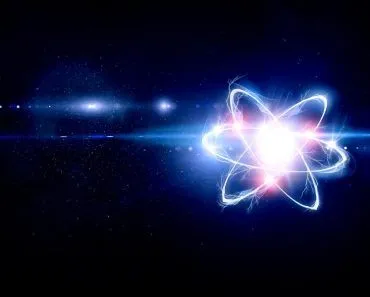
The starting point is genuinely true. An atom really is mostly empty space: almost all of its mass sits in a nucleus that fills a vanishingly small fraction of its volume, while the electron cloud is what gives the atom its size. On paper, then, there looks like plenty of room to squeeze out.
The trouble is that the empty space is not really empty, and it does not give way easily. Electrons obey the Pauli exclusion principle, which forbids any two of them from sharing the same quantum state. Force them into a smaller volume and they get pushed into higher and higher energy levels, shoving back with what physicists call electron degeneracy pressure. This is the very same pressure that holds a white dwarf star up against its own gravity, and it resists compression ferociously. Shrinking an atom is not like letting the air out of a balloon; it means overpowering one of the sturdiest effects in physics.
Even if some exotic field could win that fight, the payoff would be a nightmare of density. Cramming a person's full mass into an ant-sized body would pack matter far tighter than anything in ordinary solids, closer to the crushed material inside a dying star than to flesh and bone. No known particle, force, or field does any of this, which is why Pym particles stay firmly on the fiction side of the ledger, however fun they are to watch.
The Quantum Realm
Ant-Man uses the red Pym particles to shrink to a subatomic size and enter the quantum realm. The only way he can stay alive is if the oxygen he breathes and the DNA that makes him a living being also “go quantum” with him, which is physically impossible (you can read about why here).
By some twist of fate, if he becomes a subatomic particle, these are the things that could happen to him.
If he were a free electron approaching a bunch of neutral atoms, he would bounce around like a crazy ball due to the repulsive forces from the electron clouds around the atoms. If he were a free proton gliding between atoms, he would probably be attracted towards the oppositely charged electron. Unfortunately, if he were to shrink into a free neutron, he would decay in about 15 minutes into a proton, an electron and an antineutrino (a process called beta-minus decay) — ouch.
Clearly, while the concept of Ant-Man is more than enough to thrill fans and power a franchise — including 2023's Ant-Man and the Wasp: Quantumania, which doubles down on the Quantum Realm itself as a parallel reality — many of the physical feats executed by this size-shifting superhero are simply beyond the realm of our reality.
References (click to expand)
- The Physics of Size, and the Movie “Ant-man and the Wasp”. The University of California, Irvine
- THE SURFACE AREA TO VOLUME RATIO - www.tiem.utk.edu
- Kakalios J. (2009). The Physics of Superheroes: More Heroes! More Villains! More Science! Spectacular Second Edition. Penguin Publishing Group
- Gresh L. H.,& Weinberg R. (2003). The Science of Superheroes. Wiley
- Physicist Breaks Down Ant-Man's Pym Particles And Powers (featuring Prof. Jed Macosko, Wake Forest University) - Looper
- The Structure of Atoms - Chemistry LibreTexts
- Degenerate matter (electron degeneracy pressure) - Wikipedia