Table of Contents (click to expand)
- Eliminating The Empty Space Within All Atoms…
- Atoms
- The Constancy Of Universal ‘Constants’
- Why You Can’t Just Squeeze The Space Out Of Atoms
- The Conservation Of Mass Problem
- The Square-Cube Law Would Finish Him Off
- Would A Human-Sized Ant Be A Super-Strong Monster?
- How Small Is Ant-Man Even Supposed To Get?
The biggest scientific mistake in Ant-Man is that you simply cannot shrink a human to the size of an ant. The idea of squeezing out the empty space inside atoms breaks the laws of quantum physics, and even if it worked, conservation of mass and the square-cube law would crush or suffocate the wearer. Shrinking a person this way is physically impossible.
With every new superhero, a new saga of villain-bashing and saving ordinary folks begins. However, in some exclusive circles of people who are far too passionate about both superheroes and science, a new discussion stirs: whether a superhero and his superpowers are practically attainable in real life.
In one of our older posts, we discussed if Iron Man could be recreated in the real world. Now, it’s another Marvel superhero’s turn: Ant-Man. When he dons his suit, he can shrink himself to become as small as an ant and then return to his normal size at will.

On the macroscopic scale, there seems to be no conceivable idea (at least one that’s practical) that can possibly shrink a human to a few inches in size without pulverizing the body, along with being incredibly gory (which is hardly mainstream superhero stuff). Therefore, we must turn towards the fundamental properties that make up the human body in the hope of finding a solution to this miniaturization problem.
Eliminating The Empty Space Within All Atoms…
To begin with, here’s an interesting hypothesis: since human bodies are made of atoms, reducing the size of atoms would successfully miniaturize a human body.
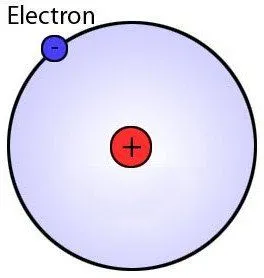
One might argue that since the nucleus occupies only a tiny fraction of all the space inside an atom, the latter possesses ample empty space that could simply be eliminated to effectively reduce the overall size of the atom.
This idea certainly makes sense intuitively, but it’s far from being physically achievable in the real world. To understand the reason behind this, we must back up a bit and do a quick recap of the basic structure and properties of atoms.
Atoms
Most of the discussions pertaining to atoms start with the statement that ‘atoms are the building blocks of matter’, which actually sums up what atoms are quite neatly. An atom is the fundamental constituent of any element; it’s an electrically neutral entity comprising a dense nucleus.
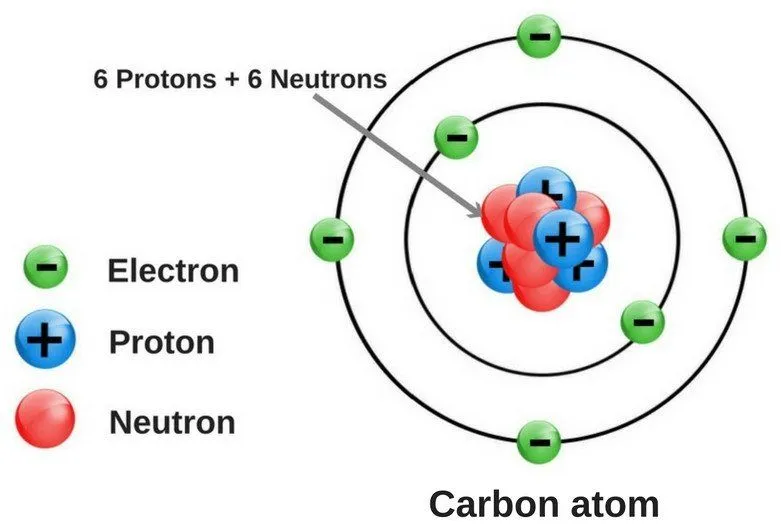
Every atom is made up of three subatomic particles, namely electrons (negatively-charged), protons (positively-charged) and neutrons. Of these three, neutrons and protons sit inside the nucleus, while electrons revolve around the nucleus in well-defined energy levels. In neutral (or uncharged) atoms, the number of electrons and protons is always the same, while the number of neutrons may or may not be the same.
Heavier atoms have more protons inside their nuclei, which pull the orbiting electrons more intensely. At the same time, electrons stack up in shells that sit farther and farther from the nucleus. The size of an atom is really a tug-of-war between these two effects: the inward pull of the positive nucleus versus how many shells the electrons have to spread across.
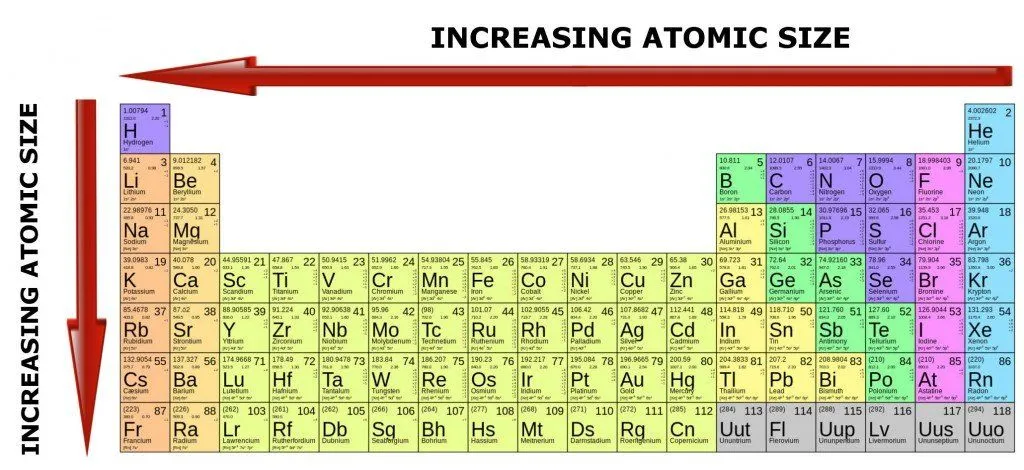
This is why an atom’s size isn’t something you can dial down at will. It’s set by where the electrons are allowed to sit, not by anyone’s choosing.
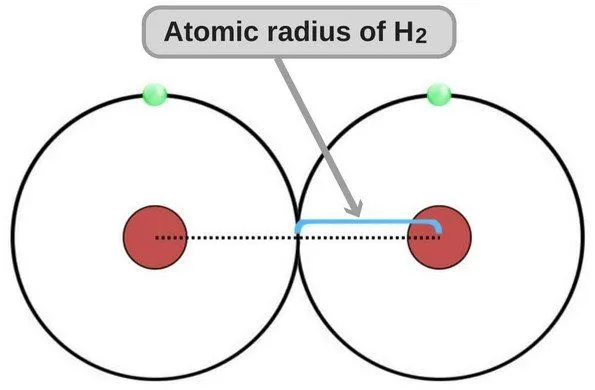
The atomic radius of any atom – just like the radius of any circle – is the measure of the distance between the nucleus and the boundary of the outermost orbit. Although this definition admittedly gives a more tangible or visually-transferrable idea of how atomic radius is calculated, it’s not technically correct. Under the laws of quantum mechanics, electrons do not revolve around the nucleus in paths that are as clear-cut and precise as those frequently portrayed in popular culture.
This depiction of an atom and electrons is not technically correct
Instead, they ‘fly’ around the nucleus in what are known as ‘electron clouds’ with no definite outer boundary; therefore, calculating the atomic radius isn’t as straightforward as taking a circle of known diameter and simply cutting it in half.
The atomic radius, which essentially dictates how large an atom is, depends on a number of parameters, including the number of protons in the nucleus, the mass of an electron and its electrical charge, and something known as Planck’s constant (denoted by ‘h’) – a fundamental constant of the universe. Note that the values of the mass of an electron, its electrical charge, and the Planck’s constant are fixed, meaning that they are not open to changes and modification, so they cannot be altered in any way.
The Constancy Of Universal ‘Constants’
The world as we know it, and everything present in it, unquestionably follows the fundamental laws of physics, which are themselves dependent on a handful of constants, including the speed of light, the gravitational constant ‘G’, Planck’s constant ‘h’ and so on.
Since these constants and laws define the very fabric of our existence and practically everything in the universe, it’s quite natural that people have often wondered if these constants have changed since the dawn of the universe. An English theoretical physicist named Paul Dirac once spurred a debate about the constancy of universal constants through his ‘large number’ hypothesis. A great deal of research has been carried out using astronomical observations of distant stars, anomalous luminosities of faint stars and orbital evolution, but as of now, there has been no experimental proof that can conclusively support the hypothesis of any variation of universal constants.
It is strictly a thing with constants; as the name implies, their values are unequivocally, incontrovertibly and indisputably fixed, so they can’t possibly be revised.

Now, since atomic size depends on nothing but a bunch of constants, it cannot be tampered with artificially or otherwise, even with a superhero serum or pill. If it were tampered with, however, then it would almost certainly be in some other world where the laws of our universe don’t hold sway.
This clearly shows that shrinking a human being to the size of an ant cannot be achieved by simply eliminating the vacant space inside an atom. You also can’t remove a given number of atoms from the human body with the hope of drastically reducing body size without losing or severely compromising a number of human abilities and vital functions.
Why You Can’t Just Squeeze The Space Out Of Atoms
The films get around all this with a hand-wave: Pym particles supposedly shrink the distance between atoms, packing them closer together so the whole body gets smaller. It sounds clever, but it runs straight into one of the most stubborn rules in physics.
Atoms keep their distance for a reason. Each electron in an atom has to occupy its own quantum state, and no two electrons are allowed to share the exact same one. This is the Pauli exclusion principle, and it is the real reason matter takes up the space it does. Try to push the atoms in your hand closer together and the electron clouds resist with a fierce outward push (physicists call it degeneracy pressure). It is the same pressure that holds up a white dwarf star against its own crushing gravity, so good luck overpowering it with a wrist gadget.
In other words, the empty space inside an atom isn’t wasted room you can scoop out. It is held open by the quantum rules that give atoms their size in the first place. Squeeze it shut and you are no longer dealing with ordinary matter at all.
The Conservation Of Mass Problem
Now suppose you ignore all of that and shrink Scott Lang anyway. Here is the next headache: where does his mass go? A human is roughly 70 kg (about 150 lb) of matter. The law of conservation of mass says that matter doesn’t simply vanish, so if you crush a 70 kg man down to the size of an ant while keeping his mass, you get an ant-sized object that still weighs as much as a grown adult.
That object would be absurdly dense. Picture standing on a floor with all your weight pressed through something the size of a grain of rice. Ant-Man would punch straight through steel, then sink through the pavement, then keep going. And the movies can’t even keep this straight. In some scenes a shrunken Ant-Man lands on a toy train and it feels his full adult weight, while in others he rides on the back of a flying ant as though he weighs almost nothing. He can’t be both. Either his mass shrinks with him or it doesn’t, and the films flip the switch whenever the plot needs it.
If, on the other hand, his mass shrinks along with his size (so his density stays normal), then he is exactly as weak as a real ant-sized creature. A tiny mass means a tiny punch. The famous “full-weight haymaker” from a thimble-sized hero quietly stops making sense.
The Square-Cube Law Would Finish Him Off
Even if you handed Ant-Man a friendly density and a working shrink ray, biology would still betray him, thanks to the square-cube law. As a body changes size, its surface area grows (or shrinks) with the square of its length, while its volume changes with the cube. The two do not keep pace, and almost every function of the body depends on the ratio between them.
Take breathing. Shrink a human to a centimeter tall and his lung volume drops far faster than the surface available to absorb oxygen and dump heat. Worse, the lungs and circulatory system that evolved for a meter-and-a-half body are now wildly oversized and inefficient for the job. Real insects sidestep this entirely. They don’t use lungs at all; oxygen seeps directly into their tissues through tiny tubes called tracheae, because at that scale passive diffusion is fast enough. A shrunken human, still wired for lungs and a heartbeat, would essentially suffocate.
The giant version, Giant-Man, is no better off, and the physics behind it is older than Marvel. Back in 1638, Galileo pointed out that you can’t just scale an animal up and expect it to stand. The biologist J.B.S. Haldane made the same case vividly in his classic essay “On Being the Right Size”: blow a man up to ten times his height and he becomes a thousand times heavier, but his bones only get a hundred times stronger in cross-section. His own skeleton would shatter under him the moment he took a step. On top of that, a giant generates heat by volume but sheds it through surface area, so a towering Giant-Man would cook from the inside, unable to dump his own metabolic heat fast enough.
So whether Ant-Man goes small or large, the same unforgiving geometry is waiting for him.
Would A Human-Sized Ant Be A Super-Strong Monster?
Flip the whole thought experiment around. If shrinking a human is a disaster, what about scaling an ant up to human size? Cartoons and old B-movies love the idea of a giant ant that keeps its legendary strength and flattens a city. The same square-cube law that finishes off Giant-Man quietly ruins that fantasy too.

Real ants genuinely are astonishing for their size. A 2014 Ohio State University study published in the Journal of Biomechanics spun Allegheny mound ants (Formica exsectoides) in a centrifuge and found that the soft joint in an ant's neck began to deform only at around 350 times the ant's body weight, and did not rupture until forces of 3,400 to 5,000 times its weight. That is why a single worker can haul a crumb or a leaf far larger than itself.
But that muscle is a perk of being small, not an ant super-power. Muscle force grows with cross-sectional area, which scales with the square of body length, while weight grows with volume, which scales with the cube. Make an animal smaller and its strength-to-weight ratio climbs; make it bigger and that ratio falls in direct proportion to how much you scaled it up. Blow a 6 mm (0.24 in) ant up a couple of hundred times to human height and its weight rises with the cube of that factor while its muscles strengthen only with the square, so its strength-to-weight ratio drops by that same couple-hundredfold. The famous lifting power vanishes. Worse, a human-sized ant would sag under its own weight the way Giant-Man does, and because insects breathe by letting oxygen seep in through tiny tubes rather than through lungs, it would suffocate long before it reached the city. The monster ant is safe only on the movie poster.
How Small Is Ant-Man Even Supposed To Get?
Here is a question the films quietly dodge: exactly how small is Scott Lang getting? In the first movie he pops the regulator on his suit and keeps shrinking past the ant, past a speck of dust, until he slips into what the story calls the Quantum Realm, described on screen as going subatomic. It sounds like the logical next rung down the ladder. It is not.
Remember the problem we already ran into: a human body is a heap of atoms, and each atom has a fixed size set by fundamental constants, not by any dial. So the smallest a body of atoms can ever be is roughly the size of the atoms it is built from. There is no tinier copy of the same person waiting underneath, and a body crushed toward that scale would raise a whole separate set of gravitational problems. Once you start talking about going below the atom, you are no longer shrinking a person at all, because there is nothing person-shaped left to be made of.
The people who worked on the movie knew this. Physicist James Kakalios, who wrote a whole book on the physics of superheroes, put it plainly: atomic size is locked to fundamental constants, and the one thing constants do is stay constant, so there is no ordinary route to a subatomic human. Rather than pretend the physics allows one, the film reached for a fictional workaround. Spyridon Michalakis, a physicist at Caltech's Institute for Quantum Information and Matter who consulted on the movie, coined the very name for that escape hatch: the Quantum Realm, a place where, by design, the normal laws of physics no longer apply. It is a neat piece of storytelling. It is also a quiet admission that a subatomic Ant-Man cannot exist in our universe, only in one written for him.

In the Marvel Universe, the creator of the shrinking potion, Dr. Henry Pym, created a generator of ‘Pym particles’, which had the ability to effectively tamper with human size, while exercising absolute control over the transformation process. If Dr. Pym wasn’t fictional, and his ‘Pym particles’ could really miniaturize a human being with such style and grace, the whole world would have a tiny superhero for once, which might be a really nice change!
References (click to expand)
- Atomic Structure - chemistry.osu.edu:80
- Atomic radius - Wikipedia. Wikipedia
- Dirac large numbers hypothesis - Wikipedia. Wikipedia
- Ant-Man (film) - Wikipedia. Wikipedia
- Pauli Exclusion Principle. Chemistry LibreTexts.
- Square-Cube Law. Wikipedia.
- On Being the Right Size. J.B.S. Haldane.
- With Their Amazing Necks, Ants Don’t Need ‘High Hopes’ to Do Heavy Lifting. Ohio State News.
- Ant-Man and the Quantum Realm. Quantum Frontiers (Caltech IQIM).