An atom does not "measure" time on its own, but it provides the steadiest beat we know of. An atomic clock counts the precise frequency at which a cesium-133 atom switches between two energy states (9,192,631,770 times per second), and that count defines the SI second. The best modern optical clocks are now so accurate they would not gain or lose a second over the entire age of the universe.
In the realm of modern science, and in general, the concept of time has always sparked curiosity in the human mind. We may say that time is an interval between two events. But how do we measure these intervals? Unquestionably, we use clocks! Clocks are such a habitual part of our daily lives, but have you ever wondered how accurate a clock really is? Let’s find out!
The Evolution Of Time
In every civilization we’ve learned about, people found ways to follow time and know when things happened. Think of the story of time as an exciting adventure that moves through science, thinking, how people live, and even cool gadgets. It’s about how humans have changed the way they think about something critically important – time!
Everything started when early human civilization explored the movements of the sun, moon and stars in the sky. They thought it was very interesting and began making special calendars that helped them know when to plant crops and celebrate important ceremonies. They even believed that the sky was like a big storybook, where time was connected to the stars.
Mechanical Clocks And Standardization
In ancient civilizations such as Egypt and China, the water clock (or clepsydra) was a revolutionary invention that kept time using the steady flow of water and continued to improve over centuries. The invention of mechanical clocks in the Middle Ages marked a crucial shift in timekeeping. These clocks used gears and weights to tell time much better than the old ways. In 1656, Christiaan Huygens made a special clock with something called a pendulum. This made clocks even better at getting the time exactly right.
Newton And Absolute Time
Isaac Newton came up with some incredibly important rules about how things move and why they fall. He also had a very cool idea about time. He thought that time was like a steady beat that was the same for everyone and everything. Imagine having a special ruler, just for time, that never changes.
Everything that happens, such as when you eat lunch or play outside, is compared to this unchanging ruler. People who study science and think deeply started using this idea to figure out how things move and why they happen. It even made people think in new ways about life, the world, and everything around us!
Time’s Epic Journey: From Newton To Einstein, Atoms To Uncertainty
Back in the early 1900s, around the birth of Modern Physics, Albert Einstein came up with a new idea about time. Previously, people thought time was always the same for everyone, like a steady beat. Einstein said that was simply not true! He showed that time can change, depending on how fast you’re moving or how strong gravity is in your immediate vicinity. Imagine time as something stretchy, like a rubber band, that can get longer or shorter. This huge change in the way we think didn’t just make time look different – it also helped us see the universe in a more detailed way.
It was like opening the door to a new way of understanding everything, wherein time and space are like dance partners moving together in a graceful and connected pattern.
In the realm of Quantum Mechanics, Heisenberg’s uncertainty principle adds a bit more difficulty in understanding the concept of time for super tiny atoms and subatomic particles. This principle says that we can’t exactly measure both the position and speed of a particle at the same time. So the question is still incomplete… how do we measure time accurately?
Atomic Clocks And Accuracy
In general, we measure time intervals by actually counting the number of cycles of a reference frequency source. For example, oscillations of a mechanical pendulum or a piezoelectric quartz crystal oscillator. This is what makes clocks work, but their accuracy can’t always be guaranteed.
In the 1930s and 1940s, the American physicist Isidor Isaac Rabi (better known as I.I. Rabi) laid the groundwork for atomic clocks. Rabi developed the molecular beam magnetic resonance method, using magnetic fields to make atoms flip between energy levels at a sharply defined frequency, work that earned him the 1944 Nobel Prize in Physics. In 1945, he was the first to suggest that this resonance could be used as the basis of an exceptionally accurate clock.
This principle of resonance provided a way to accurately measure time intervals. Later in 1955, Louis Essen and Jack Parry refined the concept and built the first practical atomic clock using a cesium atomic beam, known as the “cesium beam clock”, at the National Physical Laboratory (NPL) in the United Kingdom.
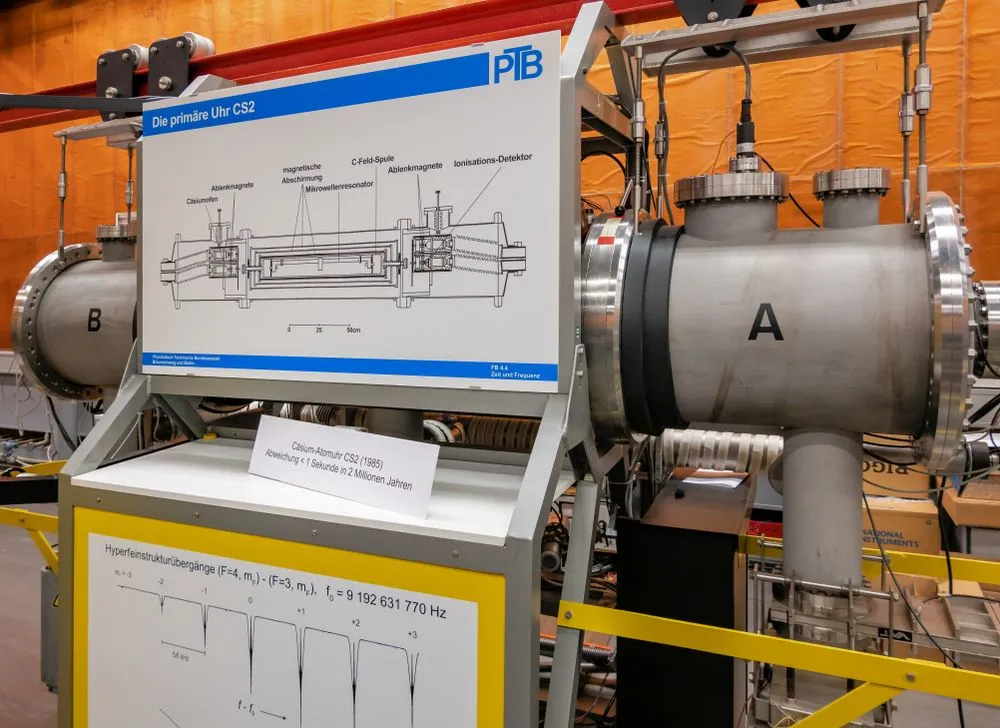
Atomic clocks rely entirely on the vibration of atoms, particularly the oscillations of electrons in their atomic shells. What makes them accurate is that these vibrations occur at well-defined and stable frequencies. For example, cesium-133 atomic clocks measure the frequency of microwave radiation that causes cesium atoms to transition between two closely spaced energy levels. This regularity of the vibrations makes atomic clocks highly accurate and the most reliable timekeepers!
Since 1967, the International System of Units (SI) has defined a second as the duration of 9,192,631,770 periods of radiation corresponding to the transition between the two hyperfine levels of the ground state of the cesium-133 atom. This definition ties the measurement of time directly to the properties of an atom.
Thus, atoms themselves cannot directly measure or assess time in the way that we typically think, but they do play a crucial role in humanity’s most accurate timekeeping device. Atomic Clocks are used extensively in scientific research, global navigation systems like GPS, telecommunications, and other applications that require extremely precise timekeeping.
How Accurate Can Atomic Clocks Get?
The cesium clocks that define the second are remarkable, but scientists have already moved well beyond them. The cutting edge today is the optical atomic clock. Instead of microwaves, these clocks lock onto transitions that vibrate at the much higher frequencies of visible light (hundreds of trillions of times per second). More ticks per second means a finer ruler for time. Optical clocks built around strontium and ytterbium atoms held in laser "optical lattices", along with single trapped ions of aluminum, now reach accuracies near one part in 1018, roughly a hundred times better than the best cesium standards.
In July 2025, researchers at the U.S. National Institute of Standards and Technology (NIST) reported the most accurate clock ever built: a quantum-logic clock that pairs a single aluminum ion with a magnesium ion. It keeps time to the 19th decimal place, with a systematic uncertainty of just 5.5 × 10⁻¹⁹. Put simply, a clock that good would not gain or lose a single second over a span longer than the current age of the universe.
Looking further ahead, physicists are now building a fundamentally different kind of clock. Rather than relying on the electrons orbiting an atom, a nuclear clock would tick on a transition inside the atomic nucleus itself, which is far better shielded from outside disturbances. In September 2024, a team led by Jun Ye at JILA used a special ultraviolet laser "frequency comb" to measure the long-sought transition in the nucleus of thorium-229 with unprecedented precision, a key step toward a working nuclear clock that could one day be even steadier than today's optical clocks.
All of this progress is pushing metrologists toward a historic change. Because optical clocks have so thoroughly outrun cesium, the international bodies that govern measurement (the BIPM and its time committee) have laid out a roadmap to redefine the SI second around an optical transition, with a formal proposal possible from 2026 and adoption expected no earlier than 2030. After more than half a century, the humble cesium atom may finally hand over the job of defining the second.
References (click to expand)
- A Walk Through Time - The Evolution of Time ....
- How Measuring Time Shaped History - Scientific American.
- Hut, R. A., & Beersma, D. G. M. (2011, July 27). Evolution of time-keeping mechanisms: early emergence and adaptation to photoperiod. Philosophical Transactions of the Royal Society B: Biological Sciences. The Royal Society.
- Optical Clocks: The Future of Time. NIST.
- NIST Ion Clock Sets New Record for Most Accurate Clock in the World. NIST (2025).
- Major Leap for Nuclear Clock Paves Way for Ultraprecise Timekeeping. NIST (2024).
- Towards a redefinition of the second. BIPM.