Table of Contents (click to expand)
Hexokinase is the broader term for a class of enzymes that phosphorylates six-carbon sugars (mainly glucose, also mannose and, in muscle, fructose) with very high affinity (Km ~0.1 mM). Glucokinase is a liver- and pancreas-specific isoform (hexokinase IV) that only acts on glucose and has a much lower affinity (Km ~10 mM), so it kicks in mainly after meals when blood glucose is high.
Being alive may seem rather effortless at times, particularly when you are feeling healthy, happy, and possibly perched up on a tropical beach somewhere. However, staying alive requires the constant expense of energy by your body’s cells. From the macroscopic scale of flexing your muscles to walk, dance, blink and swallow to the microscopic level of creating neurotransmitters and replicating genetic material, the production and utilization of energy is a perpetual process called cellular metabolism.
What Is Cellular Metabolism?
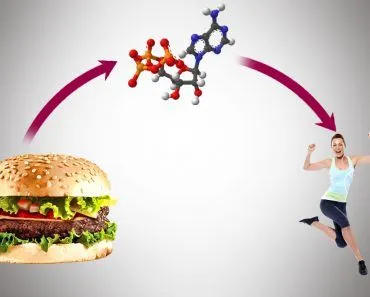
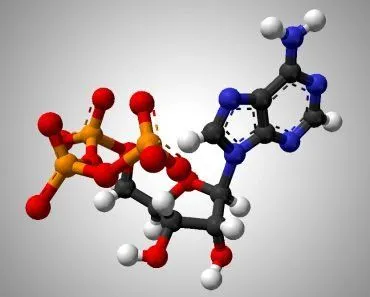
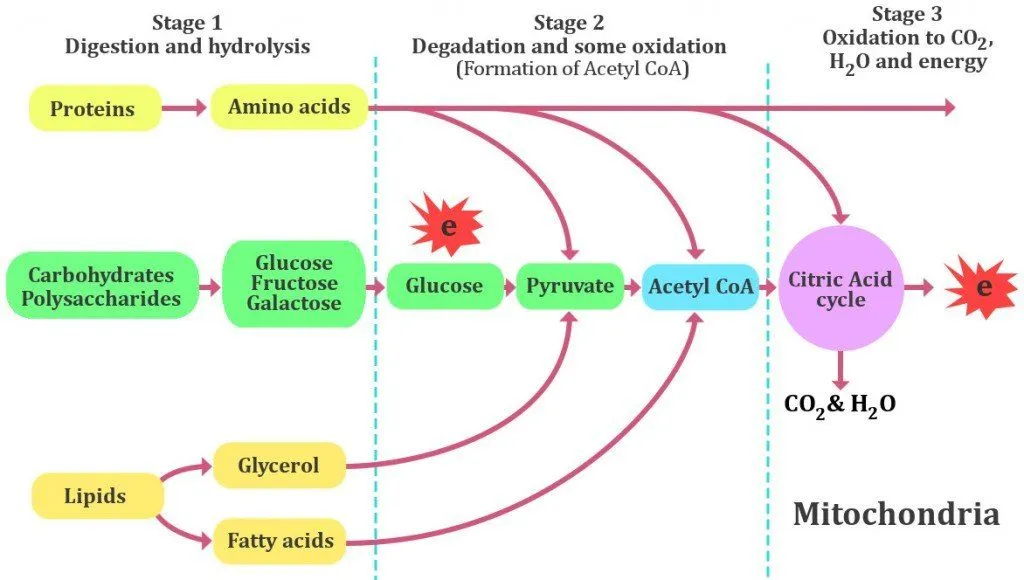
As you likely know, the main source of that energy comes in the form of food that we eat, and the subsequent breakdown of that food into usable energy. That metabolic process of breaking down food molecules (glucose, in this case) is a form of cellular metabolism, a critical catabolic pathway from which those cells can derive energy (in the form of ATP, adenosine triphosphate).
Aerobic metabolism (which occurs in the presence of oxygen) consists of three stages – glycolysis, the Krebs Cycle, and the electron transport chain.
What Is Glycolysis
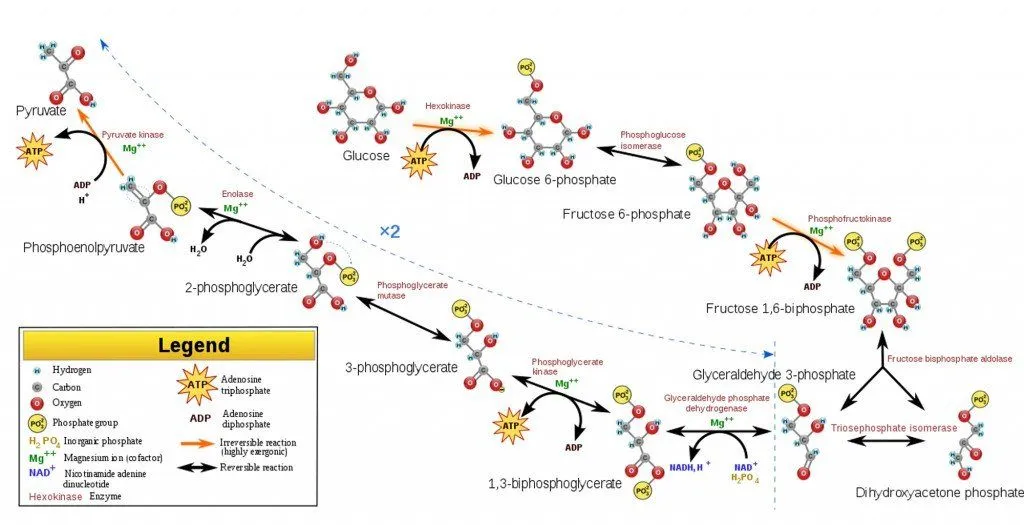
The first of three stages in this process, glycolysis, does not produce a large amount of ATP (only 2), in comparison to the electron transport chain, but it does lead to key products (2 pyruvate) that are used for the further generation of ATP within the larger metabolic pathway. Glycolysis occurs in the cytoplasm, whereas the remaining steps of cellular metabolism occur in the mitochondria.
To begin the transformation of glucose, as with many other chemical reactions, an enzyme is required. In the case of the phosphorylation of glucose into glucose-6-phosphate, depending on a number of variables, either hexokinase or glucokinase will catalyze the reaction.
Hexokinase Vs. Glucokinase
While the heading of this subsection may suggest that these two work in opposition to one another, they are in fact very similar and basically perform the same function. Hexokinase is actually a broader term for a class of enzymes (isoforms HK1 to HK3) that phosphorylates six-carbon sugars, principally glucose and mannose, plus fructose in muscle. Galactose, and most dietary fructose handled by the liver, are phosphorylated by separate kinases (galactokinase and fructokinase, respectively). Glucokinase, also known as hexokinase IV, is a specific isoform that has a much lower affinity for its substrate and exclusively works with glucose, not other 6-carbon sugars.
Both of these enzymes may perform the same function – catalyzing the first reaction of glycolysis – but they are used in specific circumstances.
Hexokinase
This enzyme is active when the amount of available glucose is relatively stable or low, and can be found in nearly all tissues of the body where cellular metabolism occurs. The notable exception is the hepatocytes of the liver, where glucokinase (its isoform cousin) takes over almost entirely. In other words, hexokinase is the major catalyst for cellular metabolism on the organism scale.
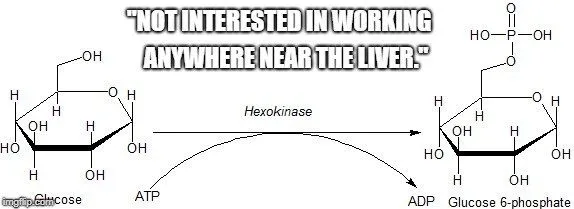
The affinity of hexokinase towards glucose is also quite high (Km ~0.1 mM); what this means is that even when glucose supply is low, the enzymatic reaction can still occur and glucose gets converted into glucose-6-phosphate, with one ATP consumed in the process. The net 2 ATP yield of glycolysis comes later, from downstream steps. The maximum reaction rate (Vmax) of hexokinase is also quite low, meaning that it isn’t ideal for the rapid generation of energy when glucose floods the system.
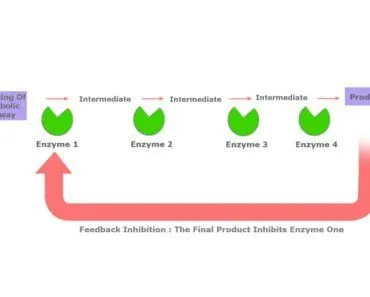
As with any enzymatic reaction, there is a control mechanism for hexokinase, an allosteric feedback loop with the reaction’s own product, glucose-6-phosphate. This means that once enough of the glucose has been converted into glucose-6-phosphate, that same product will inhibit the enzyme from engaging/reacting with additional substrate molecules (glucose).
Glucokinase
As mentioned above, glucokinase is an isoform of hexokinase, and has different conditions for activation than the latter. Glucokinase is found primarily in liver hepatocytes and pancreatic beta cells, with smaller but important roles in hypothalamic glucose-sensing neurons and gut enteroendocrine cells, and is akin to a functional control mechanism within the body.
The affinity of glucokinase towards glucose is low (Km ~10 mM, around 100 times less than hexokinase), meaning that it is only activated when there is an abundance of glucose available to a cell. If there is only a limited amount of glucose, such as during a fasting or resting period, then hexokinase can handle the enzymatic load. The maximum reaction rate (Vmax) of glucokinase is quite high, resulting in a rapid conversion of glucose into usable energy. Glucokinase comes into play following a large meal, or an influx of carbohydrates, which is related to the control mechanism for this particular enzyme.
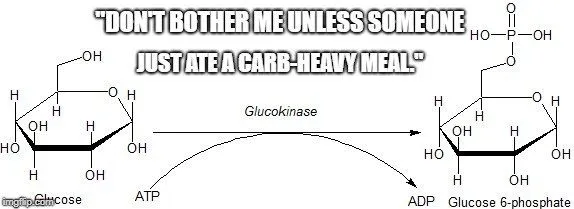
Hexokinase is allosterically regulated by one of its products (glucose-6-phosphate), whereas glucokinase is regulated quite differently. In the liver, its acute regulator is a partner protein called the glucokinase regulatory protein (GKRP), which sequesters glucokinase inside the cell nucleus during fasting and releases it when blood glucose rises. Over longer timescales, insulin drives glucokinase transcription. The glucokinase gene is switched on within about 45 minutes of an insulin signal, with enzyme activity catching up over the next several hours. Other hormones and pathways can affect glucokinase, including glucocorticoids and triiodothyronine, but the vast range of other metabolic pathways for glucokinase activity is beyond the scope of this article.
Due to the critical role of insulin in the regulation of glucokinase in the liver and pancreas, diabetes mellitus can have a serious impact on the efficacy of glucokinase, and therefore the generation of energy when glucose levels are high. Inherited mutations that knock out glucokinase cause a form of monogenic diabetes called MODY-2 (maturity-onset diabetes of the young, type 2), which presents as mild fasting hyperglycemia. On the flip side, drugs that activate glucokinase are now a real diabetes drug class: dorzagliatin, the first-in-class glucokinase activator, was approved for type 2 diabetes in China in 2022. Inherited mutations that knock out glucokinase cause a form of monogenic diabetes called MODY-2 (maturity-onset diabetes of the young, type 2), which presents as mild fasting hyperglycemia. On the flip side, drugs that activate glucokinase are now a real diabetes drug class: dorzagliatin, the first-in-class glucokinase activator, was approved for type 2 diabetes in China in 2022.
A Final Word
Hexokinase and glucokinase are both important enzymes in the process of glycolysis, which is an essential step in the larger pathway of cellular metabolism. As is true with most enzymatic reactions, these two enzymes function unconsciously, and our body will control their activation without any input from us. As small and insignificant as these enzymes appear, their constant work on our behalf is the first step towards every move we make!