Table of Contents (click to expand)
Earphones get tangled because a long, flexible cord jostling in your bag or pocket keeps folding into new shapes, and a free end eventually slips through a loop to form a knot. The odds rise with length: a cord shorter than about 46 cm (18 in) almost never knots, while one past roughly 1.5 m (5 ft) has about a 50% chance of coming out tangled.
Every now and then, you have a bad day at the office/college when time just doesn’t seem to move and the day drags on and on. Finally when the torturous hours ends, you’re exhausted as hell. You’re certainly in no mood to hear random people babbling about their problems during your commute back home, so in order to unwind and get some energy back, you decide to take out your earphones, pump up that music, and shut out the world.
However, it happens to be the day when the entire universe is conspiring against you. As you take out the earphones from your bag, you realize that they have somehow tangled themselves into a tight knot! You haven’t touched them all day, and they were perfectly normal this morning, but now they’ve managed to become an inextricable mess.
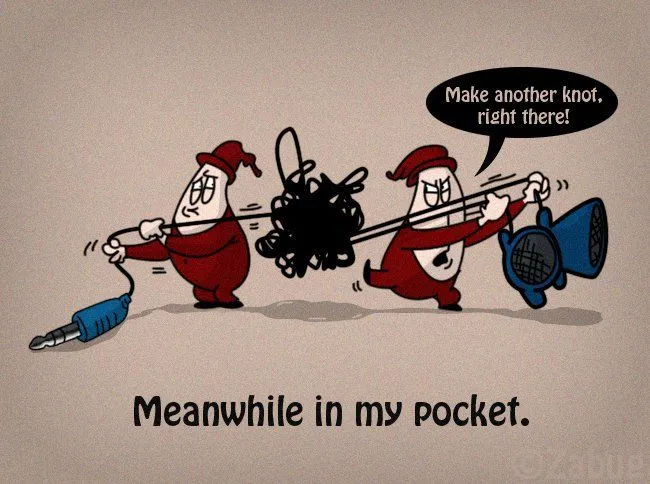
Tangled earphones have become an everyday problem. Ask any teenager; they can handle bad grades, break-ups and lectures from parents, but when their earphones get tangled, they seem to go crazy and lose their minds. These miniature music-makers seem to have minds of their own. The most frustrating part is that no one knows how the earphones get tangled all by themselves. You put your earphones perfectly in the bag and they come out transformed and unusable. Don’t even think about putting them in your jeans pocket, the tangled mess you’ll remove will take you ages to unravel. Most people can solve a Rubix cube faster than they can untangle their earphones.

The Knot Theory
This may sound ludicrous, but scientists consider the problem of earphones very seriously. Granted, their interest isn’t solely due to their desire to listen to music, but rather because of a mathematical theory known as the knot theory, the purpose of which is to figure out how on earth random things get tangled all by themselves.
Knot theory was developed in the 1800s, long before earphones were invented, and since then, scientists have been fascinated by this unexplained phenomenon, as it applies to cables, shoelaces, wires etc. They all seem to want to be tangled.

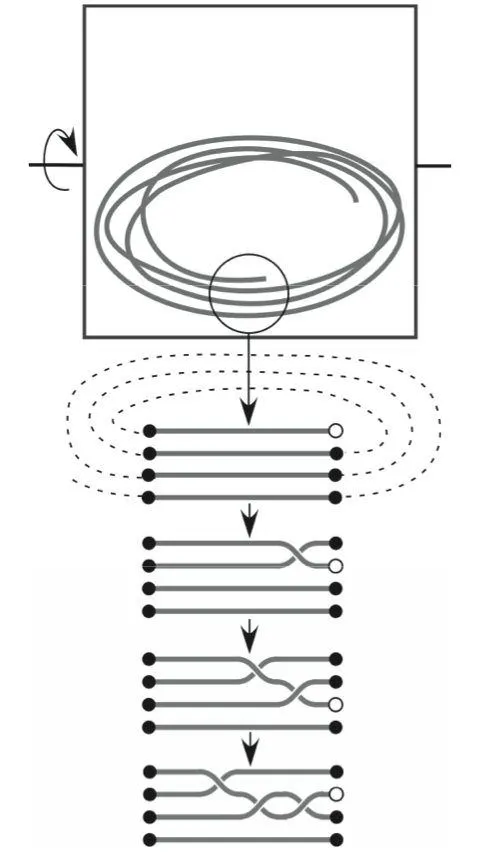
It was the year 2007 when two physicists decided to take a fresh look at this modern-day problem. Physicist Douglas Smith and his then-undergraduate student Dorian Raymer performed experiments by sealing a string inside a box (about 30 cm, or 12 inches, on each side) and tumbling it at one rotation per second for roughly 10 seconds. They repeated this experiment 3,415 times, using strings of different length and stiffness, boxes of different size, and varying rotation rates of tumbling.
They applied the famous knot theory to their results and published their study in the paper "Spontaneous knotting of an agitated string." In the study, they found that almost 50% of the time, the string would form a knot all by itself. The tangles were surprisingly varied, too: across all those trials, they catalogued 120 different types of knot, some complex enough to have up to 11 crossings.
Length Of The String
According to the paper, the chances of a string getting tangled depend on its length. A string shorter than about 46 cm (18 inches) will hardly ever get tangled, but the probability climbs steeply as the string gets longer. Once a string reaches around 1.5 m (5 feet), it has about a 50% chance of coming out knotted. Beyond that, the curve flattens: longer strings are cramped inside the box, so the probability holds steady near 50% rather than climbing toward 100%.
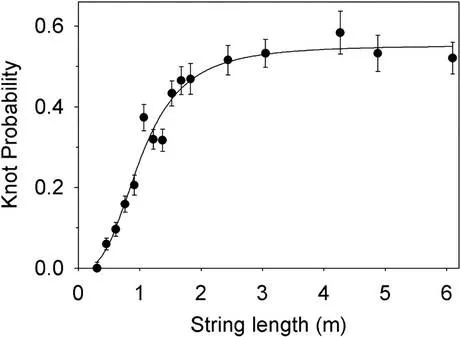
A typical earphone cord is about 120-160 cm (roughly 4-5 feet) long, which lands right in that high-risk zone. So every time you stuff your earphones in your pocket, there is close to a 50% chance that you’ll be irritated the next time you pull them out for some music.
It doesn’t take much time for a neatly placed string to get into an awful mess inside a box. As shown in the diagram, all it takes is one end of a string crossing the other end twice to form a spontaneous knot.
The good news is that the same study hints at a fix. Raymer and Smith found that stiffer strings, and strings packed into a tighter space, knotted far less often, because both leave the cord less room to fold over itself and feed an end through a loop. So you are not entirely at the mercy of luck: coiling the cord into a tight bundle, winding it around two fingers, or clipping it together all cut down on the slack that knots need. Neatly folding the earphones into the case the manufacturer provided works too (though my personal research suggests that NO ONE does this).
Basically, it’s just a daily problem that we all have to face…oh, the struggles of modern life. At least now you know why your earphones seem to hate you, but that doesn’t make it any less annoying!

As I always say, life is like a tangled earphone in your pocket; in order to enjoy all the music of life, you have to patiently untangle yourself, otherwise you’re just as messed up as a tangled bit of wire.
References (click to expand)
- Raymer, D. M., & Smith, D. E. (2007, October 16). Spontaneous knotting of an agitated string. Proceedings of the National Academy of Sciences (PNAS).
- Spontaneous Knotting of an Agitated String (full text). PNAS via NCBI PubMed Central.
- Knot Theory. Encyclopaedia Britannica.
- Crowell, R. H., & Fox, R. H. (1977). Introduction to Knot Theory. Graduate Texts in Mathematics. Springer New York.