Table of Contents (click to expand)
Quantum entanglement is a phenomenon in which two or more particles share a single quantum state, so that measuring a property of one (such as spin) instantly fixes the corresponding property of the other, even if they are light-years apart. It does not allow faster-than-light communication. The reality of entanglement was confirmed by Bell-test experiments, work that earned Alain Aspect, John Clauser, and Anton Zeilinger the 2022 Nobel Prize in Physics. The term was coined by Erwin Schrödinger.
Have you ever tried to solve a mystery of the universe? The task seems rather daunting, but there are plenty of scientists and researchers that have spent their lives trying to find answers to the most paradoxical questions of existence.
Einstein is credited with unraveling some of these fantastic mysteries, but there is one strange phenomena of the world that even the great Albert Einstein felt stumped by. He was so baffled that he gave it a decidedly unscientific name – “spooky action at a distance”.

If Einstein couldn’t figure it out, I don’t know how much luck we’ll have trying to explain it, but this bizarre phenomena of the universe, more commonly called “quantum entanglement” is far too interesting to ignore.
The Tiny World Around Us
Try to imagine the smallest thing you can hold in your hand and still see with your eyes. A grain of sand works well for this example. Now, that may be a single grain of sand, but it likely contains about 50 quintillion atoms (yes, 50 million million million atoms). The brain’s ability to comprehend the atomic scale is quite limited, but we’re going to dig even deeper.
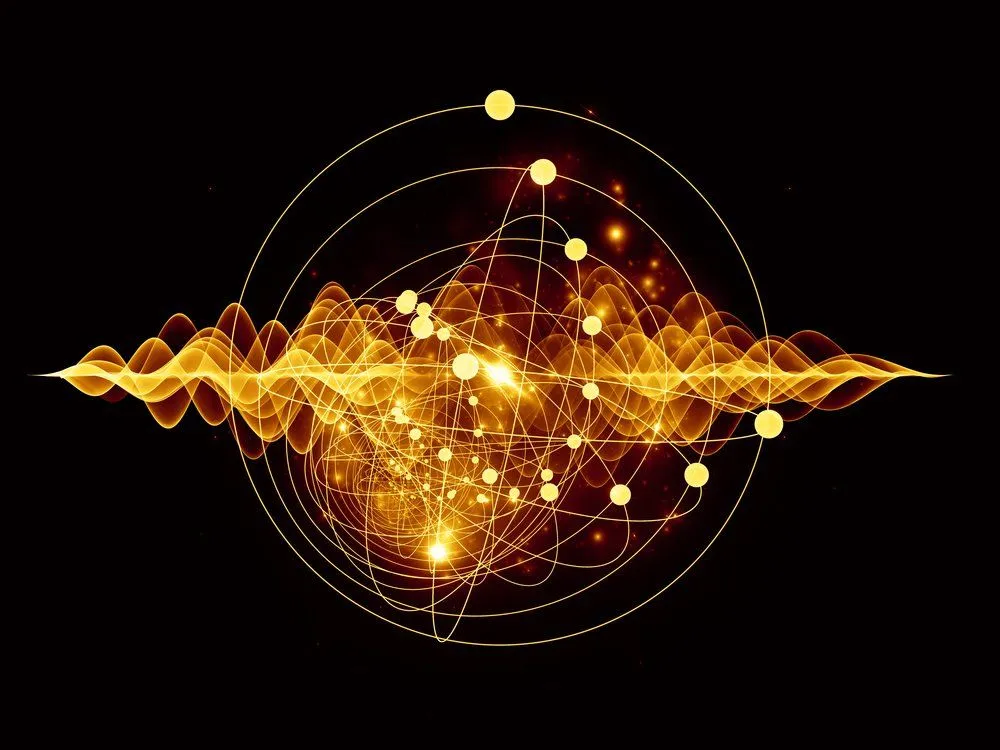
Within those 50 quintillion atoms, there is a deeper level of subatomic particles that weren’t even discovered until 1897, when electrons were first named. In the century or so since then, we have discovered more than a dozen other types of subatomic particles, including quarks, mesons, neutrinos, and the hypothetical graviton, and other names that seem pulled from the pages of a science fiction book.
Some of these subatomic particles are “elementary”, meaning that they can’t be broken down any further, while others are composite, meaning that they are composed of multiple subatomic particles. This latter category is what fascinates particle physicists and the operators at the Large Hadron Collider (LHC).
These particles were eagerly studied by researchers across the world, but it was seen that the traditional laws of Newtonian physics didn’t always apply in the subatomic world, so a new school of thought was required. An entirely new branch of physics (Quantum physics) was developed to create a framework in which these subatomic particles could be understood.
The Subatomic Particle Paradox
Now, we can measure subatomic particles based on certain pieces of information regarding their location in space-time. The most useful piece of information is “spin”, which is defined by the particle’s angular momentum. This spin isn’t “observable” per se, because this data is only acquired through packets of subatomic energy that can be measured (and thus a quantum number is assigned). Now, a subatomic particle can’t change the speed at which it rotates, but it can change the direction.
The quantum world operates on the idea of probability states, commonly known as superposition, which means that these particles exist in every state at the same time, at least until a researcher tries to measure it. Ironically, when it is measured, the waveform collapses and the spin can be measured.
Now, let’s consider a simple subatomic particle: a photon. Before this photon is measured, it is in a superposition spinning in all directions at once (remember, quantum physics is weird….). It’s possible to split a photon into two photons by shining a light through the proper medium, and at that point, you’ll have two photons in superposition. When you measure one of those two particles, the strangest thing happens… they both fall out of waveform, like Alice and Bob below.
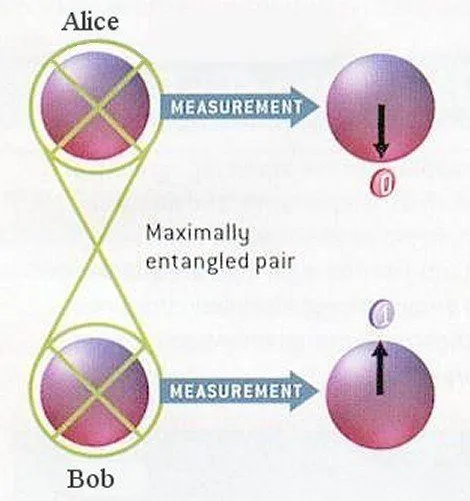
Now, remember that quantum number that was mentioned earlier? Let’s assume that the original photon has a spin value of zero. When you split it into two photons, the two will end up with anti-correlated spins, so the pair as a whole still adds up to zero. Until either photon is measured, neither has a definite spin direction; the moment you measure one and find it spinning, say, “up,” the other photon is guaranteed to be measured as “down,” no matter how far apart they have travelled. Crucially, this does not let you send a signal: the result of each individual measurement looks completely random, and the correlation only becomes visible when the two observers later compare notes.
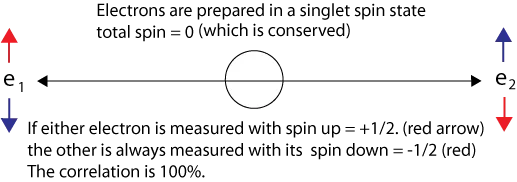
The paradox that stumped Einstein is that this change happens instantaneously. Even at that impossibly small scale, information must still be transferred, either through light, energy, waves etc., but that wasn’t the case. The two subatomic particles were linked somehow, and changing one would instantaneously change the other, even if the two particles were separated by large distances.
This inexplicable phenomenon came to be known as “Quantum entanglement”, a term originally coined by Erwin Schrödinger, another early adopter and theorist of the quantum world.
Given that nothing in the universe can move faster than the speed of light, and that the measured correlations seemed to be set up instantaneously across any distance, the greatest minds of the early 20th century were genuinely stumped. (We now know the resolution: the correlations are real and instantaneous, but no usable information actually crosses the gap between the two particles, so special relativity is not violated.)
Is There Any Explanation For Quantum Entanglement?
Theoretically, even if these particles were separated by millions of light-years, the correlations between them would still be perfectly set up at the moment of measurement, locked in their eternal connection across the cosmos. The current experimental records are eye-watering. In 2017, China’s Micius satellite distributed entangled photon pairs to ground stations more than 1,200 km (~750 miles) apart, and follow-up satellite-to-ground experiments have continued to push that distance, leaving the early Earth-bound records of a few kilometres far behind.
The entire concept has been bending minds for decades, because it breaks one of the most fundamental laws of the universe. The information transfer between the two particles cannot occur faster than the speed of light, and yet it does.

These tangled particles are not limited to pairs either; a study in 2014 artificially entangled approximately 500,000 particles, suggesting a particle cloud “group brain” that instantaneously reacts when any single component is measured or altered.
Taking this a step further, into the macrocosmic scale, let’s talk about the Big Bang, which was essentially the moment when the entire universe exploded from a single particle and began expanding (and hasn’t stopped since!). Given what we just learned about the strange nature of entangled particles, there could be entangled particles spread across the universe. Every single particle could be entangled with another, or a large group!
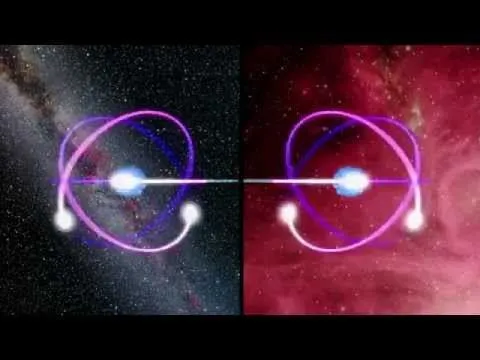
There could be billions of particles that are inherently linked through quantum entanglement, which means that some insignificant spin shift that we stimulate on Earth may have a subatomic result on the dark side of the Moon, or the other end of the galaxy!
Bitter Brainiacs
Scientists don’t like paradoxes that they can’t solve, so in response to quantum entanglement, Einstein and his friends stated that the quantum theory was “incomplete” and that some inherent concept or material was missing. Subsequent “loopholes” attempting to explain the strange facts of quantum entanglement were developed by Schrodinger, Einstein, and other theoretical physicists, as though they simply couldn’t admit not knowing the answer. These loopholes have been progressively closed in the decades since by a long series of Bell-test experiments, designed to test whether nature really does behave the way standard quantum mechanics predicts — and it does. The work that nailed this down earned Alain Aspect, John Clauser, and Anton Zeilinger the 2022 Nobel Prize in Physics, “for experiments with entangled photons, establishing the violation of Bell inequalities and pioneering quantum information science.” In other words, Einstein’s “spooky action at a distance” is now experimentally undeniable, even if it remains philosophically uncomfortable.
To this day, we don’t fully understand quantum entanglement, nor the hidden mysteries of the quantum world, but with possible applications like quantum computing and a unified Internet of entangled particles (both of which could change the world as we know it), researchers are not giving up any time soon.
References (click to expand)
- Quantum entanglement - Wikipedia. Wikipedia
- Quantum entanglement - ScienceDaily. Science Daily
- Quantum Entanglement - University of Miami News and Events. news.miami.edu
- Quantum Entanglement and Information. The Stanford Encyclopedia of Philosophy
- The Nobel Prize in Physics 2022 (Aspect, Clauser, Zeilinger). NobelPrize.org
- Bell test. Wikipedia