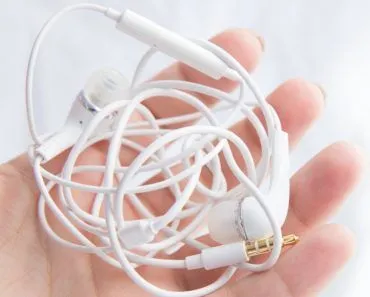
Earphones are essentially miniature speakers. Each earpiece contains a coil of wire (an electromagnet) wrapped around a thin plastic diaphragm and sitting just above a small permanent magnet. The music signal sent down the cable from your device is an alternating electrical current; as it flips back and forth, it constantly reverses the coil’s magnetic field, attracting and repelling the permanent magnet. That makes the diaphragm vibrate, and the vibrating air is what your ears interpret as sound.
In the opinion of Virginia Woolf, “nobody ever said a thing they meant, or ever talked of a feeling they felt, but that was what music was for.” Nietzsche asserted that “without music, life would be a mistake.” Charles Darwin vowed that if he had his “life to live over again,” he would “listen to music at least once every week.”

Today, we still sympathize with Woolf and Nietzsche, and a bit with Darwin. Initially speakers, and now earphones and headphones, allow us to relish music almost constantly, anytime and anywhere. Speakers, one can easily agree, are deplorable in public places (“ughh how uncouth”). The preference in such cases is earphones. Your device houses an orchestra, and earphones funnel the music straight into your ears. A private concert just for you. Ever wonder how a bicephalic or two-headed wire — the savior of introverts — manages to achieve this?
Just Smaller Speakers
A pair of earphones or headphones (we’ll refer to them as earphones for the rest of the article) is simply two speakers that are placed extremely close to your ears, except that they are incredibly small. In fact, each speaker is so small that it impeccably fills an ear’s outer void. For this reason, they are also – although quite seldom – referred to as ear-speakers.
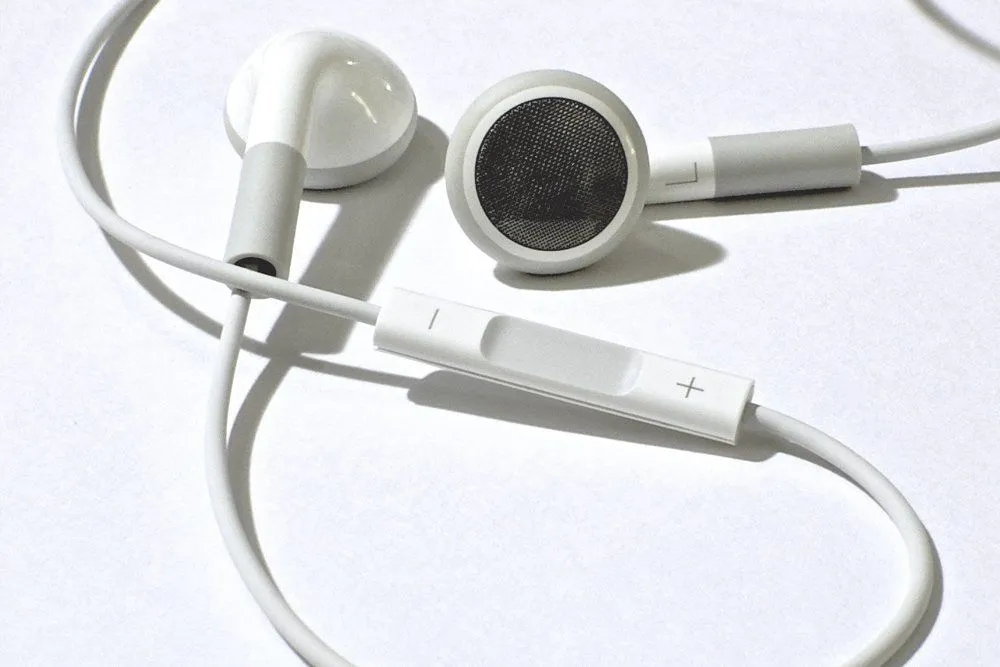
A transducer is a device that converts energy from one form into another. A pair of earphones is composed of two transducers that convert the electrical energy produced by your device into sound energy that our ears perceive as music. Basically, each earphone is just like any other circuit – a conductor drawing current from a battery (source) and providing it to a load (transducer).
The Jack
The conductor is connected to the source with what is called the jack of the earphone. The stout, shiny needle plunged into your device is actually three metal contacts stacked one on top of the other, each separated by a thin band of insulation. From the very front of the needle inward, those contacts are the tip, then the ring, and then the long sleeve that runs all the way back to the cable. That’s where the formal name of the jack comes from — the TRS connector (Tip–Ring–Sleeve).
The tip carries the signal for the left earpiece, the ring carries the signal for the right earpiece, and the long sleeve is the common ground that closes the circuit for both. Some jacks are divided into four parts instead of three (called TRRS connectors), with an extra ring tucked between the first ring and the sleeve. That fourth contact is the wire for the inline microphone you find on headsets and earphones meant for phone calls.
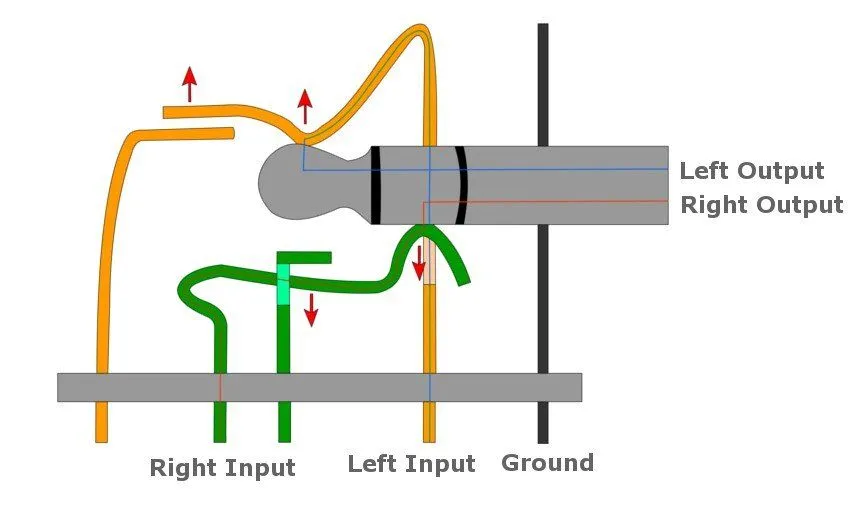
Recall that each earphone is a circuit, and a circuit cannot exist as a single wire emanating from the battery. The circuit cannot be complete unless the conductor returns to the battery. Therefore, each earphone comprises two wires — one that connects the source to the transducer, and another, the ground, that completes the circuit. While in a speaker you’d find the two ground wires to be separate, the grounds in a pair of earphones are entwined into a single wire, the common ground, which is connected to the ring.
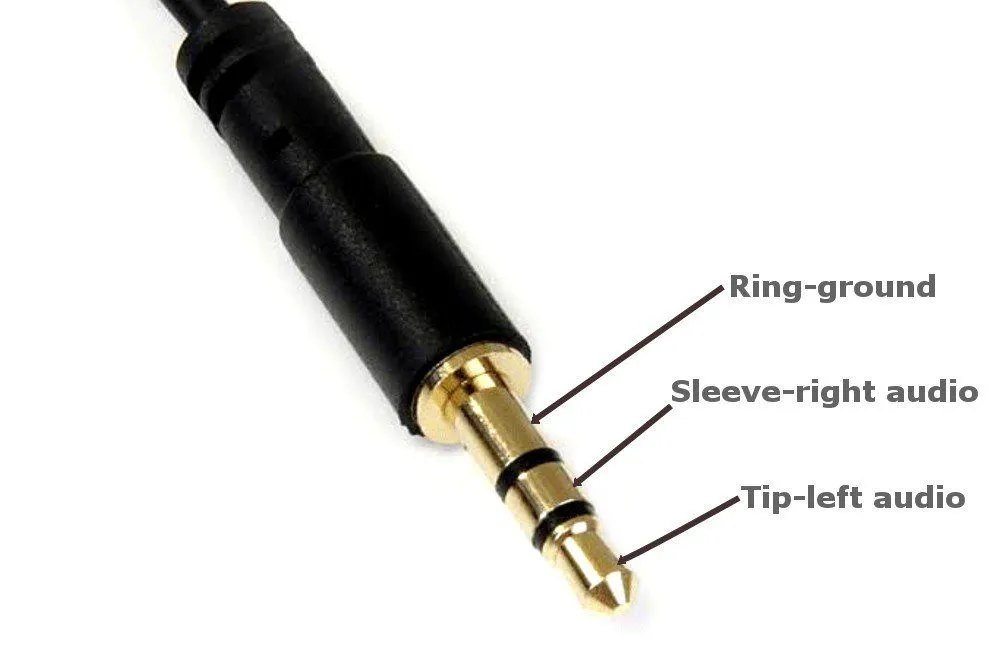
The wires are insulated with a plastic coating that is often adorned with designs to make them aesthetically appealing. The plastic that insulates the jack not only purports to ensure safety, but also to provide a grip to facilitate the insertion and removal of the jack.
The Transducer
If you were to dismantle an earphone, you’d find inside the hemisphere the two wires mentioned above coiled around a plastic cone that is suspended above a circular metallic plate. The plastic cone is called the diaphragm. In the center of the metallic plate, above which the diaphragm hovers, is embedded a permanent magnet. These components collectively form the transducer.
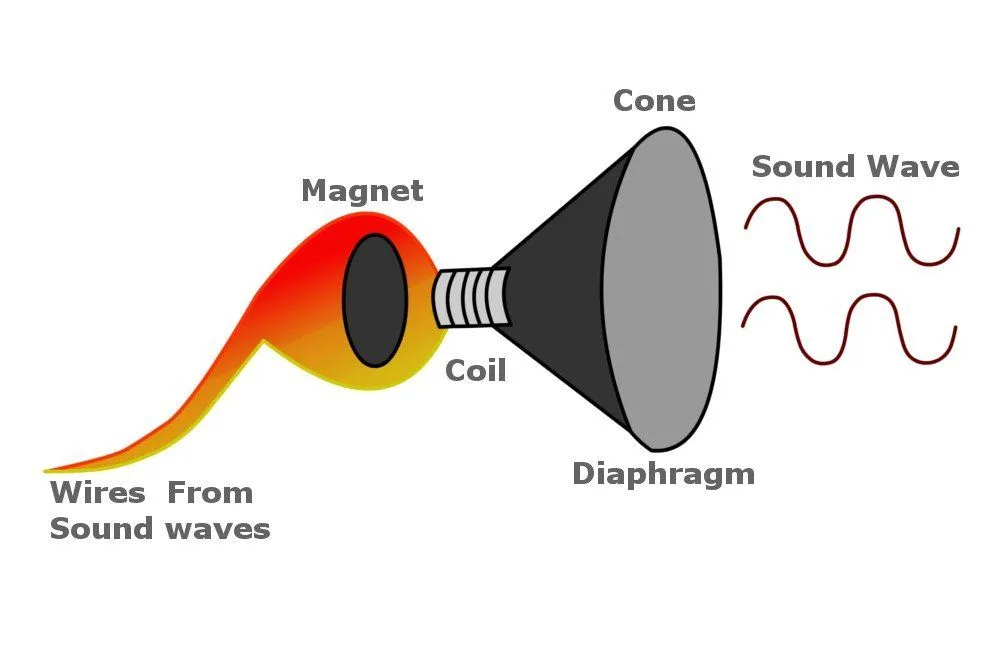
Each conductor coiling around its cone becomes an electromagnet when supplied with current. Music is an oscillatory signal. The strength of the electromagnet vacillates as the signal does. However, remember that the electromagnet is placed above a permanent magnet. The two magnets, due to their conflicting polarities, exert a force on each other. The force causes the diaphragm attached to the coil to move, which causes the air in its vicinity to vibrate. And what is sound but the vibration of air molecules?
The sound exits through a grill that is suffused with holes. The holes are large enough to allow the music to exit, but small enough to prevent dust and earwax from entering the earpiece and damaging the equipment. As it is the grill that is ultimately in contact with the ear, it is ensured that it’s soft and comfortable.
The Parts of a Pair of Headphones
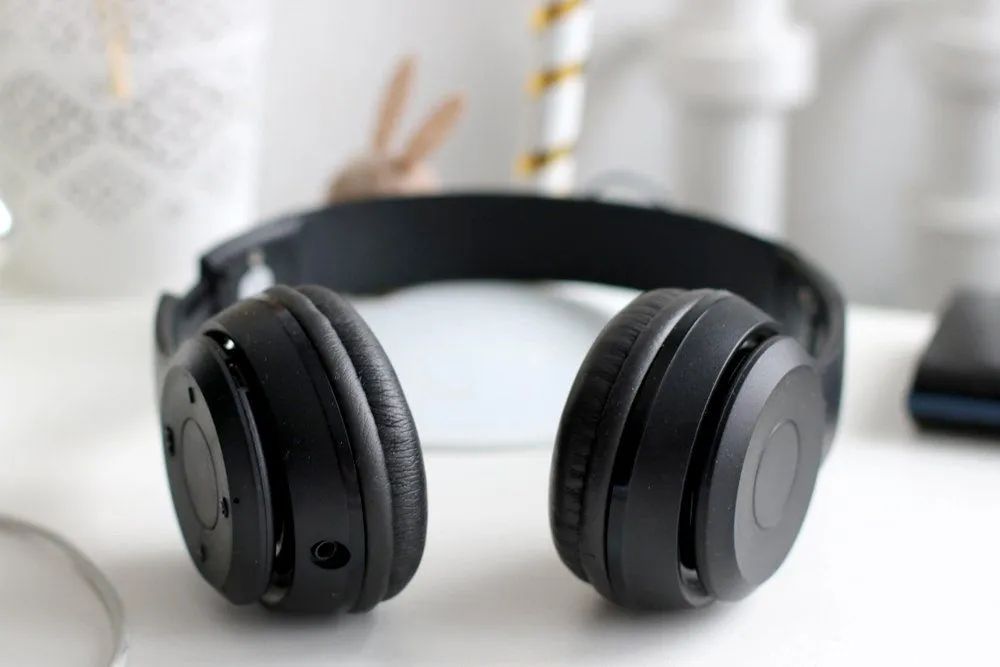
We have met the two components that do the real work, the jack that ferries the signal in and the transducer that turns it into sound, but a finished pair of headphones is more than those two pieces. Whether they clamp over your ears or nestle inside them, most headphones share the same short list of parts.

At the heart of each earpiece sits the driver, the miniature loudspeaker we dissected above. The driver is itself an assembly of three parts: the diaphragm (the thin cone or dome that pushes the air), the voice coil (the winding of fine copper wire glued to it), and the permanent magnet that the coil pushes against. Bose describes the driver simply as the component that produces sound, and it is the one part no pair of headphones can do without.
Everything else exists to hold the driver in place and deliver its output comfortably to your ear. A rigid housing (the ear cup on over-ear models, or the moulded shell of an earbud) encloses the driver and shapes its sound. A perforated grille lets that sound out while keeping dust and earwax away from the diaphragm. On over-ear headphones, plush ear cushions of foam and leatherette seal against the head, and a padded headband bridges the two cups and carries their weight. Finally, a cable and jack (or, on wireless models, a battery and radio) feed the driver its signal.
Not every driver is built the same way. The moving-coil design described here, called a dynamic driver, is what you will see in the vast majority of speakers and headphones, but pricier in-ear monitors and audiophile models may instead use balanced-armature, planar-magnetic, or electrostatic drivers, each with its own recipe for turning electricity into motion.
How Do Headphones Use Electromagnets?
Strip away the padding and the branding, and a headphone is a small exercise in electromagnetism. The physics that makes it sing is not induction, the effect that runs a microphone or a generator; it is the reverse, the motor principle, the plain fact that a wire carrying a current, when it sits in a magnetic field, feels a force.

Here is how that plays out inside the driver. The permanent magnet supplies a steady, fixed magnetic field. The music from your device arrives as a fluctuating electric current, and that current runs through the voice coil suspended in the magnet's field. As HyperPhysics puts it, a current-carrying wire in a magnetic field experiences a magnetic force perpendicular to the wire. The coil is therefore shoved back and forth, and because it is glued to the diaphragm, the diaphragm moves with it, driving pulses of pressure into the air that your ear reads as sound.
The size of that shove obeys a tidy textbook rule, often written F = BIL: the force (F) grows with the strength of the magnetic field (B), the current flowing through the coil (I), and the length of wire (L) that sits in the field. Two of those, B and L, are fixed when the driver is built, so it is the current, the music signal itself, that does the steering. A louder passage means more current and a bigger push; a higher note means the current reverses more quickly, and the diaphragm flutters faster to match. Run the same device backwards, letting sound move the coil so that it generates a current instead of receiving one, and you have built a microphone.
Today, earphones, to insulate the music from the surrounding noise, are endowed with circuits that enable them to actually cancel noise. Their operation is explained in detail here. Also, earphones or headphones are now losing their wires. Wireless pieces entail absolutely none of the unavoidable tangling and untangling that so many people loathe about their earphones. The operation is the same: a moving diaphragm vibrates the surrounding air. The signals to the coil, however, are propagated wirelessly, which it detects with a wireless sensor. Phones today, jumping on Apple’s bandwagon, don’t even have slots for jacks anymore. The future truly is wireless.
How Do Wireless and Bluetooth Headphones Work?
A wired earphone is easy to trust: you can see the copper thread running from your phone to your ear. Cut that cord, and an obvious question follows, one that turns up almost verbatim in students' worksheets. If a wireless earbud is not attached to a source of electric current, where does the energy to move the diaphragm come from? The answer is that each wireless earpiece carries its own tiny power supply, a rechargeable battery, which is exactly what the charging case tops up between uses.

What travels through the air, then, is not power but information. Instead of an electrical copy of the music, your phone sends out radio waves. Almost all wireless earphones use Bluetooth, which the Bluetooth SIG describes as a low-power radio that streams data over the 2.4 GHz unlicensed ISM band, spanning 2.402 to 2.480 GHz. To dodge the interference from Wi-Fi and every other gadget crowding that band, Bluetooth Classic chops it into 79 channels and hops between them more than a thousand times a second, a trick called frequency-hopping spread spectrum.
Before it leaves your phone, the music is squeezed by a codec, a piece of software that compresses the audio so it fits through the radio link and then decompresses it at the other end. The universal fallback is SBC, which SoundGuys notes is mandatory among all A2DP-enabled devices, though a phone and earbuds that share a fancier codec such as AAC or aptX can trade gentler compression for better sound. Once the packets arrive, the earbud's own electronics take over: a digital-to-analog converter rebuilds the waveform, a small amplifier gives it muscle, and the signal finally reaches the same voice coil and magnet described earlier. The last step is identical to a wired pair, a diaphragm vibrating the air. The earbud has simply tucked the whole electrical chain, power and all, inside itself.
Lastly, no one can deny that earphones are a marvelous invention. With the increasing sophistication of audio technology, sound quality is now reaching its zenith. However trite the statement may sound, today it is undoubtedly true – music transports us to another realm. Unfortunately, everything is good only in moderation. Nothing better exemplifies modern, urban solitude than a crowd marching along sternly, each wearing earphones, lost in their own worlds.

Music is stimulating, but, biologically, nothing trumps socializing. Considering how inextricably social human beings as a species are, the transportation is pleasurable, but alienating. A dearth of social stimulation is known to be worse than smoking. However, the effect is pernicious – dangerous but subtle. A more immediate cause of worry is the loss of hearing caused by earphones. High volumes are known to cause hearing impairment and even total deafness. George Eliot believed that “it is always fatal to have music or poetry interrupted.” Surely, readers have suffered the agony of pausing their music and reluctantly removing their earphones when approached. However, it has never been more appropriate to embrace and cherish such a moment. The inclusion of “fatal” in Eliot’s opinion was hyperbolic, but it is certainly true if the music, to her despair, is never interrupted.
References (click to expand)
- A Partial History of Headphones | Arts & Culture. Smithsonian
- How did music influence Virgina Woolf? - The Open University. The Open University
- Kivy, P. (1959). Charles Darwin on Music. Journal of the American Musicological Society. University of California Press.
- How to buy headphones - CNET. CNET
- What Is a Headphone Driver? Bose
- How do headphone drivers work? Planar, Electrostatic, Dynamic and BA. Headphones.com
- Loudspeaker. HyperPhysics, Georgia State University
- Bluetooth Technology Overview. Bluetooth SIG
- Understanding Bluetooth codecs. SoundGuys