Table of Contents (click to expand)
Toothpaste cleans and protects teeth through a blend of ingredients working together: abrasives scrub away food bits and stains, fluoride strengthens enamel and curbs decay-causing bacteria, detergents loosen debris, and flavoring agents freshen breath. The result is far better plaque removal and cavity prevention than brushing with water alone.
We are all told to brush our teeth “twice a day, every day” (even though most of us end up brushing only once, which is all sorts of wrong, but we can’t get into that right now!). The habit of brushing or cleaning the mouth is inculcated in us even before we reach 6 months of age. Before our first ever milk tooth erupts, mothers are instructed to clean the baby’s gums with a cloth, which is later swapped out for a toothbrush once the teeth start coming in.
Thus, the routine is set. We wake up every morning and brush our teeth with a nice, minty toothpaste. Of course, while we know that brushing with a toothbrush and toothpaste helps to keep our teeth healthy, how exactly does toothpaste do it?
What Does A Toothpaste Do?

In the world of dentistry, toothpaste is actually called a “dentifrice” and its primary job is to mechanically clean teeth with a basic two-point agenda: to keep the teeth clean and healthy by preventing cavities, and to give you nice clean breath so that you can go about your day without embarrassment.
These problems are not unique to today. Cavities, gum problems, and bad breath (or “halitosis”) have plagued us for centuries and we started trying to tackle them very early on.
You might be shocked to know that the ancient Egyptians (as far back as 5000 BC) used a version of tooth powder made from ingredients like burnt eggshells, pumice, and the ashes of ox hooves, ground together and mixed with water into a paste. It’s not surprising that it tasted horrible, which is why these early recipes were improved upon many times.
However, it was W.D. Miller’s chemo-parasitic theory of dental decay (proposed in 1890) that led to major innovations in the toothpaste industry. The theory stated that the cause of cavities and decay was the loss of calcium from the enamel of the teeth by organic acids, which are produced by oral bacteria when they come in contact with the food we consume.
Toothpastes not only had to address tooth decay, but they also had to solve bad breath (halitosis) and gum problems. Since the early 1900s, toothpastes have resembled the ones we have today, but it took numerous discoveries in healthcare, dental hygiene, and chemistry to reach that point.
How Does The Toothpaste “Clean” Our Teeth?
Today, toothpastes have an elaborate tool kit of ingredients to clean our teeth. In other words, we’re no longer using eggshells or bone powder.
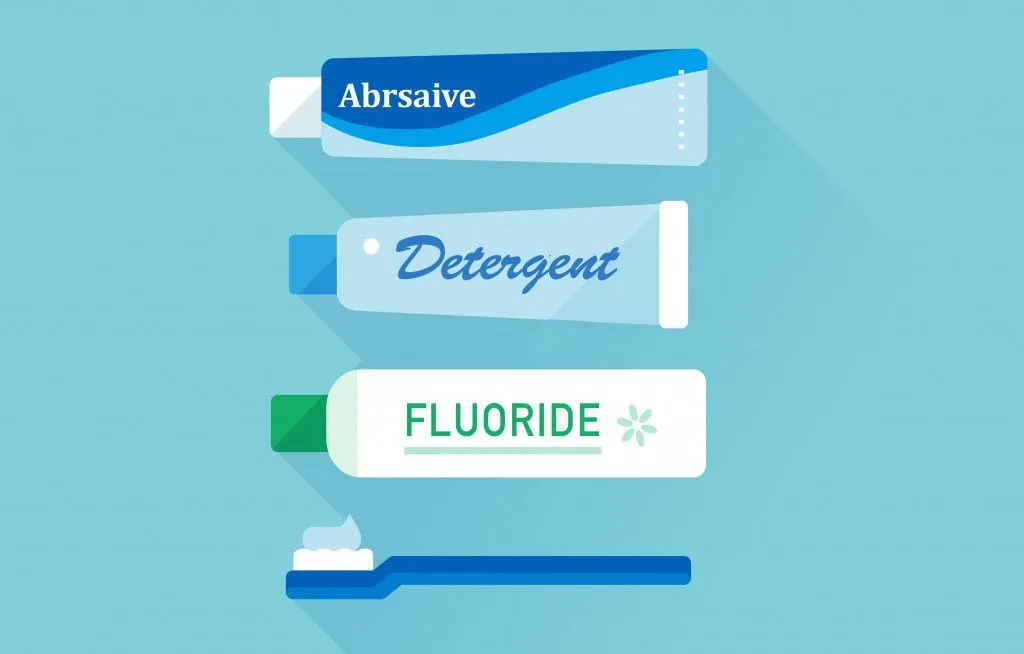
One ubiquitous ingredient is fluoride. This is included to prevent tooth decay by limiting the formation of tartar and plaque on teeth surfaces. Rather than simply killing off the bacteria in plaque, fluoride disrupts the acid-producing bacteria’s metabolism, slowing the acid attack that erodes enamel.
Fluoride compounds also play a big role in remineralizing tooth enamel, almost like replacing bricks in a brick wall of a sturdy structure. These compounds are usually sodium monofluorophosphate, sodium fluoride, and stannous fluoride.
Although fluorides are an essential anti-decay agent in today’s toothpastes, they do come with a caveat.
Fluoride was first added to toothpastes around 1914. Due to the lack of understanding around fluoride toxicity at the time, it took roughly four decades before the American Dental Association (ADA) accepted a fluoride toothpaste, finally recognizing Crest as effective at preventing decay in 1960. Due to the risk of fluorosis in young children who cannot spit out the toothpaste after brushing, or for patients with some sort of paraplegia, edible toothpaste without potentially harmful substances were formulated, but a study stated that while these edible toothpastes had an immediate impact on reducing harmful oral microorganisms, they had a minimal effect on reducing plaque and even favored the regrowth of plaque in the short term.
Besides fluoride, an abrasive agent is included to mechanically clean your teeth. Any tiny food bits stuck on your teeth will be scrubbed off with minute minerals like calcium carbonate, magnesium carbonate, or silica gel in the composition list.
To aid the abrasive agent is a soapy agent. Yes, detergents aren’t only a part of your dishwashing liquid. They make everything nice and slippery so that when you brush your teeth, debris falls right out. These are agents like sodium lauryl sulfate, and sodium lauryl sarcosinate.
Besides the cleaning chemicals, there are also some that make your toothpaste last for a long time on the shelf. There are humectants that prevent the toothpaste from drying out in the tube and a binding agent that keeps all the other chemicals in a nice gel form. Lastly, there’s the flavoring that gives toothpaste a pleasant taste, so we don’t mind using it twice a day!
There is a popular concern that the chemicals in toothpaste aren’t great for us, but there is significant evidence suggesting otherwise.
There is plenty of evidence that the various therapeutic agents and abrasives in toothpaste improve oral hygiene. For example, the fluoride present in toothpaste prevents cavities and also helps in the remineralization of enamel. For people who experience sensitivity to hot and cold while eating or drinking, a toothpaste containing 0.454% w/w stannous fluoride has been shown to reduce such sensitivity in the teeth. Antibacterial agents also help tackle gum problems and bad breath. For years that role was filled by triclosan, but after safety concerns the major brands voluntarily phased it out (Colgate Total, for example, was reformulated around 2019 to replace triclosan with stannous fluoride, which fights plaque and gingivitis on its own). These agents are absent in the water that we use for rinsing or in the mechanical action of cleaning achieved with the toothbrush alone, meaning that the use of toothpaste is imperative to achieve optimal oral health!
References (click to expand)
- Toothpastes - www.ada.org
- http://web.archive.org/web/20230126195338/https://www.adha.org/sites/default/files/7121_Colgate_Dentrifice.pdf
- Dentifrices: An overview from past to present. International Journal of Applied Dental Sciences.
- http://web.archive.org/web/20100110134007/http://www.scielo.br:80/scielo.php?script=sci_arttext
- Mason, S., Burnett, G. R., Patel, N., Patil, A., & Maclure, R. (2019, October 22). Impact of toothpaste on oral health-related quality of life in people with dentine hypersensitivity. BMC Oral Health. Springer Science and Business Media LLC.
- Stannous Fluoride in Toothpastes: A Review of Its Clinical Effects and Likely Mechanisms of Action. Journal of Functional Biomaterials. PMC.