Table of Contents (click to expand)
The Sun powers all of Earth's weather, and its roughly 11-year activity cycle (sunspots, solar wind, flares) nudges our climate up and down a little. But these solar swings are small: the Sun's output has shifted by only about 0.0 to 0.1 watts per square meter since 1750, far less than the warming from greenhouse gases. Human activity, not the Sun, drives today's rapid climate change.
One of the most important topics of debate all over the world is climate change. The discussions primarily center around human activities that are causing an increase in global temperatures, like burning fossil fuels and deforestation.
While these human-driven factors undoubtedly play a significant role in Earth’s changing climate, another player in this complex scenario is often overlooked: the Sun. Let’s dive into the intriguing relationship between events happening on the Sun and the climate changes unfolding on Earth.
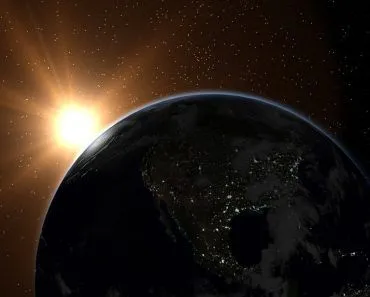
The Sun serves as the ultimate source of energy for our planet, emitting sunlight that furnishes us with both heat and light. This continual flow of solar energy renders life on Earth possible, yet the Sun’s stability is not always as unwavering as it may seem.
Sunspots
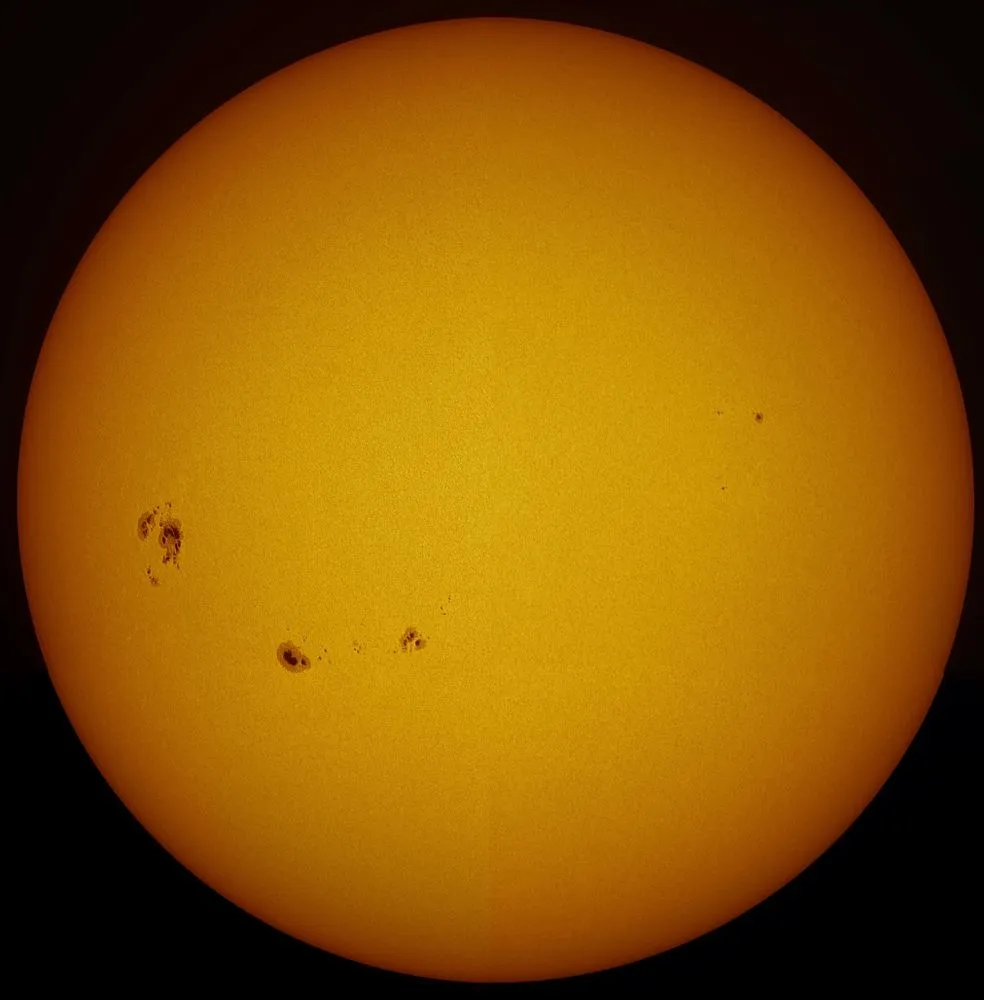
Sunspots are dark patches that appear on the photosphere, the visible surface of the Sun. They look dark because they are cooler than their surroundings, and they form where the Sun’s twisting, tangled magnetic field pokes through the surface. They are often planet-sized, and counting them is the simplest way to track how active the Sun is. Around 300 years ago, astronomers noticed that sunspots almost vanished for several decades, a stretch now called the Maunder Minimum (roughly 1645 to 1715). This quiet spell overlapped with the chilliest part of Europe’s “Little Ice Age,” and the dip in solar output is thought to have contributed to the cold, alongside a run of major volcanic eruptions. Sunspots are still a useful clue to Earth’s climate variability today.
The Solar Cycle
The Sun doesn’t shine with a perfectly steady intensity all the time. Instead, it goes through a cycle of waxing and waning that lasts about 11 years, known as the solar cycle. During periods of high solar activity (solar maximum), the Sun sprouts more sunspots and emits a touch more energy, while during the quiet stretches (solar minimum), it settles down. This rise and fall has a measurable effect on Earth’s upper atmosphere and a much smaller one on its climate. The strongest cycle on record was Cycle 19, which peaked in 1957 to 1958 at a smoothed sunspot number of about 201. That cycle ran from April 1954 to October 1964, and it brought a flurry of geomagnetic storms and radio communication blackouts. We are living through Cycle 25 right now: NASA and NOAA announced in October 2024 that the Sun had reached solar maximum, with sunspot counts hitting a 23-year high before the cycle begins its long slide back toward minimum.
Solar Activity And Earth’s Climate
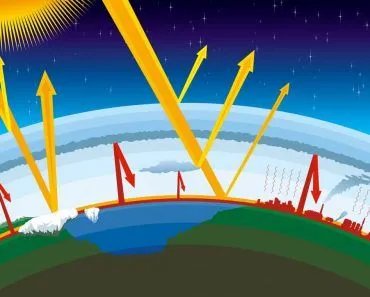
So, how exactly does the Sun’s activity influence climate change on Earth? While it’s not the primary driver of long-term climate change, it can make its presence felt. When the Sun is more active, it emits slightly more energy, leading to a warmer Earth. Conversely, during periods of reduced solar activity, our planet receives slightly less solar energy, which can result in cooler temperatures. These fluctuations are like disturbances that can vary Earth’s climate system over relatively short periods.
While the Sun’s influence on long-term climate change is quite subtle, it can have more immediate effects on day-to-day weather patterns. Solar variability, which includes changes in the Sun’s energy output and its magnetic field, can impact the Earth’s atmosphere and weather systems. You can compare it to the Sun occasionally stirring the pot of our atmospheric soup.
Solar Wind And Coronal Mass Ejections
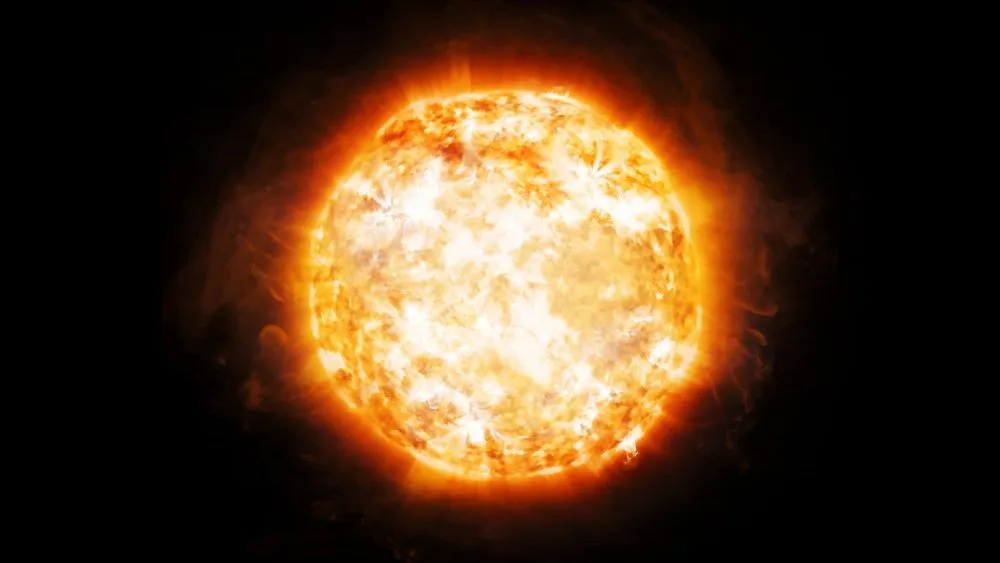
One way the Sun reaches out to us is through the solar wind, a stream of charged particles that the Sun constantly releases into space. This wind inflates a vast magnetic bubble around the whole solar system called the heliosphere. When solar activity is high, the wind and its tangled magnetic field strengthen, and the heliosphere does a better job of deflecting galactic cosmic rays, so fewer of them reach Earth.
Cosmic rays are extremely energetic particles, mostly protons, that originate far outside our Solar System. The heliosphere never blocks them completely. Plenty still make it through to Earth, but how many arrive rises and falls in step with the solar cycle: more cosmic rays at solar minimum, fewer at solar maximum.

Coronal mass ejections (CMEs) are enormous clouds of magnetic field and plasma that the Sun’s corona flings into space, often racing along far faster than the ordinary solar wind. As a CME plows outward, it drives a shockwave that accelerates protons to a large fraction of the speed of light. Those fast protons are what trigger the solar radiation storms felt near Earth.
CMEs rarely act alone. The same magnetic eruption usually sets off a solar flare at the same time, and flares can fling out their own bursts of energetic particles. When a CME slams into Earth’s magnetic field, it can also spark dazzling auroras, geomagnetic storms, and hazards for satellites and power grids, not just radiation storms.
Cloud Formation And The Weather
Now, here’s where the Sun’s role gets even more intriguing, and a lot more uncertain. One long-debated idea, first proposed by Danish physicist Henrik Svensmark, suggests that cosmic rays might nudge our climate by helping to form clouds. As cosmic rays slice through the atmosphere, they ionize the air and may help seed tiny clusters of molecules called aerosols, which can in turn act as the specks that water vapor condenses onto to make clouds.
Clouds are like nature’s thermostats. They can either cool the planet by reflecting sunlight back into space or warm it by trapping heat. So, in theory, more cosmic rays could mean more aerosols, more low clouds, and more sunlight bounced away, like nudging the thermostat down a notch. It’s a neat story, but the evidence is shaky. The CLOUD experiment at CERN has confirmed that cosmic rays can enhance aerosol formation in a lab chamber, yet it also found the effect is small and easily swamped by ordinary atmospheric processes. Most climate scientists conclude this cosmic-ray pathway plays, at most, a minor role in real-world climate, and it remains an open research question rather than a settled fact.
A Final Word
To sum it all up, while the Sun does play a role in climate change, it’s just one part of multiple potent factors. Human activities, like burning fossil fuels and deforestation, remain the primary drivers of modern climate change. However, understanding the Sun’s influence does help scientists refine climate models and improve our ability to predict future climate changes.
So, is climate change influenced by events happening on the Sun? The answer is yes, but with a clear asterisk. The Sun’s natural variations, such as the solar cycle and its possible tug on cosmic rays and cloud formation, can nudge Earth’s short-term climate. The catch is scale: the IPCC estimates that the change in the Sun’s energy reaching Earth since 1750 amounts to only about 0.0 to 0.1 watts per square meter, a tiny fraction of the heating added by the greenhouse gases we have pumped into the air.
However, the dominant force behind the rapid climate changes we are currently experiencing is undoubtedly human activity. While we can’t control the Sun, we can take action to control the effects of our own actions on the planet and work towards a more sustainable future for all.
References (click to expand)
- Coronal Mass Ejections - Space Weather Prediction Center.
- The Dawn of a New Solar Cycle. NASA Earth Observatory.
- What Is the Sun's Role in Climate Change? NASA Science.
- Joint Solar Maximum Announcement from NASA and NOAA. NOAA Space Weather Prediction Center.
- Maunder minimum. Encyclopaedia Britannica.
- CLOUD: studying the link between cosmic rays and clouds. CERN.