Table of Contents (click to expand)
Yes, there is lightning on other planets. It is firmly confirmed on Jupiter and Saturn, where NASA's Juno and Cassini missions recorded powerful flashes. Lightning is suspected but contested on Venus and Mars, and Voyager 2 picked up radio hints of it at Uranus and Neptune. Beyond Earth, alien lightning can be hundreds of times more powerful than our own.
One of my favorite things about planet Earth is the remarkable weather patterns that are continuously shifting and affecting life around the globe. Watching storms is a particular favorite; nothing feels better than watching a warm summer storm roll in over the horizon, with its streaks of lightning and the roaring crash of thunder. With such a complex atmospheric composition and unique climate and topographic features, our planet’s weather is extraordinary, so far as we know.
However, we know that other planets have atmospheres as well, so what does that mean for their weather? Are there hurricanes on Uranus? Floods on Venus? Massive lightning strikes on Saturn?
To get a handle on the wide variety of weather in our solar system, particularly lightning in its many forms, we need to understand the science behind lightning!
What Is Lightning?
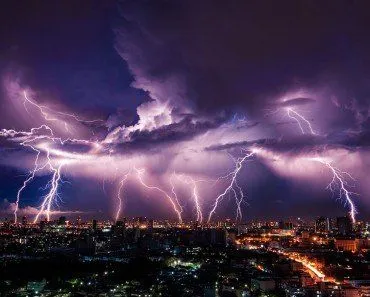
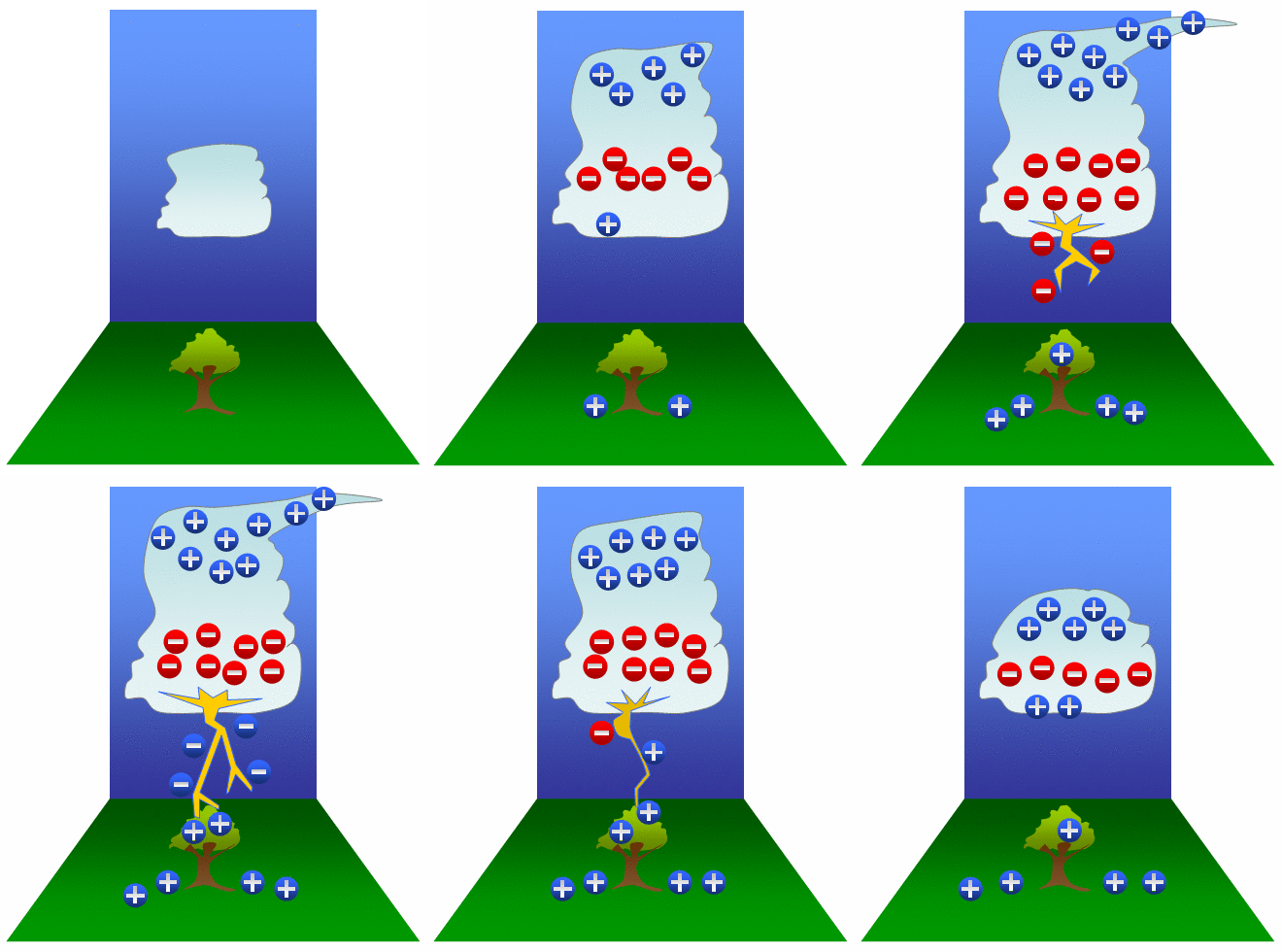
In general terms, a lightning strike is a powerful electrical discharge, typically of a very short duration, that results from opposing electrical buildups equalizing and then releasing the pent-up energy. In the context of a storm, a thundercloud will have an area of negative charge near its base, and a region of positive charge that rises to the top of the cloud and begins to spread out horizontally.
On Earth, lightning strikes occur between two different clouds, between a cloud and the ground, or within two regions of the same cloud. The main condition required for any sort of lightning discharge is a significant difference in electrical potential between two regions. In storm clouds, that difference is built up by collisions between supercooled water droplets and soft pellets of hail called graupel. As the charge continues to build, it will eventually discharge, overcoming the resistance of the air and electrifying the molecules along its path to the ground. Those molecules become plasma, giving us the brilliant visual flash of a lightning bolt. The accompanying thunderclap that nearly always follows a strike (except in the case of heat lightning) is actually a shockwave caused by the air experiencing an instantaneous rise in temperature and pressure.
Basically, lightning is a natural effect of dynamic, shifting atmospheric conditions, so logic would argue that other planets with changing atmospheres would similarly have storms, and lightning, right?
Absolutely!
Is There Lightning On Other Planets?
Now that you understand the climatic basis of lightning, it makes sense that there would be lightning on other planets, but it might look very different than it does on Earth! As it turns out, lightning is firmly confirmed on Jupiter and Saturn, strongly suspected (though hotly debated) on Venus and Mars, and hinted at on the distant ice giants Uranus and Neptune. Let's take a tour.
An interesting aspect of lightning on Earth we haven’t mentioned, and one that is very relevant to detecting lightning on other planets, is that it produces radio waves at a rather distinct frequency. These signals are known as whistler waves, and since photographing lightning on a distant planet is obviously challenging, having another way to confirm the existence of lightning is very helpful!
Mars
The red planet has fascinated human beings since we first saw it gleaming like a ruby in the sky. Most people know that the majority of Mars’ atmosphere has been stripped away, leaving it a barren wasteland, so hearing that there are storms and lightning on Mars may come as a surprise. The massive dust storms that blow across the Martian landscape may not be filled with moisture like storms on Earth, but they are instead filled with incredibly fine Martian soil.
Due to the low gravity and thin air, this fine soil can be picked up by even a light breeze and carried for hundreds of kilometers (hundreds of miles) before settling back to the surface. As the dust grains rub and collide, they swap electrons and build up static charge, a process called triboelectric charging, and that charge can eventually snap as a tiny discharge. For years this was only a strong suspicion backed by laboratory experiments. Then, in March 2026, NASA’s MAVEN orbiter reported the first direct evidence: a single lightning-generated “whistler” radio wave lasting about 0.4 seconds, picked out of more than 108,000 measurements, which tells you just how rare and elusive Martian sparks really are. NASA’s Perseverance rover has also recorded the crackle and mini sonic booms of electrical discharges inside passing dust devils. To be clear, no spacecraft has ever photographed a true lightning bolt on Mars, and these discharges are nothing like the dramatic forked bolts of an Earthly thunderstorm. They are closer to the faint static zap you get pulling off a sweater on a dry day.
Jupiter
If you’ve ever read anything about Jupiter, the largest planet in our solar system, then you know it is absolutely wracked with storms. Jupiter is a gas giant, so swirling, turbulent atmospheric conditions are exactly what you would expect. Its largest storm, the Great Red Spot (GRS), has been tracked by astronomers since the 1830s and could be roughly 200 years old (an older 1660s spot is thought to have faded, so the popular “350-year-old storm” claim is now in doubt). Once big enough to swallow two or three Earths, the GRS has been shrinking for over a century and is now only about the size of our planet. Jupiter’s lightning, meanwhile, is the most thoroughly studied beyond Earth. Voyager 1 caught the first radio “whistlers” in 1979, the Galileo and Cassini probes photographed flashes in the clouds, and NASA’s Juno orbiter (still circling Jupiter today) has confirmed that Jovian lightning is surprisingly Earth-like.
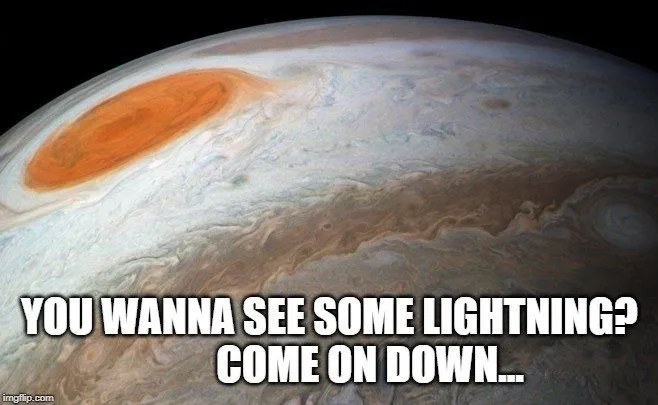
Individual Jovian flashes are quick, lasting only milliseconds just like ours, and Juno even found they pulse with a rhythm much like the in-cloud lightning that crackles inside Earth’s thunderheads. The power, though, is staggering: some of Jupiter’s strongest “superbolts” pack hundreds of times more energy than a typical strike on our planet. There is one striking difference in where the bolts fall. On Earth, lightning clusters around the warm Equator, but on Jupiter most of it strikes near the poles. The reason is that Jupiter sits about 25 times farther from the Sun than we do and is heated mainly from within, so its calm, sun-baked equator rarely brews storms while heat welling up at the poles drives violent convection.
Juno has also revealed that Jupiter’s lightning is genuinely alien in places. Some of it is “shallow lightning” crackling high in clouds of ammonia and water, far above the depth where bolts form on Earth. The same storms may even forge slushy ammonia-water hailstones nicknamed “mushballs” that rain down into the planet’s depths.
Venus
Venus is the solar system’s great lightning argument. Back in 1978, the Pioneer Venus orbiter picked up whistler-like radio signals, and for decades many scientists took these as evidence that Earth’s scorched twin (its surface sits at a lead-melting 462 °C, or 864 °F) was crackling with storms. Lately, though, the case has weakened. NASA’s Parker Solar Probe found no lightning signature when it swung past Venus, and Japan’s Akatsuki orbiter, watching with a dedicated lightning camera, saw essentially no optical flashes. Some researchers now argue the whistler waves come not from lightning at all but from disturbances in the planet’s wispy magnetic field. So if you are wondering whether Venus has lightning, the honest answer in 2026 is a firm “maybe.” It is the one planet where the experts genuinely disagree.
Saturn
Saturn is the other planet where lightning is beyond dispute. NASA’s Cassini spacecraft, which orbited the ringed giant from 2004 to 2017, both heard and saw it: its instruments recorded radio crackles from storms and, in 2009, captured the first video of lightning flashing on a world other than Earth. Saturn does not do anything by halves. During the Great White Spot storm of 2010–2011, a tempest that wrapped the entire planet, Cassini clocked flashes at more than ten per second, and individual Saturnian “megaflashes” are estimated to be on the order of a thousand times more powerful than a typical bolt on Earth.
Uranus And Neptune
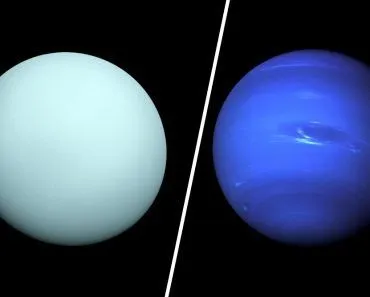
What about the distant ice giants? Only one spacecraft has ever visited them, Voyager 2, which flew past Uranus in 1986 and Neptune in 1989. At both worlds its instruments caught the radio fingerprints of lightning: clear bursts of static (called electrostatic discharges) at Uranus, and a handful of faint whistler waves at Neptune. The Neptune detections were sparse, so the evidence there is thinner than at Uranus, but the best reading of the data is that lightning flickers in the deep, frigid, methane-tinted clouds of both ice giants. We simply haven’t been back to take a closer look.
Weather On Other Planets
As you likely know, when it comes to ideal real estate in the solar system, Earth is definitely our best option. Yes, we have to deal with brutal winters, changing seasons, hurricanes and other natural disasters, but we should be grateful! We live in a veritable paradise compared to the other planets in the solar system. The two worlds closer to the Sun than we are, Mercury and Venus, are brutally hot. Mercury bakes to about 430 °C (800 °F) on its sunlit side, while Venus, smothered under a runaway greenhouse atmosphere, holds a steady 462 °C (864 °F) all over. Mars is a barren wasteland with almost no atmosphere to speak of, so survival there isn’t exactly “possible”. As you move further out, you arrive at the gas giants, where there isn’t even any solid ground to stand on! Finally, you reach the ice giants, where temperatures in the cloud tops plunge to roughly -200 °C (-330 °F) at Neptune.
Those extreme conditions make living there impossible (for now), but studying the weather on those other planets can give us critical data about our own climatic future. Earth has the most complex weather system in the solar system, thanks to our complex planetary composition, with its atmosphere, ice caps, seasonal variations, the impact of mankind, and so much more. Since we can only predict Earth’s future climate based on our past, it is helpful to see how other planets’ atmospheres have evolved or developed, potentially providing insight for our own planet’s weather destiny!
References (click to expand)
- Lightning Across the Solar System. NASA Science.
- Juno Solves 39-Year-Old Mystery of Jupiter Lightning. NASA Jet Propulsion Laboratory.
- “Shallow Lightning” and “Mushballs” Reveal Ammonia to NASA’s Juno Scientists. NASA.
- Flash: NASA’s Cassini Sees Lightning on Saturn. NASA Jet Propulsion Laboratory.
- Lightning-Generated Waves Detected at Mars. Science Advances (2026).
- Radio Detection of Uranian Lightning by Voyager 2. Nature.
- Atmospheric Electricity at the Ice Giants. Space Science Reviews.
- ‘Lightning’ on Venus May Not Be Lightning at All, Parker Solar Probe Finds. Space.com.
- How’s the Weather on Other Planets? NOAA SciJinks.
- Lightning. Wikipedia.