Table of Contents (click to expand)
Without greenhouse gases, Earth’s average surface temperature would fall from about 15°C (59°F) to roughly -18°C (0°F), a 33°C drop. Heat radiated by the surface would escape straight to space instead of being absorbed by water vapor, CO₂, methane and other infrared-active gases, freezing every ocean and leaving the planet uninhabitable for most life.
The sun has been worshipped since the beginning of civilization. After all, it is the source of all energy and life on Earth. The average annual solar energy received by Earth’s surface is 340 watts for every square meter of surface area. A joule is a unit of energy and one watt equals 1 joule per second. A joule is the energy used to lift a small fruit, like an apple. A Watt refers to rate at which this energy is used. For example, lifting 10 apples in one second would be equal to using 10 watts of energy.
In contrast, the average geothermal heat flux from the Earth’s interior is negligible, at roughly 0.09 W/m² (about 4,000 times smaller). This makes the Sun the sole powerhouse of all climate systems on Earth.
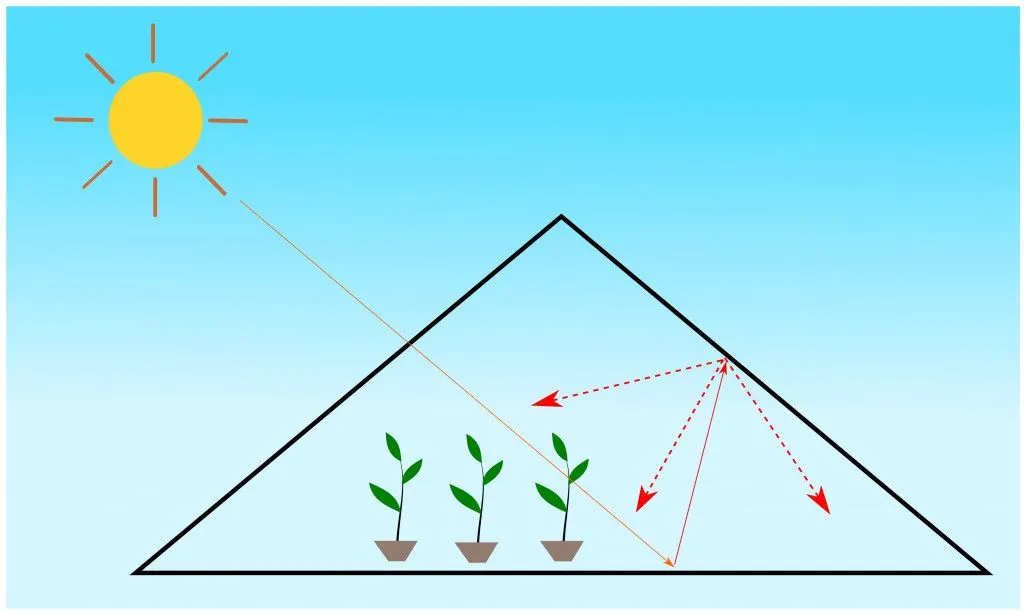
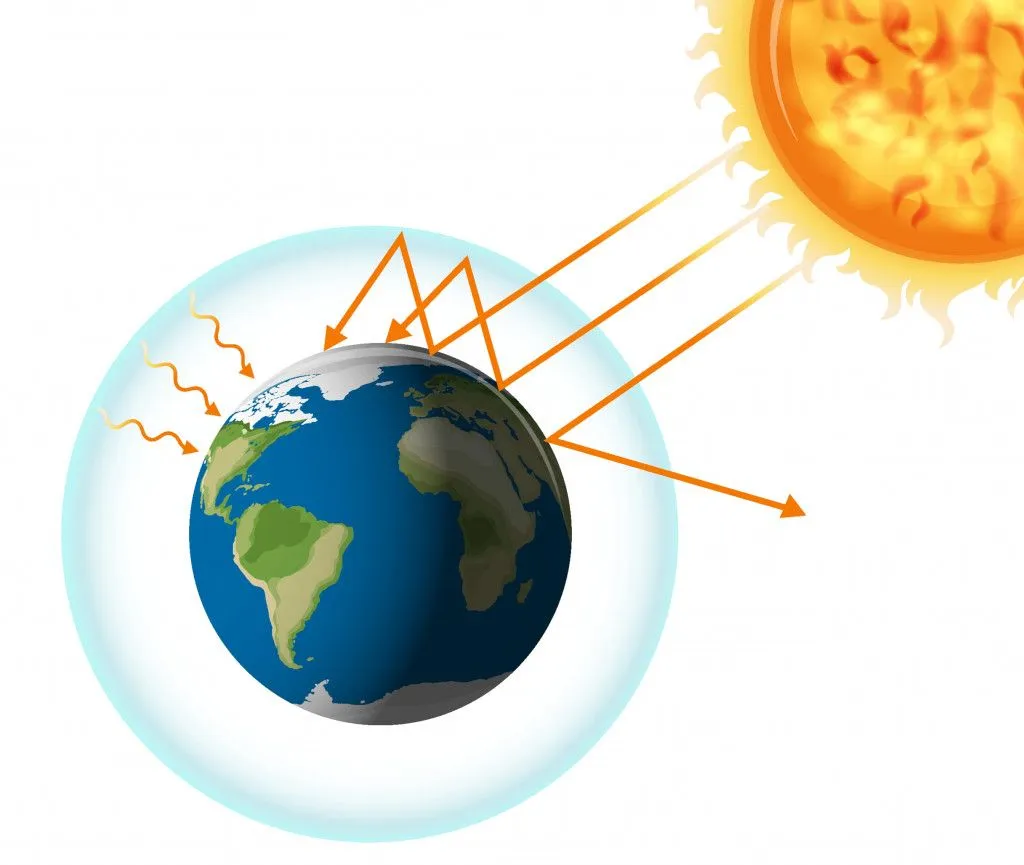
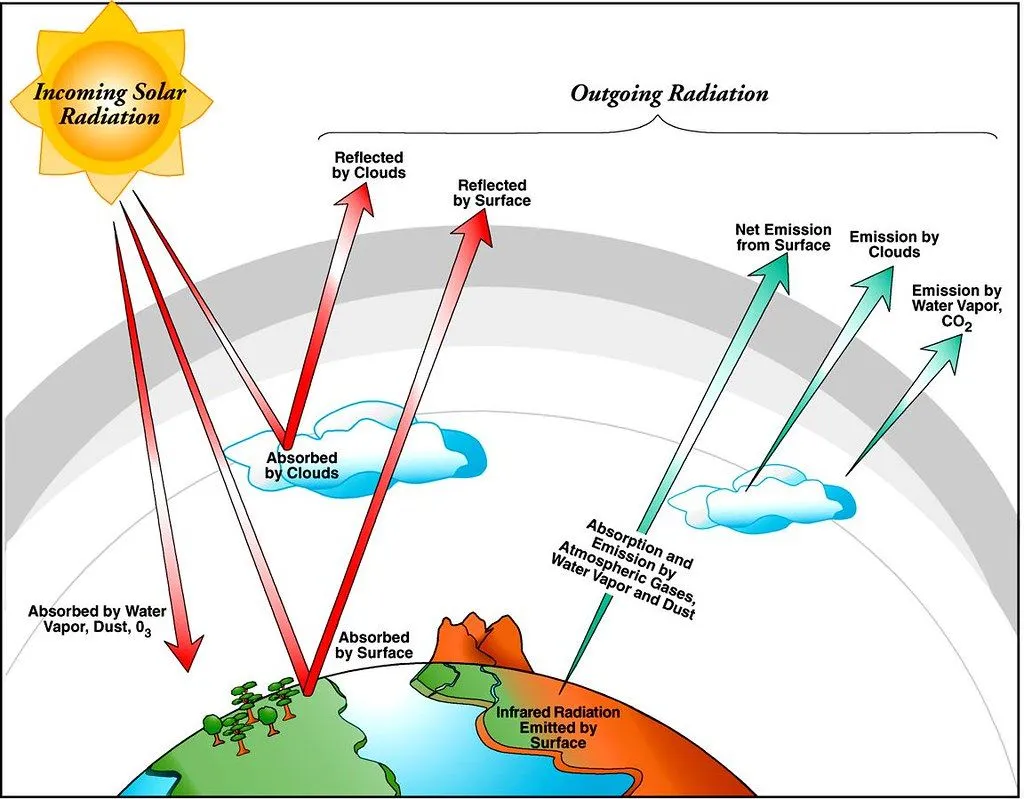
Most of the sunlight that reaches the surface is absorbed by land and ocean and then re-emitted upward as longer-wavelength infrared radiation (heat). That outgoing infrared is what greenhouse gases intercept: they absorb it, then re-radiate part of it back down toward the surface. Without these gases, almost all of the heat the Earth radiates would escape straight to space, and the globe would freeze over.
The main greenhouse gases doing this work are water vapor (by far the largest contributor), carbon dioxide, methane, nitrous oxide and ozone.
What Is The Greenhouse Effect?
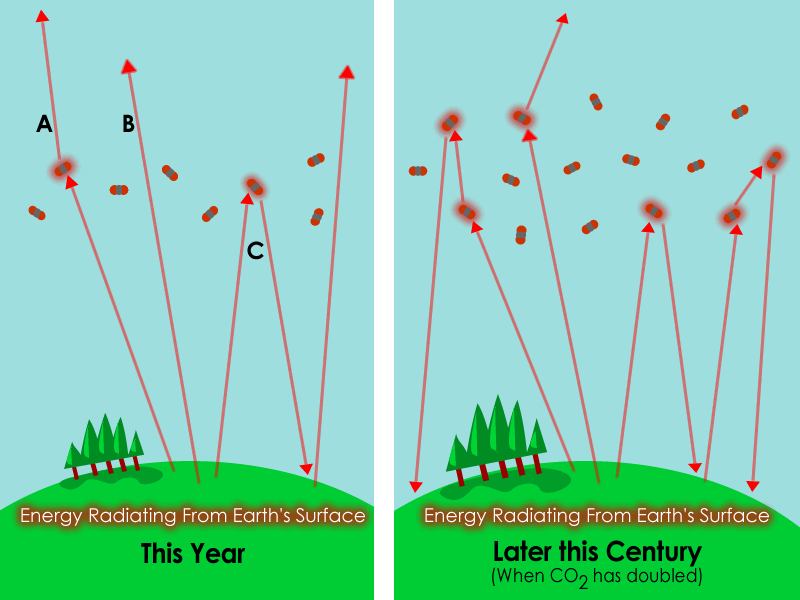
Greenhouse gases absorb energy from both the Sun and the Earth’s surface and emit it in all directions as infrared energy, including downward to the surface. They function similarly to a greenhouse’s glass, as they permit light to pass through, while retaining heat in the air. The greenhouse effect results from this heat being trapped, thus elevating the temperature at the earth’s surface.
How Does The Greenhouse Effect Affect The Planet?
Averaged over daily and seasonal cycles, the global mean surface temperature is roughly constant. That means Earth, as a whole, must shed energy to space at the same rate it absorbs it from the Sun, about 240 W/m² once you subtract what the atmosphere and surface reflect away. If outgoing energy fell short, the surface would warm; if it ran ahead, the surface would cool.
The Earth maintains an equilibrium among incoming and departing radiant energy called radiation equilibrium. The amount of solar radiation reflected by a planet depends on its albedo.
A perfectly black planet would absorb every photon of sunlight it received, while a perfectly white one would reflect everything. To read more about how a brighter, icier Earth could amplify its own cooling through the albedo feedback effect, see our piece on whether the Earth was ever a giant snowball. As a black body heats up, the power it radiates rises sharply (it scales with the fourth power of temperature, the Stefan-Boltzmann law). Left in sunlight, it warms until it emits exactly as much energy as it absorbs.
For a “gray body” like the Moon, the same rule holds, but the reflected energy must be taken out of the radiation balance. Day and night cycles must also be taken into consideration for spinning planets like the Moon and Earth. The Moon’s equator bakes to about 127°C (260°F) at lunar noon, then plunges to roughly -173°C (-280°F) by the end of the two-week-long lunar night. Who would even think of living there?
The Earth revolves considerably quicker than the Moon (once daily, instead of once per month), which balances out temperature differences between day and night. Because of Earth’s blue seas, white clouds, and polar ice, its albedo is around 29 percent. If our atmosphere did not include greenhouse gases, the average surface temperature needed to balance the absorbed solar energy would be around -18°C (0°F), the figure NASA cites for Earth’s effective radiating temperature.
This is well below the freezing point of water, so every ocean and lake would lock up in ice, the surface would brighten with that ice and reflect even more sunlight, and the planet would settle into a deep-frozen state. Instead, the actual global average surface temperature is about 15°C (59°F). Greenhouse gases handle that 33°C gap between an airless rock and a livable world.
How Does Earth Balance Incoming And Outgoing Solar Radiation?
The solar energy that is not reflected is absorbed by the Earth’s surface. To establish radiation balance, Earth radiates the same amount of energy as infrared energy back into space. Because of the heat captured by greenhouse gases, the quantity of energy transferred away from the Earth’s surface is much greater than the amount received as direct solar radiation.
The surplus is the energy emitted by greenhouse gases as infrared radiation towards Earth. This “back radiation” is responsible for the Earth’s surface being 33 degrees Celsius hotter than it would be without greenhouse gases.
How Do Greenhouse Gases Absorb Heat?
Greenhouse gases trap heat because of their molecular geometry. Unlike nitrogen and oxygen, whose simple two-atom molecules are essentially invisible to infrared light, gases like water vapor, CO₂ and methane have three or more atoms arranged so that the bonds between them can bend and stretch at frequencies matching infrared radiation. When an outgoing infrared photon hits one of these molecules, it gets absorbed, the molecule vibrates, and that energy is then re-radiated in all directions, including back down to the surface. Other greenhouse gas molecules in the air can absorb that re-radiated infrared in turn, passing it around like a slow-moving relay that keeps the lower atmosphere warm.
Interestingly, greenhouse gases do not absorb every photon that passes through their routes. Instead, they mostly absorb photons escaping the Earth towards space.
Which Gases Are Not Greenhouse Gases?
Here is the surprising part: the gases that make up almost the entire atmosphere play no part in the greenhouse effect at all. Dry air is roughly 78 percent nitrogen, 21 percent oxygen and just under 1 percent argon. Together those three account for more than 99 percent of every breath you take, yet not one of them is a greenhouse gas.

The reason comes down to molecular shape. Nitrogen and oxygen each travel as a pair of identical atoms (N2 and O2), and that perfect symmetry means the molecule’s electric charge does not shift as its bond stretches or bends. Infrared radiation can only be absorbed by a molecule whose charge distribution changes as it vibrates, so these symmetric pairs are essentially invisible to the outgoing heat. Argon is even simpler: it drifts through the air as a single atom with no bond to flex, which leaves it completely transparent to infrared.
The heavy lifting is left to the trace gases. Water vapor, carbon dioxide, methane, nitrous oxide and ozone are all measured in fractions of a percent or even parts per million, but their bent and lopsided molecules do change shape in ways that soak up infrared. It is a striking reminder that in climate, abundance and influence are two very different things: the gases we rarely think about are the ones keeping the planet warm.
Could Life Survive On Earth Without Greenhouse Gases?
For life as we know it, the honest answer is no, at least not on the surface. Every living thing on Earth depends on liquid water, and an average surface temperature of -18°C (0°F) sits well below freezing. Strip out the greenhouse gases and the oceans, lakes and rivers would turn to ice, cutting off the one ingredient every known organism needs.

That -18°C figure is actually the optimistic version. As ice spread across the seas, the bright white surface would bounce far more sunlight back to space than dark water does, so the planet would absorb even less warmth and cool further still. That runaway chill is exactly the feedback that can tip a world into a globally frozen “snowball” state. Photosynthesis, the base of nearly every food chain, would collapse without open water and reliable sunlight, and the ecosystems built on top of it would follow.
Would anything hang on? Possibly, in the most sheltered corners. Heat leaking up from Earth’s interior could keep pockets of water liquid deep underground, where hardy microbes might cling on much as they do around today’s undersea vents. But the green, teeming, breathable world at the surface, the one that grew us, simply could not exist. Far from being the villain of the climate story, greenhouse gases are the thin thermal blanket that makes Earth livable in the first place.
Conclusion
Several greenhouse gases remain in the environment for hundreds of years after they are emitted. This results in long-term warming impacts on the climate that will impact both current and future generations.
With all of the international discussion surrounding the alarming rate of climate change and global warming, we might be quick to label greenhouse gases as the evil culprit. However, it is important to realize that greenhouse gases are the reason for the existence of life on Earth.
What is concerning is the rate at which these gases are being added to the air, owing to anthropogenic activities. It would not be wrong to say that the Earth could not be the way it is without greenhouse gases, but if we continue adding more to the atmosphere, and if the temperature keeps rising, the planet might become unlivable for countless species, humans included.
References (click to expand)
- The Greenhouse Effect - UCAR Center for Science Education. The University Corporation for Atmospheric Research
- How do greenhouse gases trap heat in the atmosphere?. climate.mit.edu
- Grotzinger J.,& Jordan T. H. (2014). Understanding Earth: Seventh Edition. Macmillan Learning
- What is the greenhouse effect? NASA Science
- Ask the Experts: Why is carbon dioxide a greenhouse gas? Scientific American
- Earth Temperature without GHGs. Energy Education, University of Calgary