Table of Contents (click to expand)
No. Earth is, of course, not flat (it's an oblate spheroid), but even in the hypothetical case of a flat-disc Earth, you wouldn't fall off the edge into space. Gravity always points toward the centre of mass, which on a disc is the middle of the disc. As you walked toward the rim, gravity would tilt sideways and walking would feel like a steep uphill climb. Step over the edge and you'd simply find yourself on the underside, with gravity again pulling you "down" toward the centre.
Right from the time when we, as children, begin to understand the most basic things in life, science pops up in one form or another to make us more confused (and fascinated!) by the world and everything in it. As ‘sensible’ adults, we accept many things as they are without asking questions, but for kids, everything they come across and observe is novel. Therefore, so are the queries that you, as their elders, have so much trouble explaining.
Talking about the ‘most commonly accepted things’ in nature, one of the first things that comes to mind is that Earth is round. We believe it, despite the fact that when we look around, we don’t see people standing at impossible angles, holding onto something to avoid getting thrown into the void of space, or tumbling end over end. If we did see that, then it would provide us with visually convincing, daily-life proof of the rotundity of Earth.
Come to think of it, what would happen if the Earth were a flat disk instead of the slightly squashed sphere (an oblate spheroid) it actually is? What would life be like? And if you ever happened to stroll to the edge, would you fall off into space?
Earth: Round Or Flat?
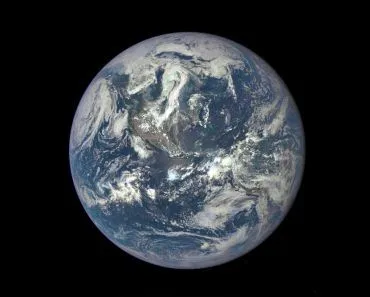
The debate of whether Earth is round or flat went on for centuries, and while the vast majority of people agree that the Earth isn’t flat, there is still some debate about the shape, namely, whether the planet is a perfect sphere or something else. The current and most popular theory is that Earth’s shape is very close to a perfect sphere, with some slight deformation. The exact technical name of the shape that fits Earth’s shape the best is ‘Oblate Spheroid’ (for more information, check out Is Earth a Perfect Sphere?)
What If Earth Were Flat?
If Earth were flat, like a disc, people living near the center of the disc would not feel anything out of the ordinary. Their architectural structures would be normal, and people wouldn’t have to over-exert themselves when doing basic tasks that involved motion, such as walking, jogging, etc.
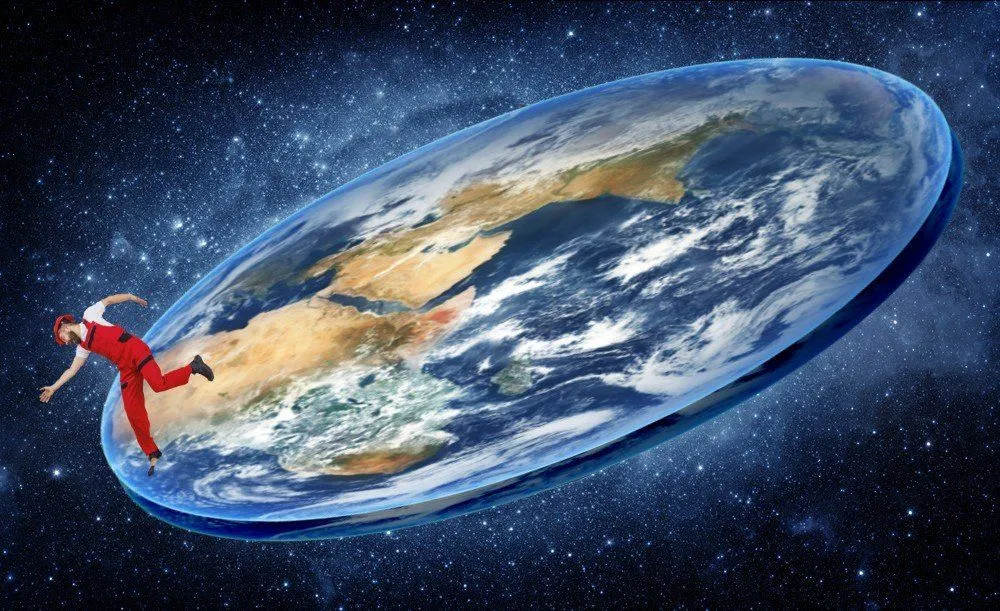
However, things would change as you moved away from the center, i.e., towards the edge of the disc. Gravity would skew slightly, and as you continued to move away from the center, you would be pulled at a greater and greater angle towards the center. Buildings and other architectural structures far from the center would not appear as they do to us now; instead, they would be oriented in such a way that their bases would align with the center of the disc. For better clarity on this, take a look at this picture.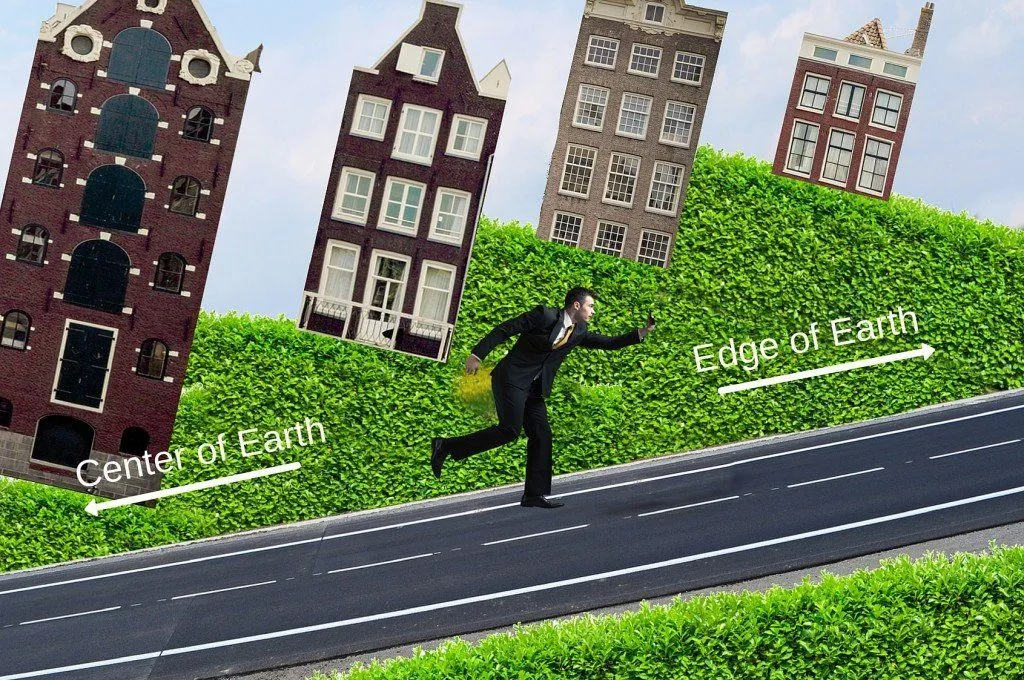
If you were to go jogging, you would feel more and more exhausted as you jogged towards the edge, because by doing that, you would essentially be distancing yourself more and more from the center of the disc. As you move towards the edge Earth’s gravity would skew towards the center, pushing you more and more towards it, hence the exertion. Think of how winded up you feel after walking or running uphill; it’ll be similar to that.
Now, coming back to the question posed in the title of this article; would you fall off once you’ve (after a lot of exertion!) reached the edge and chosen to continue your jog?
Absolutely not! In fact, you’d be pleased once you reached the edge, because as soon as you stepped over the edge, you’d reach the face of the disc that’s oriented in a way to make you feel exactly as you normally do on a spherical Earth.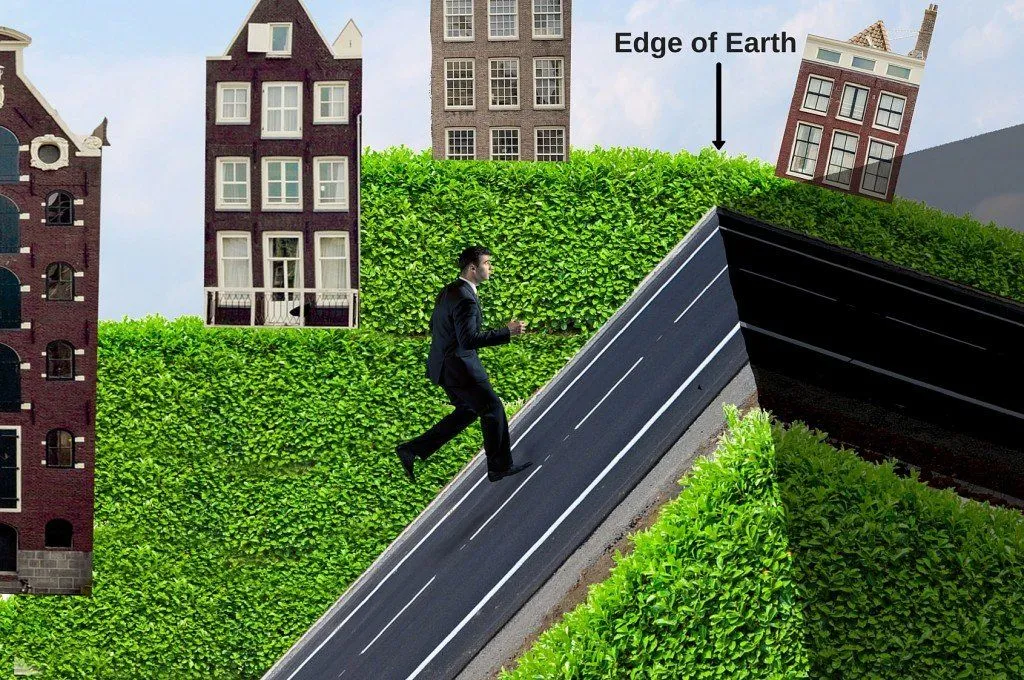
Jogging on that surface would be much more comfortable, especially after all that exertion! Furthermore, you wouldn’t fall off into space, as gravity would still continue to ‘ground you’.
Since this is a purely hypothetical scenario that requires a lot of abstract visualization on your part, make sure to check out this VSauce video. This will help you gain a more comprehensive understanding, with the help of the cool simulation of a man jogging towards the edge of a flat Earth.
If Earth Is Round, Why Don't We Fall Off It?
Here's the question that has nagged almost every curious kid (and plenty of grown-ups too): if Earth is a ball spinning through space, why don't the people on the ‘bottom’ simply drop off into the void? It feels like the folks in Australia ought to be hanging upside down, clinging on for dear life. The reason they aren't comes down to one word, gravity, and specifically the direction in which it pulls.

As NASA puts it, gravity is the force by which a planet draws objects toward its center. That last word is the whole trick. There is no fixed, universal ‘down’ floating out in space that everyone shares. Instead, ‘down’ simply means ‘toward the center of the Earth’, and that direction is different depending on where you are standing. For you, down points one way; for someone on the exact opposite side of the planet, down points the other way. Both of you are being pulled toward the same spot in the middle, so both of you stay firmly planted on the ground, no clinging required.
Why is that pull so reliable? Because there is an enormous amount of Earth doing the pulling. Our planet's mass is roughly 6 × 1024 kg (about 1.3 × 1025 lb), and every bit of it tugs on every bit of you. That's why you never notice the spin and never slide toward any ‘edge’: no matter which patch of the globe you walk to, gravity keeps pointing toward the center and quietly holds you down. The same logic, by the way, is why a planet ends up shaped like a sphere in the first place, since gravity pulls its material inward evenly from every side.
Why Doesn't The Earth Itself Fall In Space?
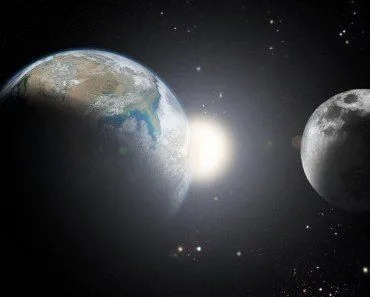
Fine, gravity keeps us stuck to the Earth. But then a sneakier question pops up: what is holding the Earth up? If gravity always pulls things toward a center of mass, and the Sun is a vastly more massive object sitting nearby, why doesn't our planet simply plummet straight into it?
The surprising answer is that the Earth is falling toward the Sun, constantly, and has been for billions of years. It just never arrives. The planet is also racing sideways at tremendous speed, so as it falls toward the Sun, it keeps overshooting and ‘missing’. Combine a steady inward pull with enough sideways motion and you don't get a crash, you get an orbit. An orbit is really just falling forever in a giant loop.

Isaac Newton illustrated this beautifully with a thought experiment about a cannon on a mountaintop. Fire the cannonball gently and it arcs down and hits the ground nearby. Fire it faster and it lands farther away. Fire it fast enough, though, and the ground curves away beneath it just as quickly as the ball falls, so it never lands at all. It circles the whole planet instead. That is exactly what satellites do: a low-orbiting weather satellite like NOAA's has to travel around 27,000 km/h (about 17,000 mph) to keep ‘falling and missing’, while one parked far higher up, roughly 36,000 km (22,000 mi), needs only about 10,800 km/h (6,700 mph). The Moon does the very same dance around us, and the Earth does it around the Sun.
So nothing is ‘holding up’ the Earth the way a shelf holds a book. There is no shelf. Our planet is in permanent free fall, looping around the Sun simply because it has exactly the right sideways speed. The same principle explains why things in space don't just drift off into the void. Take that speed away and yes, the Earth really would fall straight into the Sun, but it isn't going to slow down anytime soon.
References (click to expand)
- The Flat Earth. - www.lhup.edu:80
- The Flat Earth - SMU Physics. Southern Methodist University
- What If The Earth Were Flat? (Vsauce / Michael Stevens, YouTube)
- Oblate spheroid (Encyclopaedia Britannica)
- What Is Gravity? (NASA Space Place)
- Falling Toward Earth (Smithsonian National Air and Space Museum)
- Why Don't Satellites Fall out of the Sky? (NOAA NESDIS)
- Why Doesn't the Earth Fall Down? (West Texas A&M University)
- Newton's Cannonball (Wikipedia)