Carbon dioxide (CO2) is nonpolar. Although it has polar C=O bonds, its linear 180-degree geometry causes the bond dipoles to cancel out, giving it a net dipole moment of zero. of valence electrons; since there’s no unequal sharing of valence electrons in the case of carbon dioxide, it is nonpolar.
However, before we get to the bottom of this, it helps to first understand a few underlying concepts regarding the polarity of a molecule.
What Is Polarity?
Molecules that have regions of positive and negative charge are referred to as ‘polar’, and this property of such molecules is called polarity.
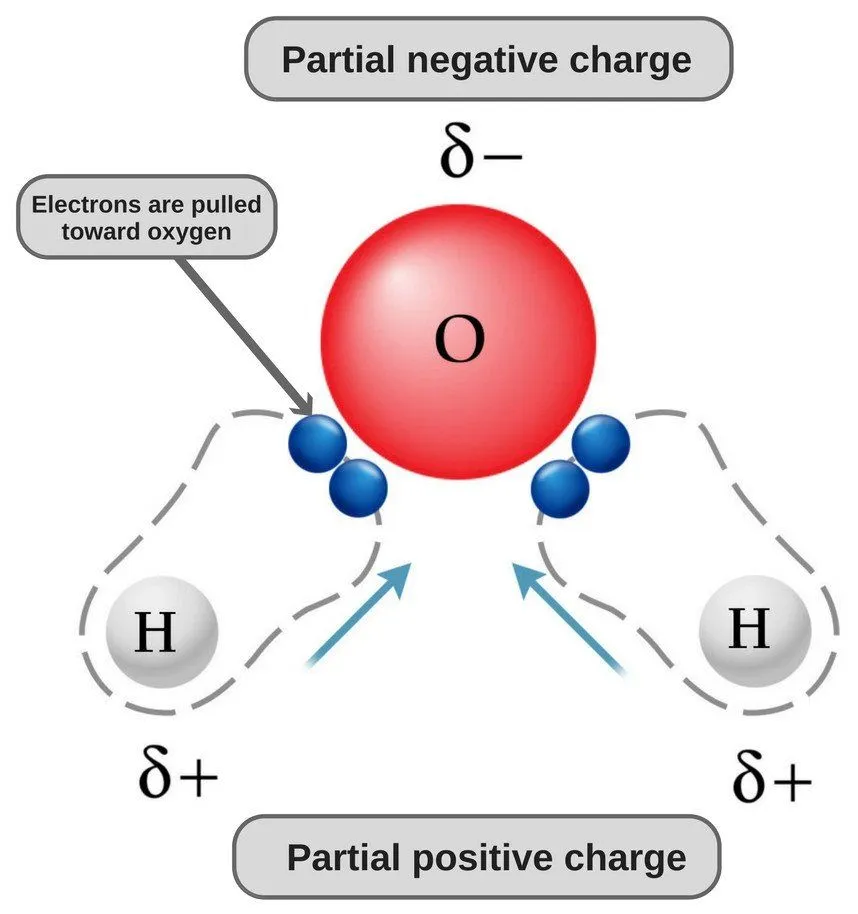
Take water, for instance. Due to its bent structure and the type of bonds it has, one end of its molecule (i.e. the oxygen end) possess a slight negative charge, while the other end possesses a slight positive charge (i.e., the hydrogen end). This makes water a polar molecule.
 Similarly, molecules that do not have regions of positive and negative charge are referred to as nonpolar. Ethane, for example, is a nonpolar molecule. The shape that it has and the type of bonds it consists of leave it with no regions of charge.
There’s a notion in chemistry that says ‘likes dissolves likes’; this is actually a reference to a substance’s solubility in another. Polar materials tend to be more soluble in polar solvents, and the same is true for nonpolar materials.
What Makes A Molecule Polar?
The polarity of a molecule is related to the shifting of electrons in a particular direction. This, in turn, depends on the polarity of the bonds present in the molecule, as these bonds also contain electrons.
The bond between two atoms is said to be polar if both atoms are different, because if both atoms are the same, then the nuclei of both these atoms will hold on to their electrons and consequently, these electrons won’t be able to shift in any direction. On the other hand, if the two atoms are different, they will definitely have dissimilar powers to attract the electrons of the bond.
Hence, the atom with the higher power to attract electrons towards itself (i.e. it’s more electronegative than the other atom), will acquire a slight negative charge on itself, and the bond between the two atoms will become polar.
All in all, you could say that the electron density of a polar bond accumulates towards one end of the bond, which results in that end possessing a slight negative charge, while the other end has a slight positive charge. This makes a molecule polar. Likewise, if a molecule does not have regions of positive and negative charge, it’s considered nonpolar.
However, an interesting thing to note is that the larger the electronegativity difference, the more polar the bond will be within a molecule. Carbonyl compounds are polar because the carbonyl carbon is slightly positive. So, shouldn’t carbon dioxide, which contains a positive carbon and two partially negative oxygens, be polar?
Why Is Carbon Dioxide Nonpolar?
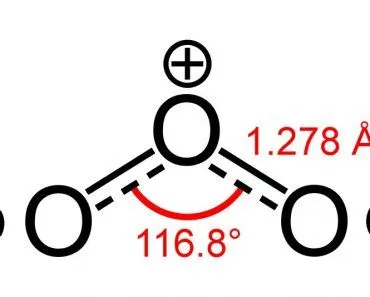
If a molecule consists of more than one bond, then the combined effect of all these bonds must be considered. Let’s look at the structure of carbon dioxide:
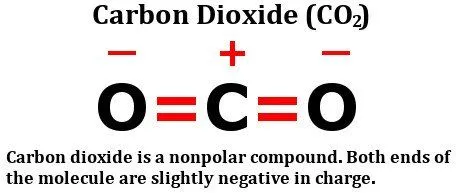
As you can clearly see, the molecule has a carbon atom sharing two double bonds with oxygen. Sure enough, oxygen is more electronegative than carbon (3.44 vs 2.55 on the Pauling scale), so one might think that the electrons present in the bond between carbon and oxygen would be pulled towards the oxygen atom.
However, that doesn’t really happen. The reason lies in the geometry of the molecule. As you can see, both of these double bonds are at 180 degrees from the central carbon atom. Therefore, as the oxygen atom on the right tries to pull the electron density from the carbon over itself, the (other) oxygen atom, i.e., the one on the left, pulls the electron density over itself with equal force.
The result is that there is no net shifting of electrons in any direction, so there is no build up of net charges on any of the atoms, making the carbon dioxide molecule nonpolar.
What Is The Shape Of A CO2 Molecule?
Everything about CO2's polarity comes back to one thing: its shape. Carbon dioxide is a linear molecule. The central carbon atom sits in the middle, flanked by an oxygen atom on each side, and the whole thing lies in a perfectly straight line with an O=C=O bond angle of 180 degrees.

Why linear and not bent like water? The answer is VSEPR theory, which says that the groups of electrons around a central atom spread out as far from each other as possible. In CO2, the carbon forms two double bonds, and in this model a double bond counts as a single group of electrons. Carbon also has no lone pairs left over. So there are just two electron groups to arrange, and the way to push them as far apart as possible is to place them on opposite sides, 180 degrees from one another. That gives the linear shape. (Carbon here is described as sp hybridized, which is the orbital picture that goes hand in hand with a linear, two-group geometry.)
Water, by contrast, has two lone pairs on its oxygen that take up space and squeeze the molecule into a bent shape. That difference in shape is exactly why CO2 ends up nonpolar while water ends up polar, even though both contain polar bonds.
What Type Of Bond Does CO2 Have?
The bonds inside carbon dioxide are polar covalent bonds. Carbon shares two pairs of electrons with each oxygen, so each C–O link is a double covalent bond. They are covalent because carbon and oxygen share electrons rather than handing them over completely, which is what happens in an ionic bond such as the one in table salt.

And they are polar because the two atoms are not equally greedy for the shared electrons. Oxygen pulls harder than carbon (3.44 versus 2.55 on the Pauling electronegativity scale, a difference of about 0.9), so within each bond the electron density leans toward oxygen. This is the part that trips people up: CO2 genuinely does contain polar bonds, two of them, in fact. It is only the symmetry of the linear molecule that lets those two polar bonds cancel each other out, leaving the molecule nonpolar overall.
Does Carbon Dioxide Have A Charge?
A common follow-up question is whether CO2 carries a charge. The short answer is that as a whole molecule, carbon dioxide is electrically neutral. It has no net charge and no overall formal charge. That is different from an ion like carbonate (CO32−) or bicarbonate (HCO3−), which do carry a real, full charge.
What CO2 does have are partial charges. Because each oxygen tugs the bonding electrons toward itself, the carbon ends up slightly electron-poor (a small positive, written δ+) and each oxygen ends up slightly electron-rich (a small negative, δ−). These tiny partial charges are why people sometimes ask whether the carbon in CO2 is "positive" or "negative". The carbon is the partially positive end and the oxygens are the partially negative ends, but the pluses and minuses are balanced and symmetric, so they add up to zero. The molecule has no leftover charge to pass around.
Does CO2 Have A Dipole Moment, And How Does It Dissolve In Water?
A dipole moment measures the overall separation of positive and negative charge across a whole molecule. For carbon dioxide, that overall value is zero. Each C=O bond has its own bond dipole, but because the molecule is linear, the two dipoles point in exactly opposite directions and are equal in size. Add them together as vectors and they cancel, so CO2 has no net molecular dipole.
That has a practical consequence for how CO2 molecules stick to one another. With no permanent dipole, there are no dipole-dipole attractions between CO2 molecules. The only forces holding them together are London dispersion forces, the weak, fleeting attractions that arise when electron clouds momentarily slosh to one side. These weak forces are part of why CO2 is a gas at room temperature rather than a liquid.
So how does a nonpolar gas dissolve in polar water at all? It seems to break the "likes dissolves likes" rule. The trick is that CO2 does not simply sit there as nonpolar molecules; a small fraction of it actually reacts with water, combining to form carbonic acid (H2CO3): CO2 + H2O ⇋ H2CO3. That reaction, alongside the slight solubility of the loosely hydrated gas itself, is what puts the fizz in soda water and is the same chemistry behind the gradual acidification of the oceans.
References (click to expand)
- Biology Topics | Principles of Chemical Science | Chemistry. MIT OpenCourseWare
- Main Experiment Menu - Harper College. William Rainey Harper College
- Molecular Polarity - chemistry.bd.psu.edu:80
- Molecular Polarity. The University of Wisconsin–Madison
- The Polarity of Molecules - archives.library.illinois.edu
- VSEPR Model - Chemistry LibreTexts
- Molecular Shape and Polarity - Chemistry LibreTexts
- The Chemistry of CO2. Purdue University Department of Chemistry