Table of Contents (click to expand)
Yes. Free antimatter is vanishingly rare in the universe, yet every proton hides plenty of it. Inside a proton, a churning "sea" of quark-antiquark pairs constantly pops in and out of existence. So the very matter we are made of carries antimatter within it, even though that antimatter never escapes.
At some point, all of us have digested some matter-antimatter facts and fiction. For example, there is the fact that we are made of matter; the soil, the plants, the Sun, the planets, and everything else that we see is made of matter.
There is also the fact that antimatter is exactly like matter, but with opposite charges, and their collision can release a large amount of energy.
We also know that antimatter is not found very freely anywhere in the known universe. In fact, 99% of the visible universe is made of matter! Note that I said visible because we don’t yet know what dark matter is made of!
Now, what is less widely known is that matter and antimatter don’t necessarily have to come together and destroy each other. Strangely, their combination can actually produce matter!
An excellent example of this is the pion. A pion is a subatomic particle made of a quark and an antiquark (its antiparticle). And did you notice that I said subatomic?
Yes, these particles are found inside our atoms, specifically inside the nucleus, where they are constantly exchanged between protons and neutrons like ping-pong balls. That exchange is, in fact, what holds the nucleus together.
However, are pions the only matter particles made of antimatter? What about the neutrons and protons, which are responsible for the largest portion of visible matter in the universe?
For that, we might have to gear up and dive into the Proton Sea to find out!
What Is The Proton Sea?
In high school, we were told that a proton is a minuscule sphere with a positive electric charge. When we graduate to higher classes, we are told that the proton is actually made of three smaller particles, called quarks, with fractional electric charges that add up to a total of one positive charge.
That doesn’t mean what we were told in high school was incorrect, just incomplete.
In the same way, the three-particle picture of protons is incomplete.
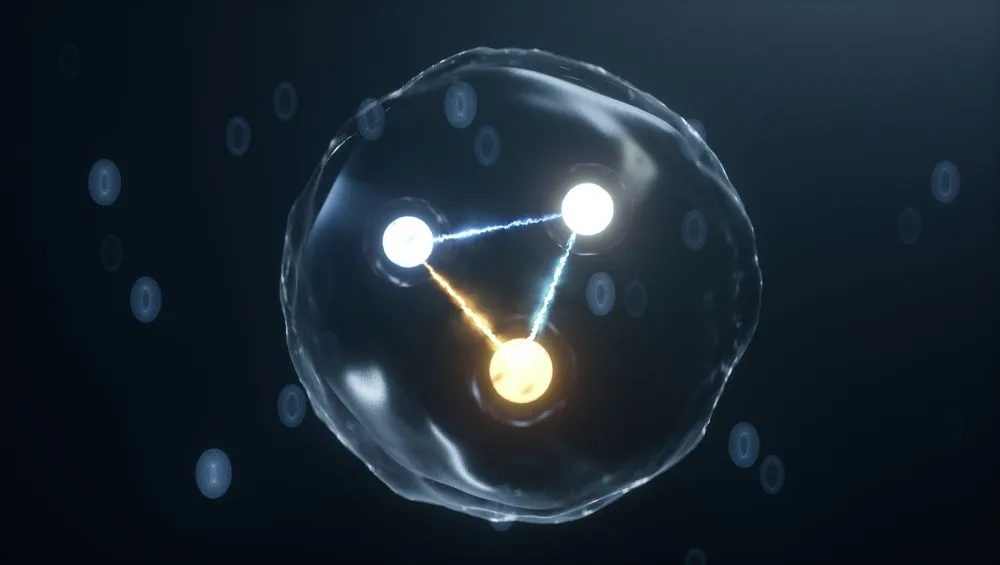
The fact is that protons are some of the most complicated and complex particles we have ever tried to understand.
A proton is actually made of a large number of particles called quarks and gluons, not just three quarks like we were taught.
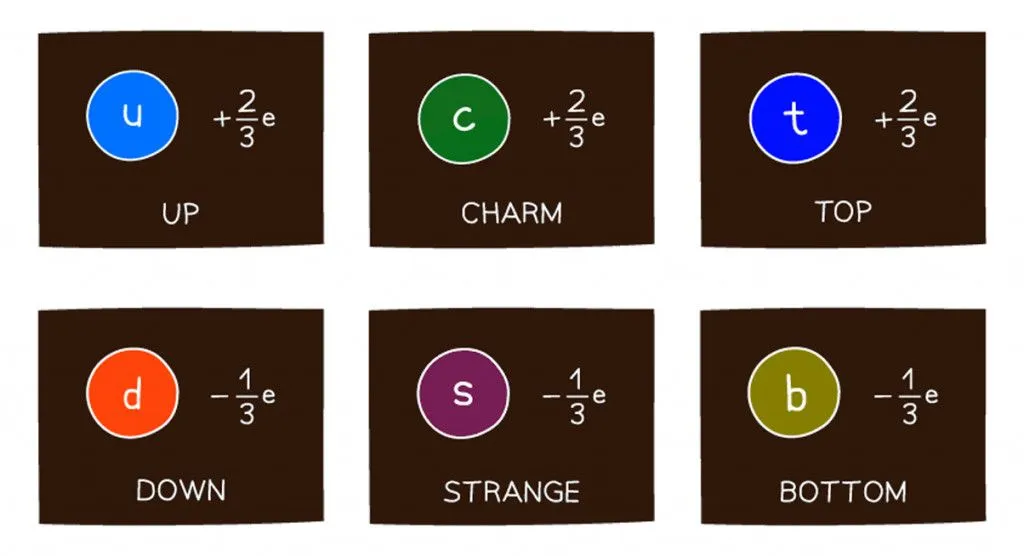
But first, let me introduce you to these particles. There are six types of quarks, also known as flavors of quarks, and each carries a fractional electric charge. The lightest flavors (up, down, and to a lesser extent strange and charm) flicker in and out of existence inside a proton. The two heaviest, bottom and especially top, are far too massive to appear there under ordinary conditions.
Regarding gluons, they are basically keeping the quarks “glued” together, while also acting as messengers between them.
But that’s not where a gluon’s job ends.
A gluon is one of the strangest elementary particles you will ever learn about. For instance, consider the fact that a gluon not only helps a quark interact with another quark, but it can also interact with other gluons too! Not only that, but a gluon can readily shapeshift into a quark-antiquark pair and then shift back. Given its tendency to multiply, there is a whole sea of quarks-antiquarks coming in and out of existence inside a proton! No doubt it should be called a Proton Sea!
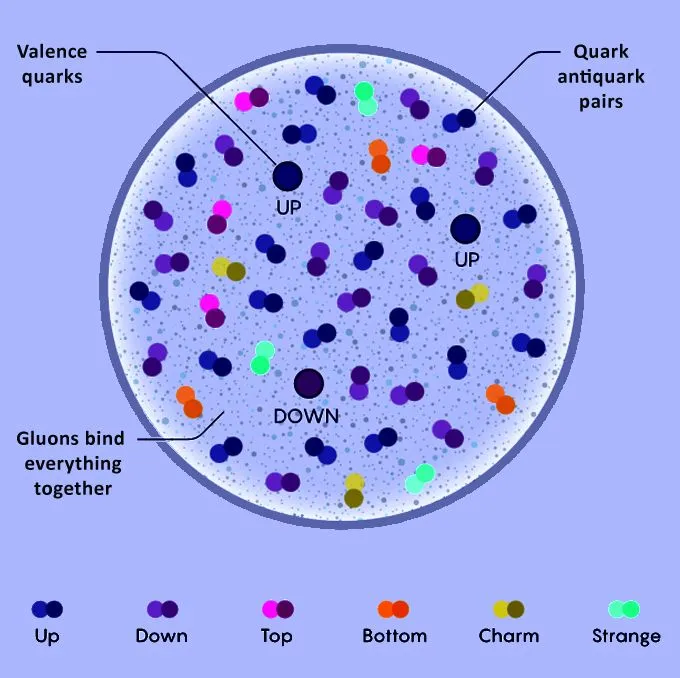
So… why are three quarks given more importance?
The answer is pretty simple. The other quarks all come in pairs with their antiquark counterparts. Basically, their charges get nullified. These other quarks and their antiquarks are called sea quarks. The remaining (or valence) quarks that do not get negated are exactly 3 in number (up, up, and down) and are responsible for the positive charge on the proton.
In other words, when books say that the proton is made of three quarks, they aren’t lying, but they aren’t telling the full set of facts either.
That also does not mean that the sea quarks should be overlooked. These matter-antimatter pairs are responsible for much of the proton’s mass! Also, the mysterious antimatter won’t allow itself to be neglected…
The Mystery Surrounding Proton Antimatter
Historically, scientists first discovered the proton, and then they discovered that the inside of the proton is made of three quarks. Later, they realized there was a sea of quarks and gluons inside.
Now technically, since sea quarks exist because of gluons, scientists believed that up and down antiquarks would be the same in number, since they have almost the same mass. However, after more than 20 years of experiments, the Fermilab SeaQuest collaboration concluded in 2021 that there are more down antiquarks than up. The proton holds roughly 1.4 down antiquarks for every up antiquark, and the reason for that imbalance remains unknown!
To put this into perspective, less than 1% of the matter in the visible universe is antimatter, and the rest of the visible matter in the universe is composed of protons. That being said, the insides of these protons contain a large amount of antimatter that isn’t contributing to the charge, but certainly adding to the mass. So, although the existence of antimatter in the universe seems incredibly rare, strangely, it can be found hiding inside the very matter we are made of!
This is also a good moment to clear up a common question. The antimatter twin of a whole proton is a separate particle called the antiproton, made of two up antiquarks and one down antiquark, with a negative charge instead of a positive one. Physicists routinely create and even briefly store antiprotons at CERN. That is different from the antiquarks tucked inside an ordinary proton, which can never escape the sea they belong to.
Why the universe ended up made almost entirely of matter rather than antimatter is one of physics’ biggest open questions. In 2025, CERN’s LHCb experiment reported the first clear sign of matter-antimatter differences (called CP violation) in baryons, the family of particles that includes the proton. It is a tantalizing clue, though still far too small to fully explain why any matter survived the early universe at all.
References (click to expand)
- Decades-Long Quest Reveals Details of the Proton's Inner Antimatter. Quanta Magazine.
- Inside the Proton, the ‘Most Complicated Thing’ Imaginable. Quanta Magazine.
- Gao, H. (2021). Antimatter in the proton is more down than up. Nature.
- Investigating an Antimatter Imbalance in the Proton. U.S. Department of Energy, Office of Science.
- A new piece in the matter–antimatter puzzle. CERN.
- LHCb Collaboration (2025). Observation of charge–parity symmetry breaking in baryon decays. Nature.