Yes. In our current physics, the absolute upper limit is the Planck temperature, about 1.4 × 1032 °C (or roughly the same number in kelvin) - the point at which gravity itself becomes a quantum effect and known physics breaks down. The hottest temperature humans have actually produced is around 5.5 trillion °C, made in 2012 at CERN’s Large Hadron Collider by smashing lead ions together.
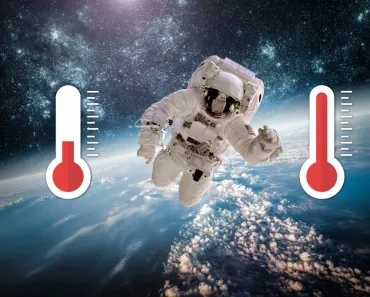
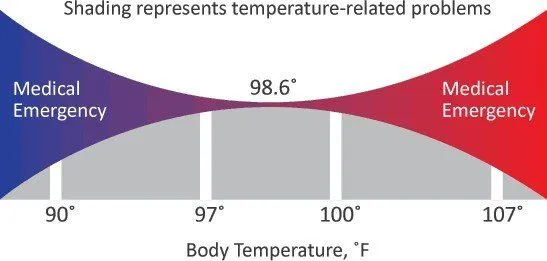
It seems like we all miss the sun when it’s cold outside, even though we might hate it on hot summer days. Humans can only adapt to minor fluctuations in body temperature, which is why the weather is one of our favorite topics of conversation! During an average day of the year, our body temperature only changes by about 1 degree Celsius (roughly 2 degrees Fahrenheit) with the lowest temperature occurring during the night.
If the temperature is too high or too low, it can be lethal for warm-blooded species. If body temperature falls to 35°C or 95°F, it can result in hypothermia, while 40°C or 104°F leads to hyperthermia. However, most of us have nothing to worry about, since our surroundings rarely experience such broad temperature changes.
Absolute Zero
Most people are pretty familiar with the concept of absolute zero, which is -273.15 °C (0 K). It is also the lowest possible temperature that can be achieved, according to the laws of physics as we presently know them. This is because it’s the coldest that an entity can get when all of its heat energy has been sucked out of it. At this temperature (absolute zero), there is no thermal motion at the subatomic level. To put this in perspective, attempting to go below absolute zero would be like trying to get your car to go slower than completely stopped.
So if temperature has a strict floor at one end, it is natural to ask: does it have a ceiling at the other? To find out, we have to take a quick tour of the temperature scale, from the surface of the Earth all the way up to the moments after the Big Bang.
How hot is really HOT?
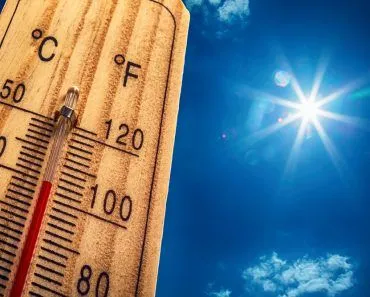
The Earth: The hottest temperature ever recorded on Earth’s surface is 56.7 °C (134 °F), measured in 1913 at Death Valley in California, USA, which is extremely far from the highest temperature possible in the universe.
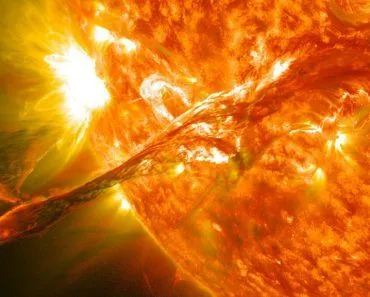
The Sun: Obviously, the Sun is the first thing that pops into our head when we think about the hottest stuff in the universe (or at least our solar system). The temperature at its surface is around 5,500 °C (9,900 °F), while at its core, the temperature can be as high as 15 million °C (27 million °F). To understand how hot that is, try to imagine if an iron ball could be kept at that temperature without melting. The heat from that ball would instantaneously kill every living thing within a 2,000-kilometre radius. If that still isn’t hot enough for you, let’s look at some stars that are even hotter than our Sun.
Other Celestial bodies: A rather unimpressive white dwarf at the heart of the Red Spider Nebula shines at an estimated surface temperature of 150,000–250,000 °C, roughly 25 to 45 times hotter than the Sun’s surface, which makes it one of the hottest known white dwarfs. Even hotter than that is a ‘quasar’, where a supermassive black hole at the centre radiates more energy than every star in the Milky Way put together. The inner accretion disk swirling into a quasar can reach tens of millions of degrees Celsius, hot enough to glow in X-rays.
Some of the most violent events in the universe are the deaths of giant stars. These events are called supernovas and emit huge bursts of energy in the form of gamma rays. If one of these occurred close enough to Earth, it could essentially wipe our world from existence. During the bounce that follows core collapse, temperatures in the heart of the supernova briefly soar to around 100 billion °C.
Subatomic Temperatures: Now, as we move up the temperature ladder, we need to come back to Earth. The hottest temperature humans have ever actually produced is at CERN’s Large Hadron Collider in Switzerland, where the ALICE experiment smashes lead ions together at almost the speed of light. For a split second, the resulting quark-gluon plasma reaches about 5.5 trillion °C, the current Guinness World Record, set in 2012. That is roughly 38% hotter than the earlier 4-trillion-degree benchmark set in 2010 with gold ions at Brookhaven National Laboratory’s Relativistic Heavy Ion Collider (RHIC) in New York. Either way, it is much higher than a supernova explosion or a nuclear explosion, and is high enough to melt even subatomic particles into a soupy mess.
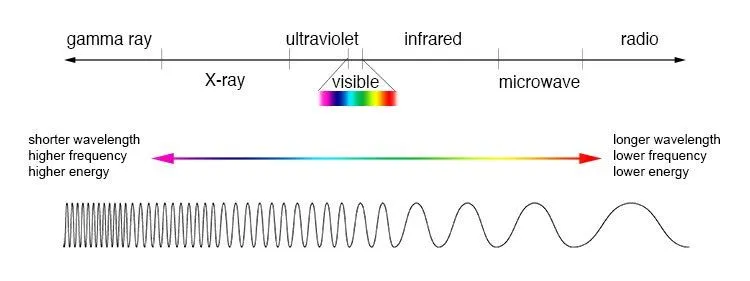
Higher temperatures have never been recorded, although they can easily be theorized. First, we need to realize that every object with a higher temperature than absolute zero (-273.15 °C) has a wavelength of emitted light associated with it. Even our bodies emit light, which lies in the infrared region of the spectrum and can only be seen through special cameras. As the temperature of an object rises, the wavelength of light associated with it decreases. The sun, being at a higher temperature than our bodies, can emit light with a much lower – and hence visible – wavelength.
Why Do Hotter Objects Glow And Change Color?
Heat one end of an iron bar in a flame and you can read its temperature straight off its color. It first turns a dull red, then a brighter orange, then yellow, and finally a glaring white as it gets hotter. That color shift is not a coincidence; it is a strict rule of physics called Wien’s displacement law. The law says the wavelength at which a hot object radiates most strongly is inversely proportional to its absolute temperature, λmax × T = 2.898 × 10⁻³ m·K. In plain terms, the hotter the object, the shorter (and bluer) the peak wavelength of the light it pours out. This is the same blackbody radiation behavior every warm object shares, from a campfire ember to a star.

There is a second rule working alongside it. The Stefan–Boltzmann law says the total power a surface radiates climbs with the fourth power of its absolute temperature (P = σAT4, where σ = 5.670 × 10⁻⁸ W/m2·K4). Double an object’s temperature in kelvin and it does not glow twice as brightly, it glows 16 times as brightly. So as temperature rises, an object both shifts toward blue and blazes far more intensely.
Astronomers use exactly this trick to take a star’s temperature from light-years away, no thermometer required. According to NASA, the coolest stars glow red at surface temperatures below 4,000 K, the Sun shines yellow at roughly 6,000 K, and the hottest stars burn blue-white above 50,000 K. The lesson is counterintuitive: a red star is one of the cooler ones, while a blue star is a furnace. It is the same reason the deep blue base of a gas flame is hotter than its orange tip, and why our own body heat shows up only as invisible infrared radiation.
Absolute Hot
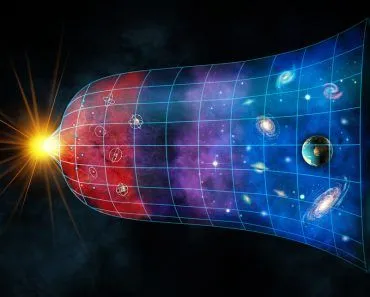
In the standard cosmological model (Lambda-CDM, the modern Big Bang framework), the hottest possible temperature ever reached occurred a fraction of a second after the Big Bang. During that minuscule period of time, the emitted light only had a wavelength of 10^-35 meters. This length is called the Planck length and is the smallest measurable length in the Universe. Due to this small wavelength, the temperatures were as high as 10^32°C, which is called the Planck temperature and stands as the closest definition of an “absolute hot” that we currently have.
Beyond the Planck temperature being the hottest temperature ever theoretically reached in our universe, physicists hypothesize that at any temperature higher than the Planck standard, the gravitational forces of the affected particles would become so strong that they could create a black hole. A black hole that is created from energy, rather than matter, is called a ‘kugelblitz’ (German for ‘ball lightning’). A 2024 paper in Physical Review Letters argued that quantum effects like vacuum polarization may make a real kugelblitz impossible even though classical general relativity permits one, so a pure-light black hole may always remain a thought experiment. Either way, our currently accepted conventional models of physics break down past the Planck temperature, leaving many questions unanswered.
However, many scientists disagree with this model and believe that as we continue to learn about the subatomic behavior of matter, the maximum attainable temperature will continue to increase!
Can A Temperature Be Negative, And Would That Be Colder Or Hotter?
Here is a twist that breaks most people’s intuition. There is a way to push a system past the top of the temperature scale, and when you do, the number it reports is negative. Stranger still, a negative absolute temperature is not colder than absolute zero; it is hotter than any positive temperature. To see why, you have to remember what temperature really measures. It is not simply “how much energy” a system has, but how the system’s disorder changes as you add energy. In ordinary matter, piling in energy always opens up more ways for particles to arrange themselves, so the temperature stays positive.
In 2013, a team at Ludwig-Maximilians University Munich and the Max Planck Institute of Quantum Optics, led by Ulrich Schneider and Immanuel Bloch, built a system where that rule could be flipped. They took about 100,000 potassium atoms, chilled them to a billionth of a kelvin, and held them in a lattice of laser beams that capped how much energy the atoms could carry. With an energy ceiling in place, they could force most of the atoms into high-energy states rather than low ones, an “inverted” arrangement that simply cannot happen in everyday matter. As Schneider put it, “the temperature scale simply does not end at infinity, but jumps to negative values instead,” and the gas was “even hotter than at any positive temperature.”
This does not mean someone has out-baked the Planck temperature. Negative absolute temperatures are a quirk of how temperature is defined for special, energy-capped systems, not a loophole for heating an everyday object beyond the ceiling described above. But they are a neat reminder that “how hot can it get” is a deeper question than a single big number lets on.
References (click to expand)
- Highest man-made temperature - Guinness World Records. guinnessworldrecords.com
- Brewing the World's Hottest Guinness - Brookhaven National Laboratory. bnl.gov
- Planck temperature - NIST CODATA. physics.nist.gov
- Planck length - NIST CODATA. physics.nist.gov
- Absolute hot - Wikipedia. en.wikipedia.org
- Kugelblitz (astrophysics) - Wikipedia. en.wikipedia.org
- A black hole made from pure light is impossible - Science News (2024). sciencenews.org
- Blackbody Radiation (Wien’s and Stefan–Boltzmann laws) - University Physics, OpenStax. phys.libretexts.org
- Ask an Astrophysicist: star color and temperature - NASA Imagine the Universe. imagine.gsfc.nasa.gov
- Atoms at negative absolute temperature: the hottest systems in the world - Max Planck Institute of Quantum Optics. mpq.mpg.de