No, fire can melt and burn many things, but not everything. An ordinary wood or house fire tops out around 1,100–2,000 °F, which isn't hot enough to melt steel (2,500 °F) or most ceramics, and the noble gases (helium, neon, argon, krypton, xenon) won't burn at any practical temperature. Specialized plasma torches reach 36,000 °F and can melt almost any solid, but a substance with no chemical fuel still cannot 'burn'.
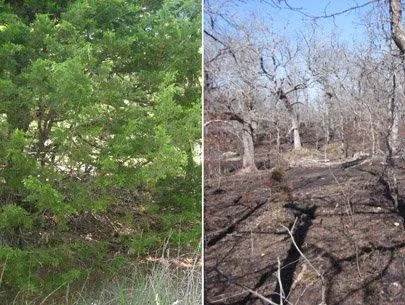
There are few things as entrancing as a campfire, or any fire for that matter. They are beautiful and deadly, unpredictable and mysterious. We fear them, create them, douse them and protect against them because there are few forces in the world as destructive. Thousands of acres of forest can burn in a matter of hours or days if the winds are right and the fuel is dry enough.
Given how pervasive and universal fire is, it does bring up a common question: is there anything that fire can’t burn or melt?
Burning Vs Melting
Before we delve into the limitations of fire, we should begin by briefly reviewing the difference between burning and melting; while fire can do both of these things, the processes involved are not the same.
When something is melted, such as an ice cube, it represents a phase change. In other words, ice changes from a solid state of water to a liquid state of water, but the chemical composition of the material itself is not changed. Similarly, when a chocolate bar melts in your bag on a hot day, it shifts from a solid state to a liquid state, but the flavor and basic composition doesn’t change in any way, just the form.
 When something burns, however, it represents an oxidizing chemical reaction, where the material being burnt will be chemically altered into other substances with different characteristics. Wood is the most common example of this. Unlike ice or chocolate, wood cannot melt because the combustion temperature is lower than the melting point; a fire would start before the material could change phase to “liquid” wood.
When you throw a log on the fire, the wood begins to heat up until it reaches an ignition point, where the fuel (the hydrocarbons of the wood) can interact with oxygen in the air and ignite, i.e., start to burn. This typically occurs once the wood reaches a temperature of 500 degrees Fahrenheit, although smoke will be released at around 300 degrees Fahrenheit. Smoke consists of hydrogen, carbon and oxygen compounds, including carbon dioxide and other volatile gases. The material left in your fireplace or campfire ring consists of char and ash. Char is essentially pure carbon, and is the basis of charcoal, while ash is composed of the minerals in the wood that cannot be burnt off in the form of gas.
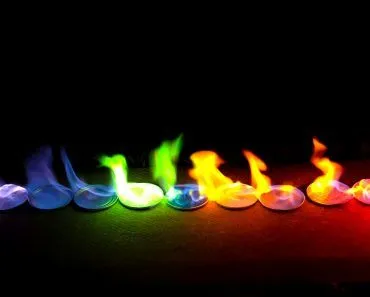
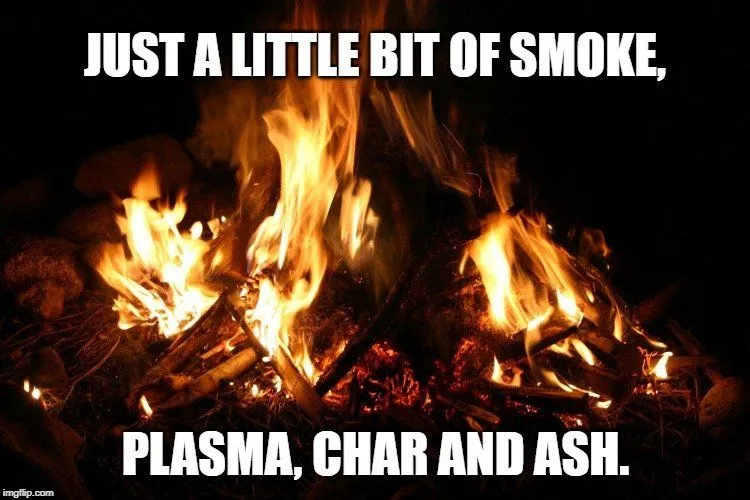 While "fire" itself is a chemical reaction, the visible flames that you see are a soup of very hot gases continually reacting and giving off light. Hot flames also contain a small fraction of ionized molecules, formally a weakly-ionized plasma, which is why a candle flame can be deflected by an electric field. The temperature of those gases being given off, and the fire itself, will usually top off at approximately 1,100 degrees Fahrenheit, while the charcoal that burns once the volatile gases are all released will burn at roughly double that temperature, 2,000 degrees Fahrenheit.
What Determines Whether A Material Melts Or Burns When Heated?
Here's the puzzle at the heart of fire: aim the same flame at two different objects and one slumps into a puddle while the other bursts into flame. Why? Because when you heat any material, two completely different changes are racing each other. It can melt, a physical change in which a solid turns to liquid but stays the same substance, or it can burn, a chemical change in which it reacts with oxygen and is converted into entirely new substances such as carbon dioxide and ash.

Which one wins comes down to a simple contest: as the temperature climbs, does the material reach its melting point first, or its ignition (decomposition) temperature first? Whichever arrives first decides its fate. Metals win the melting race. Iron's atoms sit in a tough metallic lattice that simply loosens into a liquid at 1,538 °C (2,800 °F), and there is no easy reaction with the surrounding air to derail it on the way, so iron melts cleanly. Wood loses that same race in the opposite direction: its long cellulose molecules start breaking apart near 250–300 °C (480–570 °F) and the gases they release ignite, well below any temperature that would turn solid wood to liquid. That is why wood never melts; it chars and burns instead.
The same rule explains the oddities you meet in chemistry class. Copper sulfate crystals decompose at around 200 °C, long before they could melt, while potassium sulfate happily melts at about 1,069 °C without breaking down at all. A humble candle shows both outcomes in one object: the flame's gentle warmth melts the wax (a physical change), while the wick and the rising wax vapor are hot enough to burn (a chemical change).
What Can Fire Not Affect?
While 2,000 degrees Fahrenheit is incredibly hot, and very dangerous, there are many substances with combustion points higher than that temperature. On average, most house fires will burn between 1,000 and 2,000 degrees Fahrenheit, so there are plenty of things in your house that wouldn’t be consumed.
Your jewelry, for example, which may be made of gold and silver, have melting points of 1,950 degrees and 1,700 degrees, respectively, your diamonds are usually safe in an ordinary house fire too, although at standard pressure diamond doesn't melt; it oxidises (burns) into CO2 at around 1,300–1,650 °F in air, and only melts at all under tens of thousands of atmospheres of pressure. Most precious gemstones are similarly high in terms of their melting point. Steel has a melting point of approximately 2,500 degrees Fahrenheit, so most of your tools and cookware would survive a normal house fire, as would most of the tools in your garage.
However, we have only been considering a normal fire, one that is burning primarily carbon-based fuels/objects with low combustion temperatures. It is difficult to create a fire that burns hotter than this, but far from impossible. If you run a current of electricity through a gas, it will plasmize, similar to what occurs in the colorful flames above a fire, but the temperature of those gases can rise to temperatures of 36,000 degrees Fahrenheit. Such intense levels of concentrated heat are seen in plasma arc welding and other related fields. That temperature should be able to melt just about anything, but it won’t necessarily cause everything to “burn”.
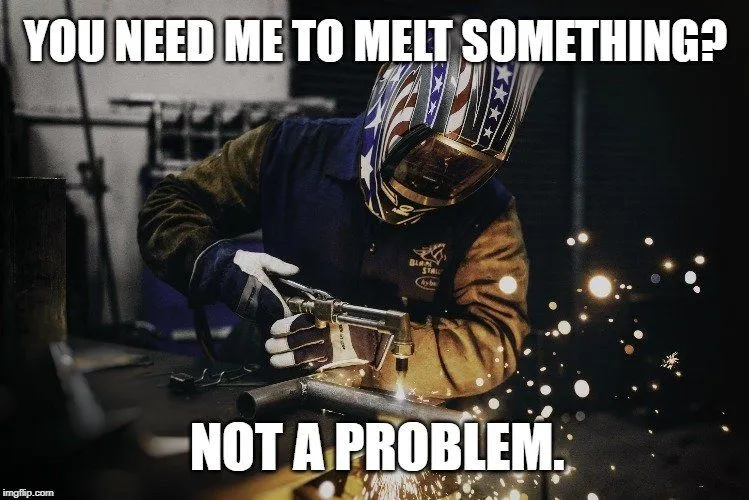
The question of what things can’t “burn” is somewhat vague, as combustion reactions, i.e., burning, are typically classified as reactions involving hydrocarbons and oxygen. Some materials have inherent structural or chemical obstacles to combusting in the presence of oxygen, and some other materials have no hydrogen present to burn. That being said, oxygen isn’t the only gas that can result in an exothermic reaction. Fluorine, an even stronger oxidizer than oxygen, supports combustion of materials that won't burn in air (and notoriously even ignites water and asbestos). And magnesium and lithium can burn in carbon dioxide or nitrogen respectively, so "fire needs oxygen" is more a rule of thumb than a universal law.
If you are trying to find something that will never burn, the noble gases are an excellent example. They are “satisfied” with their present structures, and are fully content to be non-reactive, particularly in terms of combustion. They may react when stressed in extreme circumstances, but would never actually “burn” by the standard definition.
Can Fire Melt Steel?
This is the question people ask about fire's limits more than any other, and the answer is satisfyingly two-sided: an ordinary fire can't melt steel, but a specially built one absolutely can. Steel is mostly iron, which melts at 1,538 °C (2,800 °F); common carbon steels melt a little lower, roughly 1,425–1,540 °C (about 2,600–2,800 °F). A wood campfire or a house fire, by contrast, tops out somewhere around 600–1,100 °C (1,100–2,000 °F). That is plenty to make a steel bar glow cherry-red and even sag, but nowhere near enough to turn it to liquid.

This is exactly the science behind the long-running “you can't melt steel beams” argument, and the point that usually gets lost is that steel does not need to melt to fail. In its investigation of major building fires, the U.S. National Institute of Standards and Technology (NIST) noted that the fires never approached steel's melting point, and they didn't have to: above about 600 °C (1,100 °F), structural steel already loses much of its strength and stiffness, so a hot fire can warp and buckle a steel frame long before any of it becomes molten.
So how do foundries pour rivers of liquid steel? By cheating the fire's air supply. Blow a forced stream of preheated air through burning coke and the rate of combustion, and with it the temperature, climbs dramatically. A blast furnace running on coke and a hot-air blast reaches roughly 1,650 °C (3,000 °F) in its hottest zone and taps out molten iron at about 1,400–1,500 °C (2,550–2,700 °F). A blacksmith's coal forge with a bellows works on exactly the same trick. The lesson: whether a fire can melt steel depends less on the flame itself than on how much oxygen you can force into it.
Can Fire Burn Itself?
Here's a question that sounds like a riddle: if fire burns everything, can fire burn fire? The answer hinges on remembering what fire actually is. Fire is not a substance you can hold; it is an event. Combustion is the chemical reaction, and the flame you see is simply the glowing cloud of superheated gases and soot thrown off while that reaction is underway. Burning means a fuel combining with oxygen, and a flame is already the finished product of that union, so there is nothing left inside it for a second fire to consume. In that sense, fire can no more burn itself than an explosion can explode.
What a flame can do is set light to fuel it hasn't reached yet. Blow out a candle and watch the ribbon of white smoke curl upward: that smoke is vaporized wax, and it is still perfectly flammable. Touch a lit match to the smoke trail a few centimeters above the wick and the flame races back down the vapor to relight the candle without the match ever touching it. The fire didn't burn itself; it simply found fresh fuel that the original flame had left behind.
A Final Word
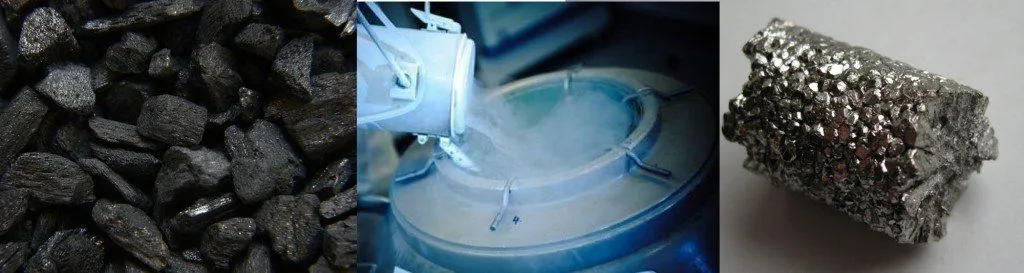
Fire should always be taken seriously, as it has such destructive potential, but it is good to know the limitations of those reactions, as well as the basic components to create one. Despite the inherent dangers, humans are still fascinated by fire, and drawn to push its limits. A few years ago, researchers created the most fire-resistant material in history, or at least the one with the highest melting point. A particular combination of carbon, nitrogen and hafnium has a melting point of 7,460 degrees Fahrenheit.
References (click to expand)
- Fire behaviour - Science Learning Hub. sciencelearn.org.nz
- Fireproofing - Wikipedia. Wikipedia
- New material has higher melting point than any known .... ASM International
- Things that Won't Burn in a House Fire - Ally1 Disaster Solutions. ally1disastersolutions.com
- What Is Fire? - How Fire Works - Science | HowStuffWorks. HowStuffWorks
- Iron - Element information (melting point 1538 °C). Royal Society of Chemistry. periodic-table.rsc.org
- WTC Investigation FAQs (steel strength loss above 600 °C). NIST. nist.gov
- Blast furnace - Definition, Temperature & Facts. Encyclopaedia Britannica. britannica.com
- Chemical Change vs. Physical Change. Chemistry LibreTexts. chem.libretexts.org
- Thermal decomposition. Wikipedia
- Make a Candle Flame Jump (relighting through wax vapor). Scientific American. scientificamerican.com