The A-series (A0, A1, A2, A3, A4 and so on) follows the international ISO 216 standard, which evolved from the German DIN 476 standard set in 1922. Every A-size sheet has a length-to-width ratio equal to the square root of 2 (about 1.414). That ratio is the only one where folding a sheet in half produces two perfectly similar (proportionally identical) sheets of the next smaller size, so A4 folded in half is two A5s, two A4s join to form an A3, and so on. A0 is defined to have an area of exactly 1 square meter.
A4-sized paper has become a staple of stationary, both in offices and households, all over the world (except the United States). Given its immense popularity, the A4 size has become the standard business letter size in countries like United Kingdom and New Zealand. A3 and A2 sheets are relatively less common, and the A1 and A0 variants even more rare.
Such standardization of paper was first introduced in the 20th century and is ascribed to all over the world to this day. So, what’s the difference between different A-sized sheets and how are they standardized?
A-Series Sheets
To give a little background, the international paper size standard is ISO 216, which specifies the international standard (ISO) paper sizes used in most countries in the world today. It is based on the German DIN 476 standard (DIN is a German organization for standardization) for paper sizes. The most popular ISO standards of paper include A, B and C-series sheets, but in this article, we’re going to talk about the most commonly used variant: the A-series.
What’s So Special About A-sheets?
A-series sheets of paper have been designed in such a way that when you cut them in half, you get two perfectly identical pieces of the next biggest size. For example, if you cut an A0 sheet in half, you will get two A1-sized sheets; if you cut an A1-sized sheet in half, you will get two A2-sized sheets and so on.
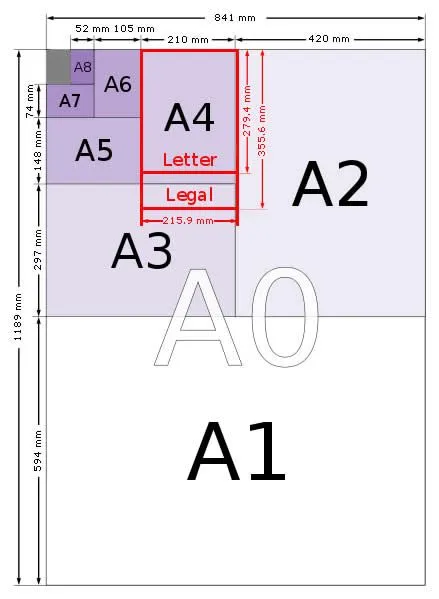
Although the dimensions of the two new sheets are different from their parent sheet, the proportion of the sheets’ length and breadth remains the same. Therefore, when you fold an A3 sheet in half, you get two A4 sheets that have the same ratio between their length and breadth as the parent (A3) sheet.
How Do You Determine The Exact Dimensions Of A-sheets?
As mentioned above, all A-standard sheets have the same ratio between their length and breadth. That being said, what’s the value of that ratio, and how does it remain constant for all A-standard sheets?
To answer this, we’ll have to go back to where it all started: the first sheet of paper that was officially standardized by putting the letter ‘A’ as a prefix to its name was the ‘A0 sheet’. An A0 sheet is exactly 46.8 inches long and 33.1 inches wide (841 mm x 1189 mm) and has an area of 1 meter squared. Now, if you divide 1189 by 841 (i.e., the dimensions of an A0 sheet) you get 1.414. What’s so special about this number, you ask?
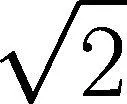
Well, the dimensions of every A-standard sheet, if you care to check the math, are in the proportion of 1.414, which also happens to be the value of ….
Given below are the dimensions of different variants of A-standard sheets:
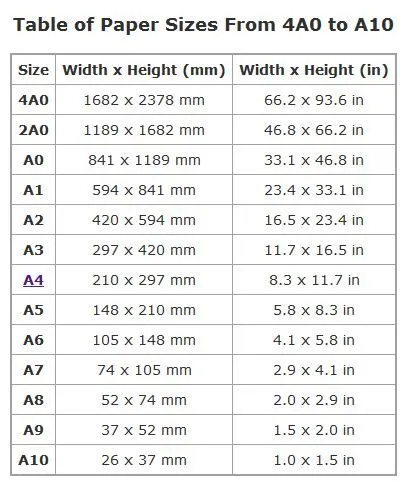
You can see that, whether it’s an A8 sheet or an A0 sheet, the ratio (1.414) between the length and breadth remains the same. The beauty of such well-defined distinction is that you can easily upscale/downscale your content (including images, text etc.) to bigger/smaller sheets without losing its symmetry.
Had the ratio of the different A-standard sheets not been fixed, the transfer of content from one size to another wouldn’t be so simple and flexible. Since the ratio of sides of all A-standard sheets is 1.414, you can easily expand a document to its next biggest size by dialing in a factor of 141% in a machine. This tip comes in handy while working on various photo-editing tools, photocopying documents and so on. Also, you can easily convert one bigger A-size sheet to the next two A-sized sheets.
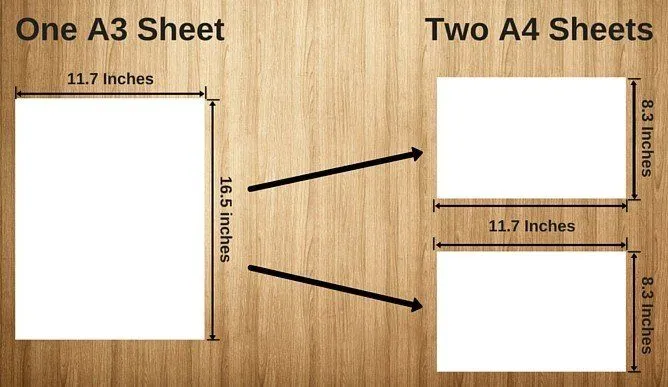
For instance, you can divide an A2 sheet to make two symmetrical A3 sheets, two A3 sheets to make four symmetrical A4 sheets, etc.
How Big Is An A4 Sheet, And How Does It Compare To US Letter?
If you just want the numbers, here they are. An A4 sheet measures 210 × 297 mm, which works out to 21.0 × 29.7 cm, or 8.27 × 11.69 inches. Step up one size and an A3 sheet is 297 × 420 mm (11.69 × 16.54 in); step down and an A5 is 148 × 210 mm (5.83 × 8.27 in). Because every size is built from the same rule, the full ladder is easy to lay out side by side.

| Size | Millimeters | Centimeters | Inches |
|---|---|---|---|
| A0 | 841 × 1189 | 84.1 × 118.9 | 33.1 × 46.8 |
| A1 | 594 × 841 | 59.4 × 84.1 | 23.4 × 33.1 |
| A2 | 420 × 594 | 42.0 × 59.4 | 16.5 × 23.4 |
| A3 | 297 × 420 | 29.7 × 42.0 | 11.7 × 16.5 |
| A4 | 210 × 297 | 21.0 × 29.7 | 8.27 × 11.69 |
| A5 | 148 × 210 | 14.8 × 21.0 | 5.83 × 8.27 |
| A6 | 105 × 148 | 10.5 × 14.8 | 4.13 × 5.83 |
Now, if you live in the United States or Canada, you may have noticed that your office printer paper is not quite an A4. The North American standard is US Letter, which measures 216 × 279 mm (8.5 × 11 in). Side by side, Letter is about 6 mm wider but 18 mm shorter than A4. The two look almost interchangeable, yet that small mismatch is exactly why a document formatted for A4 can print with cut-off margins on a Letter tray (and vice versa). The deeper reason they refuse to line up: Letter is not built on the square-root-of-2 rule, so it lacks the neat folding property that defines the A-series.
Which Is Bigger, A3 Or A4, And What Is The Ratio?
A3 is the bigger sheet. In fact, an A3 sheet is exactly twice the area of an A4 sheet, which is why two A4 pages placed alongside each other tile perfectly into one A3. Go the other way and an A4 is double an A5, an A5 is double an A6, and so on down the ladder. Each step up the number scale (A4 to A3 to A2) doubles the area; each step down halves it.
So what is the famous A4 ratio? Every A-series sheet, A4 included, has the same length-to-width proportion of 1 : √2, which is about 1 : 1.414 (√2 is famously an irrational number, so 1.414 is only a rounded value). Check it on A4 itself: 297 ÷ 210 = 1.414. That single number is the whole trick. It is the only ratio that survives folding, so an A4 halved is still a 1 : 1.414 rectangle (an A5), not a squarer or longer one. It also explains the “141%” button on a photocopier: enlarging by 141% (that is, by √2) turns an A4 into an A3, and shrinking by 71% does the reverse, with no awkward cropping.
What About The B And C Series, And Why Does Your Letter Fit The Envelope?
The A-series is the famous one, but ISO 216 actually defines two companion families. The B-series (B0 is 1000 × 1414 mm) fills the gaps between A sizes, so it turns up where you need something a little larger than the nearest A size, such as posters, books and passports. The C-series (C4 is 229 × 324 mm) is built for envelopes, and that is where the system quietly shows off.

Here is the satisfying part. A flat, unfolded A4 letter slides neatly into a C4 envelope. Fold that same A4 letter once (down to A5) and it fits just as neatly into a C5 envelope. The reason the sizes interlock is mathematical: each C-size is the geometric mean of the A-size and B-size that share its number, so a C sheet is always a touch larger than its matching A sheet, leaving just enough room to act as an envelope for it. So the next time a letter slips perfectly into its envelope on the first try, you are watching the same square-root-of-2 logic at work.
This square-root-of-2 idea is older than the standard itself. The German physicist Georg Christoph Lichtenberg pointed out the advantage of the √2 aspect ratio in a letter dated 25 October 1786. More than a century later, the engineer Walter Porstmann turned the idea into a complete system of A, B and C sizes, published as the German DIN 476 standard in 1922; it was later adopted internationally as ISO 216 in 1975.
Who would have thought that such a simple – yet ingenious! – technique using mathematics could be used to regularize the dimensions of sheets of paper all over the globe!
References (click to expand)
- A4 paper format / International standard paper sizes. cl.cam.ac.uk
- International Standard Paper Sizes - Cornell University. Cornell University
- ISO Standard Paper Sizes - www.unc.edu
- BBC Earth Lab (2013). Paper sizes explained | Number Hub with Matt Parker | Head Squeeze. Youtube
- Paper size (ISO 216 A/B/C series, US Letter, and the 1786 Lichtenberg origin). Wikipedia