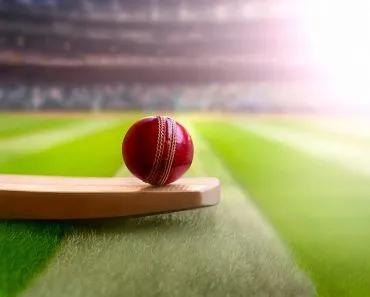
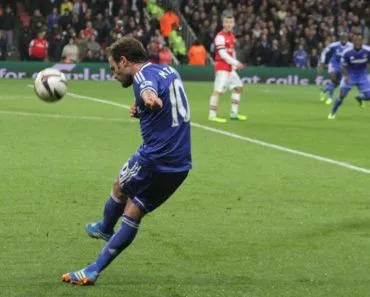
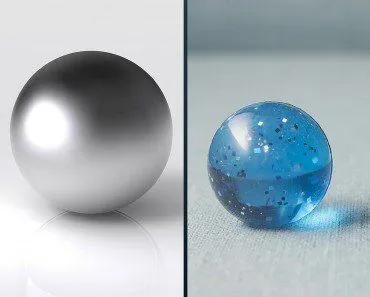
A cricket ball swings in mid-air because of asymmetric airflow. The raised seam (and a slightly rougher side after wear) trips the boundary layer on one side of the ball from smooth (laminar) to turbulent. The turbulent side stays attached for longer, creating a small pressure difference that pushes the ball sideways. At very high pace (~140 km/h and above) the effect can flip and the ball swings the other way, known as reverse swing.
Irfan Pathan, Jimmy Anderson, Wasim Akram, Dale Steyn, Trent Boult, and Bhuvneshwar Kumar. While you may know some of these names, what do all of these legendary cricketers have in common?
Yes, they’re undoubtedly great competitors, but the thing that connects all of them is swing bowling.
What Is Swing Bowling?
To understand what makes these cricketers such a special breed of bowlers, it’s worth exploring the science behind the swing bowling. Swing bowling consists of the ability to change the direction of the ball while in flight towards the batsman. In other words, swing bowlers can alter the direction of the ball mid-air, even before the ball touches the ground. If the ball changes direction after the fall, it’s called a seam, but let’s leave the science of seam for another day and focus on the swing for now.
Swing bowling comes in two types: conventional swing and reverse swing.
Design Of A Cricket Ball
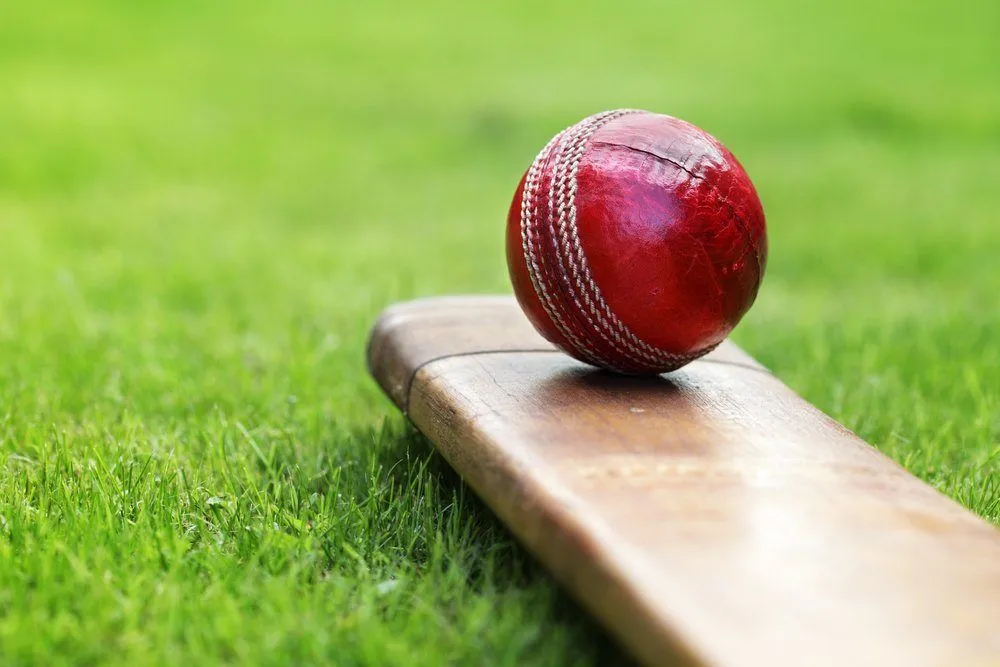
Before we get into the individual swing types, however, we first need to review the basic composition and design of a cricket ball. A cricket ball is made with a core of cork and is covered by a leather casing. To optimize the ball to swing, the leather case comes with a slightly raised sewn seam.
Now, once the game begins, the surface on either side of the ball starts to degrade and some wear and tear develops. This tinkers with the overall symmetry of the ball and can lead to the swinging of the ball in mid-air, which we’ll explore further below.
How Does A Ball Swing?
According to research conducted at CSIR National Chemical Laboratory at Pune, four factors essentially govern the swing of the ball:
- Seam of the ball
- Wear and tear of the ball
- Speed at which the ball travels
- The way the bowl is hurled
Conventional Swing
Conventional swing, as the name suggests, has been practiced for ages. Many feel that it has been a part of play since the inception of the game itself. In conventional swing, when the bowler delivers the ball, it moves through the air and a thin layer of air is formed around the surface of the ball. This surface is called the boundary layer. This layer does not remain attached around the ball throughout the journey of the ball and instead becomes separated from the ball at a certain point. The point at which this layer is separated determines how the ball will move as it travels further through the air.
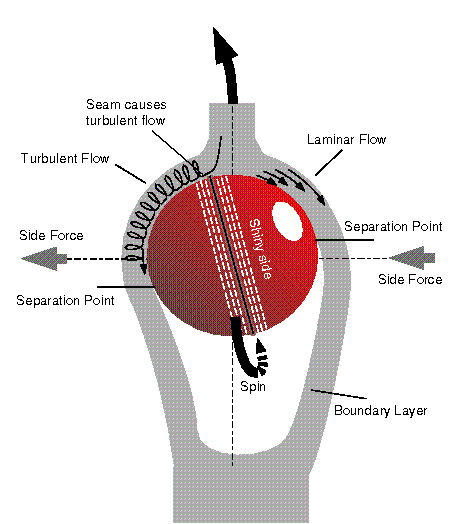
According to the physics of flow, the boundary layer has two states: laminar and turbulent.
In the laminar state, the airflow is smooth and regular, whereas, in the turbulent state, there are rapid fluctuations in velocity and pressure. To visualize the difference between the two, think of turning on a tap at low speed. The water flows linearly downwards in a disciplined manner. This is similar to a laminar flow. Now, if you increase the pressure or try to put a finger into the stream, the flow of water turns “turbulent”. This is similar to a turbulent flow of the boundary layer.
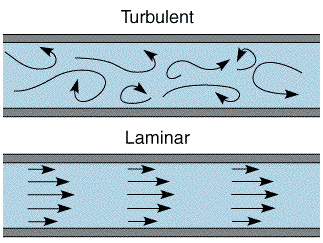
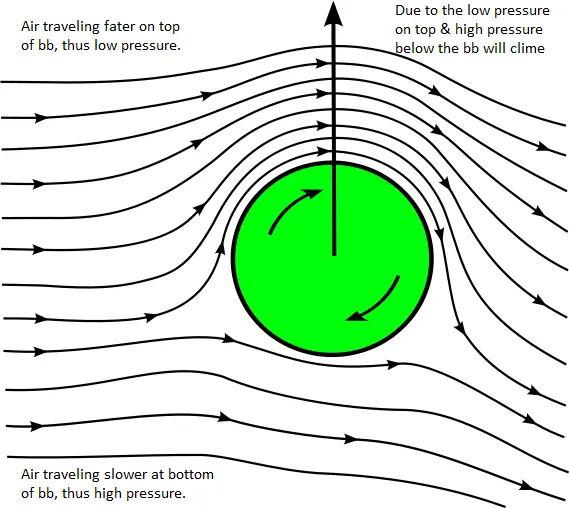
Coming back to the cricket form physics, when the ball is released at a speed of between 50km/h and 112 km/h (approximate values), the laminar layer along the bottom of the ball separates at the top of the ball. However, the boundary layer at the top is sent into a turbulent state due to the seam of the ball, so the separation of this layer is delayed. This results in a pressure difference between the top of the ball (where the pressure is low) and the bottom (where pressure is high); hence, a side force makes the ball swing in the direction in which the seam is pointing (upwards).
Reverse Swing
Reverse swing is a debatably new way of swinging the ball. It was discovered and refined by Pakistani fast bowlers, with Sarfraz Nawaz often credited as the original innovator in the 1970s and Imran Khan and later Wasim Akram and Waqar Younis turning it into a devastating weapon through the 1980s and 90s.
Where conventional swing bowling can be done at medium to medium-fast bowling speeds, reverse swing generally requires a bowler to generate a very good pace, typically 140 km/h and above! Another important factor in reverse swing is the roughness of the ball, especially how it varies between each side. Or to put it differently, the disparity between the two sides of the ball is critical. The greater the shine (i.e., no or minimal wear and tear) on one side and the roughness (i.e., more wear and tear) on the other, the better your chances are of generating a reverse swing.
If the ball is aged enough and the bowler can consistently bowl with good speeds (140+ kmph), then the bowler has a good chance of reverse swinging the ball. When I say the bowl is aged, it means that tens of overs have already been bowled and there is a higher disparity in roughness on the ball sides.
To put it simply, this is what happens in the case of “reverse” swing: a delivery that the batsman expects to be an outswinger (swinging away from the bat of the batsman), is instead characterized as an inswinger (a movement of the ball towards the batman’s body). This is why a good reverse swing bowler has higher dismissals in the form of bowled and LBWs (leg before wicket).
This inswinging trickery happens when the bowler angles the seam for conventional swing, but in this case, the rough side of the ball with more wear and tear faces the batsman. If this ball is bowled quick enough, even the laminar layer transcends into the turbulent state before it reaches the seam, i.e., before the ball hits the ground for a bounce. The seam over here has a “reverse” effect. It alters the turbulent layer so it breaks off earlier at the surface of the ball’s top than the bottom. Here, the lateral force created due to this differential pressure acts in the reverse direction, as compared to how it would have been in a conventional swing.
A NASA scientist who also happens to be a cricket enthusiast has found that there is a critical speed after which this reversing happens. This critical speed can be brought down by increasing the roughness of the ball, which generally requires human intervention. Human intervention means making a conscious effort to preserve the shine on one side of the ball while letting the other side wear. That’s why you’ll often notice fielders rubbing the ball, especially in a test match.
How Do You Bowl An Outswinger Vs. An Inswinger?
So far we have looked at why the ball moves. But how does a bowler actually pick which way it goes? It comes down to the grip and, above all, to where the seam is pointing. The first two fingers rest on either side of the seam with the thumb underneath, and the ball sits up in the fingers rather than buried in the palm. Held like that, the seam becomes a tiny rudder that you aim in the direction you want the ball to drift.

To bowl an outswinger to a right-handed batsman (a ball that curves away towards the slips), you angle the seam towards the slip cordon and keep the polished, shiny side on the inside, facing the batsman's legs. The shiny half keeps its airflow smooth and laminar, the seam trips the other side turbulent, and the ball slides away from the bat. Reverse everything for an inswinger: angle the seam towards fine leg, keep the shiny side on the off side, and the ball curls back in towards the pads. That late inward dart is the delivery that wins so many bowled and lbw dismissals.
This is also why fast bowlers crave the new ball. A fresh ball has a hard, proud seam and a smooth lacquered surface, which is exactly what conventional swing needs. To keep it swinging, the fielding side polishes one side with sweat and a quick rub on the trousers while letting the other side roughen naturally, preserving the asymmetry over after over. None of this is the spin-driven Magnus effect that bends a curveball or a banana free-kick; swing is purely a story of one smooth side and one turbulent one.
Does A Cricket Ball Really Swing More On Overcast Days?
Walk into any cricket ground under a grey sky and you will hear it: win the toss, bowl first, the ball is going to hoop around all morning. Cricketers treat humid, overcast days as a swing bowler's paradise. The laboratory, however, is not convinced.

Rabi Mehta, the NASA aerodynamicist behind much of the swing research, soaked cricket balls and ran them through a wind tunnel. The seam did not swell, and the wet balls produced no extra side force. A 2012 study by David James and colleagues at Sheffield Hallam University went further, conditioning balls in an atmospheric chamber, laser-scanning their geometry and feeding the numbers into a trajectory model. Their verdict was blunt: humidity had no measurable effect on how far the ball swung.
So why does the belief survive? Part of it is simple psychology. As sociologist Nick Allum has noted, a bowler who is convinced the ball will swing tends to pitch it fuller and straighter, gives it every chance to move, and then remembers the days it did. Calmer, less turbulent air under a thick cloud deck may also help a bowler hold a clean, asymmetric flow around the ball. What almost certainly is not happening is moisture in the air physically bending the ball. The cloud sets the mood; the seam and the shine still do the work.
Taking It Too Far
However, many cricketers in the past have ventured beyond just rubbing in a bid to make the ball more favourable for reverse swing. This is called ball-tampering. This includes rubbing a ball with foreign material, like sandpaper, chewing gum or lozenges. Some cricketers have even tried to bite the seam off the ball for this purpose! They have faced match bans and penalties for this behavior. Moreover, ball-tampering with artificial substances is illegal under the Laws of Cricket and the ICC code of conduct. The most high-profile recent example was the 2018 “Sandpapergate” scandal in Cape Town, when Australia’s Cameron Bancroft was caught on TV using sandpaper to scuff the ball, leading to year-long bans for then-captain Steve Smith and David Warner and a nine-month ban for Bancroft.
Swing bowling is one of the finest aspects of cricket and makes the game much more lively and entertaining. If you’re an aspiring fast bowler or an admirer of fast bowling, you would do well to understand the aerodynamics of swing bowling. Hopefully this article managed to do that, so next time you pick up the ball to bowl, you’ll send those stumps flying with an unplayable inswinger!
Watch this fascinating video to learn more about how to bowl an in-swinger by properly gripping the ball:
References (click to expand)
- The Swing of a Cricket Ball - Exciting Science. excitingscience.org
- Mehta, R. D. (2005, December). An overview of cricket ball swing. Sports Engineering. Springer Science and Business Media LLC.
- Swing bowling. Wikipedia.
- James, D., Macdonald, D. C., & Hart, J. (2012). The effect of atmospheric conditions on the swing of a cricket ball. Procedia Engineering. Sheffield Hallam University Research Archive.
- Allum, N. Why we think the weather affects how a cricket ball swings when it doesn't. The Conversation.