Rubber bounces because it deforms a lot on impact and springs back, returning most of the energy that pushed it down. An iron ball is far stiffer, so it barely deforms and instead dumps its energy into denting or jarring the surface. Iron is not "non-elastic," it simply loses more of the energy on a typical floor.
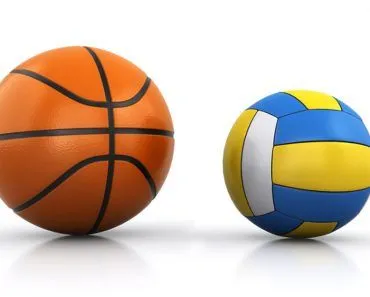
Whether entertaining yourself on a rainy afternoon by bouncing a ball off the wall or watching an exciting game of baseball, we’ve all been entertained in countless ways by this banal spherical toy. The most enjoyable of all, however, may be bouncing a rubber ball with a lot of force and watching it careen in all directions. Unfortunately, you can’t have nearly as much fun with a plastic or metal ball.
That begs the question, of course, what makes a rubber ball so special? Why are rubber balls the ultimate bouncing toys? There are two factors that contribute to bounciness; one is the elasticity of the material out of which the ball is made and the other is related to the interaction between the force at which it is bounced and that elasticity.
What Makes Rubber Elastic?
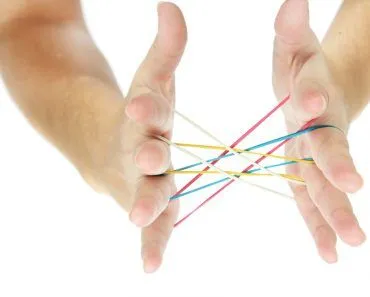
Elasticity refers to the readiness/quickness with which a material returns to its original shape after being compressed or stretched. Rubber is made of long tangled strings of carbon attached at different points along its length to other strings of carbon. As such, rubber has very strong molecular bonds. The long molecular chains of rubber can physically rotate around the chemical bonds that hold them together, which results in the property of flexibility. This helps rubber to momentarily deform its shape without breaking. Since the molecular chains are cross-linked, rubber can rapidly return to its original shape after deformation.

The Physics Of Falling
Whenever an object is lifted off the ground and raised to a certain height, work is done against the weight of the object, which is stored as potential gravitational energy. When the object – in this case a rubber ball – is released and falls to the ground, the force of gravity acting on the ball causes it to accelerate, converting potential energy into kinetic energy. Just before the ball collides with the surface, all the potential energy is converted into kinetic energy.
At the molecular level, when the ball comes in contact with the surface of the ground or wall, the molecular strands of the ball are compressed or squashed by the downward force acting on it, coupled with the upward force exerted by the ground. The ball briefly flattens from a sphere into a squashed, oval shape. As the ball changes shape, the force produced by the bonds, which hold the different strands of rubber together, becomes larger.
Changes After Impact
During impact, the ball is momentarily brought to rest, and for that instant its kinetic energy has been traded for stored energy. A small amount is lost to the surface, but most of it is held in the squashed rubber as elastic energy, like a loaded spring. Again at the molecular level, the downward force on the strands decreases, while the force exerted by the bonds increases, which results in the strands regaining their original shape. It takes a very short time for the ball to flatten and then rebound, after which the stored elastic energy is released and the ball pushes against the ground. By Newton’s Third Law, the ground pushes back on the ball with an equal and opposite force in the upward direction, which makes it bounce. The conversion of elastic energy back into kinetic energy is what sends it upward. In other words, it bounces back into the air!
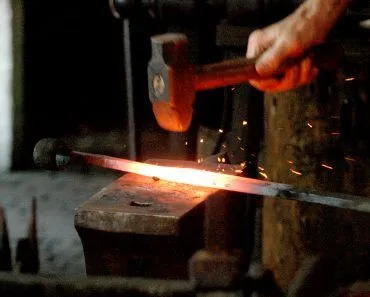
Now, what about a plastic or iron ball, which arrives with just as much kinetic energy? It is tempting to say that iron simply “isn’t elastic,” but that isn’t true. Iron is actually highly elastic in the technical sense; its stiffness (Young’s modulus) is roughly 200 GPa, around a thousand times stiffer than rubber. The catch is that this very stiffness means an iron ball barely deforms at all on impact. Because it hardly squashes, it can only store a tiny sliver of elastic energy to spring back with. The rest of the kinetic energy still has to go somewhere, so most of it is dumped into the surface, denting a soft floor, or lost as heat, sound and vibration. With almost nothing returned to the ball, it barely lifts off. (Curiously, this is also why a hardened steel ball dropped onto a thick steel plate can bounce surprisingly well: neither one dents, so very little energy is lost.)
The surface also matters, often as much as the ball itself. If the same rubber ball is bounced off a carpet, it won’t rise to the same height as when bounced on solid ground. The carpet squashes and takes longer to push back, so more of the ball’s energy is soaked up by the carpet (as heat and deformation), leaving less to power the “bounce back”.
Why Do Steel And Glass Balls Often Bounce Higher Than Rubber?
Here is the part that surprises most people: on a hard floor, a steel ball bearing or a glass marble can actually out-bounce a rubber ball dropped from the same height. It feels backwards, because we tend to think of rubber as the bouncy material and steel as dead weight. The catch is that, in the language of physics, steel is more elastic than rubber, not less. Elasticity is measured by a material's Young's modulus, the ratio of stress to strain, and a higher value means the material resists deformation and snaps back more completely. Steel sits around 200 GPa, roughly a thousand times higher than rubber, so it returns almost all of the energy you put into it.

Rubber, by contrast, deforms a great deal on impact, and that flexing is exactly where it bleeds energy. As the tangled molecular chains slide past one another, internal friction turns some of the motion into heat, a loss known as hysteresis. Glass and hardened steel barely flex at all, so they ring like a struck bell instead of warming up, and very little energy escapes. In one classroom experiment in which balls were dropped onto a concrete floor, a glass marble and a steel bearing each kept a respectable share of their speed through the bounce (coefficients of restitution of about 0.66 and 0.60), squarely in the range of everyday balls despite being made of "hard" materials. The everyday intuition is not wrong, though: a rubber ball wins on a sidewalk or a wooden gym floor, where its give protects it while a glass marble would simply shatter. Steel and glass only show off their bounce on an equally hard, unyielding surface.
What Is The Coefficient Of Restitution?
Physicists put a single number on bounciness, called the coefficient of restitution (often written as e). It runs from 0 to 1. A value of 1 would be a perfectly elastic collision, where the ball rebounds with exactly the speed it arrived with and loses nothing at all. A value of 0 is a perfectly inelastic collision, where the object thuds to a stop and does not rebound. Every real ball lands somewhere in between.

The handy part is that you can measure it yourself with nothing more than a ruler. Drop a ball from a height H, note how high it rebounds to a height h, and the coefficient is simply e = √(h/H). A ball that returns to a quarter of its drop height has a coefficient of about 0.5. This is also why a bouncing ball traces that familiar run of ever-smaller hops: each impact multiplies the height by the same fraction, so the bounces shrink steadily until the ball settles. The coefficient is not a property of the ball alone, though. It depends on both surfaces in the collision, which is exactly why the same ball bounces crisply off tile and limply off a thick rug. For the full derivation, see our explainer on the coefficient of restitution.
Why Are Rubber Balls Vulcanized?
Natural rubber straight from a tree does not make a good ball. In its raw state it turns soft and sticky in summer heat and goes hard and brittle in the cold, so a ball made from it would deform out of shape instead of springing back. The fix is vulcanization, a process the American inventor Charles Goodyear stumbled onto in the late 1830s when he accidentally dropped a mixture of rubber and sulfur onto a hot stove and found that it stayed firm rather than melting. He patented the process in 1844.
Vulcanization heats rubber together with sulfur, which forms permanent cross-links between the long molecular chains, stitching them together at fixed points. Those cross-links are what allow the material to stretch and then snap cleanly back to its original shape across a wide range of temperatures, instead of oozing or cracking. It is the same chemistry that puts the spring into tires, erasers and elastic bands. So when a basketball made from non-vulcanized rubber is left out in the summer sun, the honest answer is that it turns soft and sticky and can deform out of shape, not that it suddenly bounces higher. And if you have ever wondered why a worn-out band stops snapping back, the same cross-link chemistry explains why rubber bands lose their elasticity over time.
Now that you know the science of elasticity, try bouncing a few things off your walls and see what happens!
References (click to expand)
- Rubber elasticity - Wikipedia. Wikipedia
- Why is Rubber Elastic. web.mit.edu
- Impact Force from Falling Object - Hyperphysics. Georgia State University
- Coefficient of Restitution Balls. UCLA Physics & Astronomy
- The Coefficient of Restitution. Physics LibreTexts
- Coefficients of Restitution. The Physics Factbook
- Charles Goodyear and Vulcanized Rubber. National Inventors Hall of Fame