Table of Contents (click to expand)
- Basic Performance Requirement Of The Ball
- How Are The Balls Different?
- Why Pressure Matters
- How The Outside Structure Of The Ball Makes A Difference
- Impact Of Weight
- Why Was The Volleyball Built To Be Lighter Than A Basketball?
- Is Volleyball Or Basketball Harder To Play?
- Can You Use Basketball Shoes For Volleyball?
- Let’s Stick To The Guidelines!
You can’t really swap them. A basketball is roughly twice as heavy as a volleyball (~510–620 g vs. ~260–280 g), inflated to nearly double the pressure (7.5–8.5 psi vs. 4.2–4.6 psi), and covered in pebbled grip bumps rather than smooth dimples. Each ball is engineered for its sport, so substituting one for the other ruins the bounce, the flight and the grip.
Two of the most popular games played across the globe are volleyball and basketball. Both games have their own set of rules, but the common thing between the two is the large size of the ball used in the games.
Have you ever tried playing volleyball using a basketball ball or basketball using a volleyball?
Why is it that specific ball types are used in these games and how do they make a difference?
Basic Performance Requirement Of The Ball
Assuming that we all know the basic rules of the game, let us first note the requirements of the balls used in volleyball and basketball.
In the game of volleyball, the ball should be:
1. Light enough so that it can be kept airborne;
2. Heavy enough so that it doesn’t change its direction easily due to wind while airborne
In the game of basketball, the ball should:
1. Bounce enough so that players can easily dribble the ball;
2. Provide a good grip for players to pass and hold the ball easily.
How Are The Balls Different?
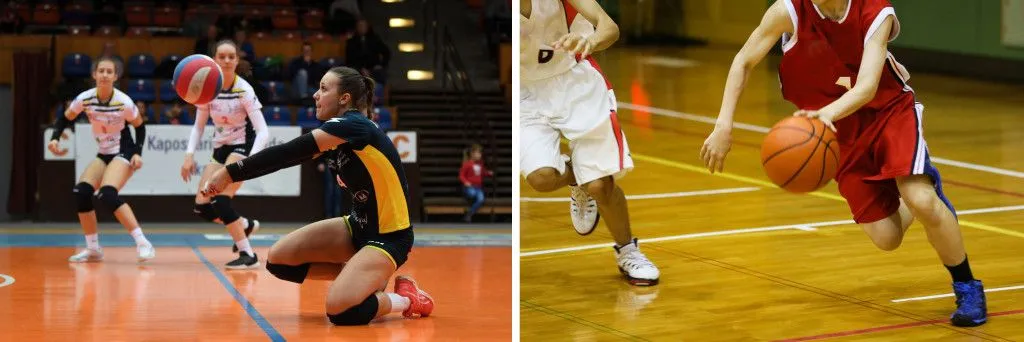
The most prominent differences between the balls used for volleyball and basketball are (specific to balls used in professional-level games):
- Physical dimensions of the ball: A volleyball has a circumference of approximately 650-670 mm and weighs approximately 260- 280 gm. On the other hand, a basketball has a circumference of about 730-770 mm and weighs about 510- 620 gm.
- Pressure inside the ball: According to FIVB rules, the air pressure inside a volleyball should be around 4.2 to 4.6 psi, whereas the air pressure inside a standard basketball (as per NBA guidelines) is between 7.5 to 8.5 psi. We can say that’s close to double the pressure inside a volleyball.
- Outer structure: Basketballs have a large number of small bumps on the surface, whereas a volleyball will either have a smooth surface or a large number of small dimples (dents).
For detailed guidelines of balls used in volleyball (as per their official governing body: FIVB), follow this link.
For detailed guidelines of balls used in basketball (as per their official governing body: FIBA), follow this link.
Why Pressure Matters
As we saw above, a basketball ball has much higher air pressure than a volleyball.
A ball with higher air pressure tends to bounce more once it hits the surface, which is one of the major requirements of the ball used in basketball.
Let’s try to understand the logic behind this.
As we try to push more air into the ball, we are inserting more air molecules into a limited space, which increases the air pressure within the ball. When this ball hits a hard surface, the high air pressure within the ball doesn’t allow the ball to deform much.
Instead, the air molecules try to give a reaction force in the opposite direction, leading to a greater bounce. However, there is a limit to this air pressure, or else it would make the ball bounce more than the desired height.
By that logic, if we increase the pressure inside a volleyball ball, could we easily play basketball with it? Not exactly. That is where the outer structure of the ball comes into play.
How The Outside Structure Of The Ball Makes A Difference
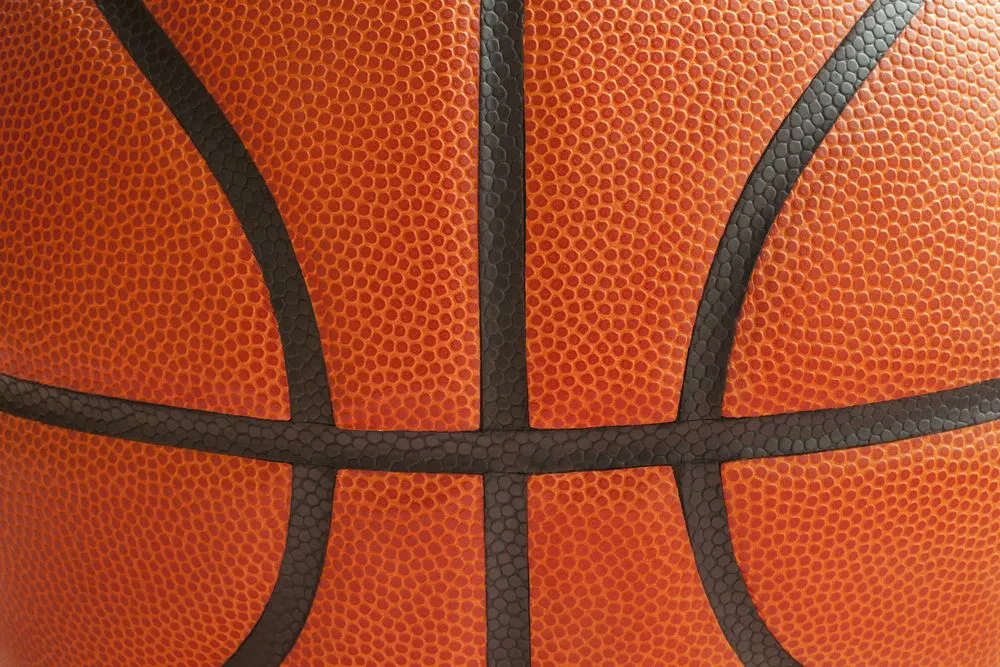
If you look closely, basketballs have a lot of small-sized bumps on their outer surface called pebbles. The purpose of these pebbles is to provide more surface area and more friction. This provides a better grip for players as they pass and hold onto the ball. On the other hand, a volleyball has dimples/dents on the surface, which would make it difficult to grip the ball easily if you were to play basketball with it.
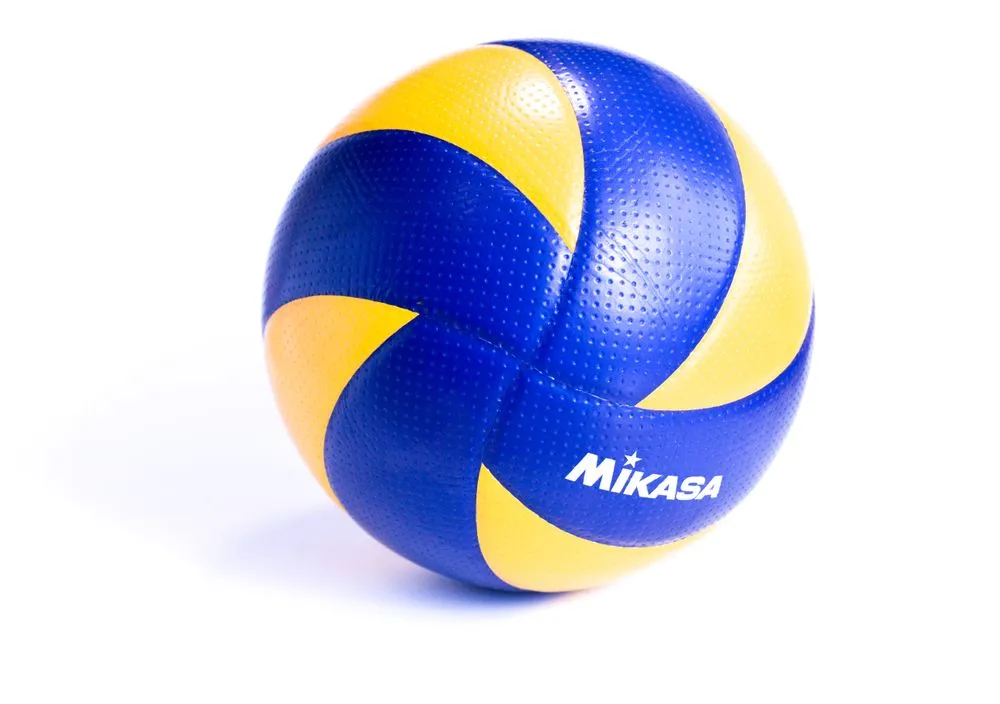
However, there is a reason for these dimples on the volleyball. We know that a volleyball should be kept airborne for a successful play. These dimples on the ball provide consistency in the flight of the ball, thus keeping it airborne more efficiently. If we use a basketball with pebbles to play volleyball, those pebbles will increase the friction with air, thus opposing the efficient flight of the ball.
Impact Of Weight
A volleyball must be hit with a player’s bare hands to keep it airborne, battling against gravity. If we replace it with a basketball, which is almost double its weight, we would have to apply a much greater force. Thus, more energy must be spent to make the ball cover the same distance. Also, a heavier ball hitting our hands as we try to return the ball could cause injury, or at least more discomfort over the course of the game. Clearly, for efficient play and safety, a lighter ball is preferred for playing volleyball.
Why Was The Volleyball Built To Be Lighter Than A Basketball?
The lightness of a volleyball was not a happy accident. It was the whole point. The game was invented in 1895 by William G. Morgan, a YMCA physical instructor in Holyoke, Massachusetts. Basketball had been created just four years earlier a short distance down the road in Springfield, and Morgan found it far too strenuous for the older and less athletic members of his gym. He wanted a gentler game, and for that he needed a gentler ball.

Finding the right ball turned out to be tricky. A basketball was too heavy, while the rubber bladder from inside a basketball was too light. After running out of options, Morgan asked the sporting goods company A.G. Spalding & Bros. to build him a custom ball. The result was a light leather sphere with a circumference of roughly 635 to 686 mm and a weight of just 255 to 340 g (25 to 27 inches and 9 to 12 ounces), almost exactly the range a modern volleyball still follows today.
Morgan originally called his game Mintonette. It was only later, after an onlooker noted that players spent their time volleying the ball back and forth over the net, that it was renamed volleyball. So when you wonder why a volleyball feels so feather-light next to a basketball, the answer goes all the way back to its very first day: it was designed that way on purpose.
Is Volleyball Or Basketball Harder To Play?
Since these two sports are so often mentioned in the same breath, a fair question follows: which one is actually harder? The honest answer is that neither is harder in any absolute sense. They simply stress the body in different ways.

Volleyball is built around repeated, explosive jumping. A hitter or blocker may leave the ground a few hundred times in a single match, springing up again and again from a near standstill to spike or to wall off an attack. That demands quick reaction time, fast-twitch power and careful landing control to protect the knees and ankles over so many jumps. The rallies are short and sharp, and a single mistimed touch can end the point.
Basketball spreads its effort out differently. Players cover a larger court and spend much of the game walking and jogging, punctuated by sudden sprints, cuts and a smaller number of jumps. On top of that, the game layers in a wide mix of skills, like dribbling, shooting, passing and defending, all while an opponent is in your face. So volleyball leans on raw vertical explosiveness, while basketball rewards stamina and varied, continuous movement. Which one feels harder really comes down to which of those demands your own body finds tougher.
Can You Use Basketball Shoes For Volleyball?
It is not just the ball that is tuned to each sport. The shoes are too, which is why so many players ask whether basketball shoes will do for a game of volleyball. The short answer is that you can get away with them for casual or recreational play, but they are not the ideal choice.

Volleyball shoes are deliberately light and low to the ground, with gum-rubber soles tuned to grip consistently on indoor wood and synthetic courts. Their cushioning is responsive rather than soft, placed to handle the constant vertical jumping and quick sideways movement of the game. Basketball shoes, by contrast, are heavier and more heavily padded, often with a higher cut, because they are built to absorb hard landings from running jumps and to support the ankle over a bigger, faster court.
That extra bulk is exactly what works against you on a volleyball court. The added weight can slow your lateral movement and tire your feet sooner, and the traction is not always as sure-footed on indoor surfaces as a dedicated volleyball sole. So if you are simply having fun on the weekend, basketball shoes are fine. If you play regularly, a proper pair of volleyball shoes will give you better agility and grip.
Let’s Stick To The Guidelines!
In order to enjoy playing volleyball and basketball, it’s best to stick to the guidelines for the balls used in these sports, as per their respective governing bodies.
So, when you play basketball, use a ball with higher pressure to assist in dribbling, as well as a large number of pebbles, which assist in maintaining a good grip.
When you play volleyball, use a lightweight ball with dimples, as these provide consistency in flight to keep the ball airborne.
Next time you play either of these sports, it might be a good idea to consider the importance of the pressure, weight and texture of these balls and pay attention to how it impacts your game!
References (click to expand)
- (2016, March 25). []. Journal of Physical Education and Sport. Physical Education and Sport Faculty.
- (PDF) Volleyball elastic properties depending on ball pressure. ResearchGate
- FEEL THE PRESSURE - www.nba.com
- Volleyball: The secret to sneaky float serves - ScienceDaily. Science Daily
- William G. Morgan - Wikipedia
- William G. Morgan - International Volleyball Hall of Fame
- Basketball vs Volleyball - Topend Sports
- Best Shoes for Volleyball - WearTesters