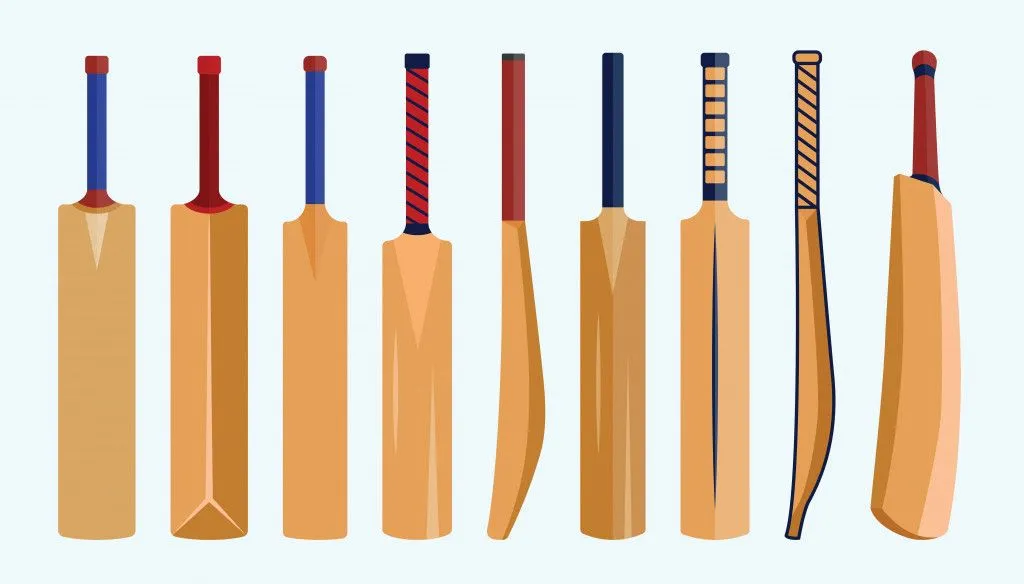
No single bat weight is ideal for every player. A heavier cricket bat carries more momentum into the shot, while a lighter bat can be swung faster. Since these effects compete, each player has an optimum weight, usually the heaviest bat they can still swing quickly and control, that maximizes their bat speed at impact.
Cricket bats can vary greatly in weight, and it has been observed throughout history that the weights of bats chosen by cricketers hasn’t converged to a uniform value and neither type of bats have proven to be universally better.
So why is there no “ideal” type of cricket bat, and is there any scientific reason behind it?
Let’s try and figure it out!
Understanding The Science Behind Hitting A Cricket Ball
All of us enjoy superlative-laden commentary when a batsman is hitting the ball around the ground and scoring at a brisk pace, but let’s put on our science hats and try to decode the art of batting.
The act of hitting a ball with a bat can be understood in a broad sense using Newtonian mechanics. First, let’s revisit the concept of momentum.

Momentum is essentially a measure of movement. In the image, when we release the ball, it moves down with a certain “momentum” and upon colliding with the next ball, it transfers this “momentum” to the ball with which it collided. Mathematically, we define momentum as the product of an object’s mass and its velocity.
P = m × v
Where P = momentum
m = mass
v = velocity
Let’s try for a more intuitive understanding behind this equation. A car and a truck are moving at the same speed, but since the truck is much heavier, it will be harder to stop it by applying external force. Similarly, if there are two trucks, the one going at a faster pace will be tougher to stop. In both the cases, the object with more momentum is tougher to stop.
Thus, momentum can be thought of as an inherent measure of movement. An object that’s not moving at all has no momentum; the same can be understood from the equation above. Since the velocity will be 0, the momentum would also be 0.
Newton’s Second Law Of Motion
Newton’s second law of motion states that the rate of change of linear momentum of a body is directly proportional to the external force applied on the body, and that this change always takes place in the direction of the force applied. The external force applied is the rate of change of momentum.
Thus, when we apply a certain amount of force to an object, we are able to change its momentum. For example, while typing this article, I used my fingers to apply a force to the keys of my keyboard, giving those keys momentum in the downward direction.
Now, let’s try to understand how the momentum changes when a batter hits the ball. The batter applies their muscular force using the bat to strike the ball. This force exerted by the batter gives a certain momentum to the ball, sending it in a different direction with a certain velocity.
The batter uses his muscular force to change the ball’s momentum. Whether a ball travels to the boundary or stops after just a small distance depends on the amount of momentum a batter is able to impart to the ball.
So How Does The Weight Of The Bat Factor In?
Now that we understand that batting is essentially the art of imparting momentum to a ball in a certain direction, we can come back to our original question regarding the weight of the bat.
A batter must be able to impart adequate momentum to the ball to score runs. How fast the ball flies off the bat depends mostly on the bat’s own momentum at the instant of contact, and that momentum is itself a product of two quantities: the bat’s mass and the speed of the swing. Here’s the catch. A lighter bat is easier to swing, so the batter can whip it through with a higher speed, but it brings less mass to the collision. A heavier bat brings more mass into the collision, but it cannot be swung as quickly. The two effects pull in opposite directions.
Because the two effects compete, the best weight sits somewhere in between: for any given player there is an optimum bat weight at which the ball comes off fastest, and going either heavier or lighter than that slows the ball down. That optimum is different for everyone, which is exactly why there is no universally preferred weight of a cricket bat. In practice, adult bats tend to fall in a fairly narrow band of roughly 1.1 to 1.4 kg (about 2 lb 7 oz to 3 lb), and many players actually pick something a touch lighter than their absolute power optimum because a lighter bat is easier to control and gives them a fraction more time to react to the ball.
A similar case is observed in baseball, where players also use bats of differing weights for the very same reason.

The study of bat weights has been taken up extensively in the field of baseball, where a bat-choosing machine has been developed to measure bat swing speed in order to recommend an ideal bat weight. Choosing an ideal bat weight has had a great impact on player performance.
Is Hitting A Six About Strength Or Timing?
Watch a batter casually deposit a ball into the stands and it can look effortless, which raises an obvious question: are big sixes about raw strength or about timing? The honest answer is that it’s both, but timing does more of the heavy lifting than most people assume. The ball is only in contact with the bat for about a thousandth of a second, so there is no chance to “push” it. Almost everything that matters is decided in that instant by how fast the bat is moving and, crucially, exactly where on the blade the ball lands.
Every bat has a “sweet spot,” a region where the blade barely vibrates on impact, so the collision wastes very little energy and the ball springs back at its maximum speed. Miss it, and a chunk of your swing energy is lost to the bat shuddering in your hands. In one study of cricketers performing a range-hitting task, how fast the bat was swung and how close the impact was to the sweet spot together accounted for about 68% of the variation in how quickly the ball left the bat. That is timing, not muscle. A perfectly timed strike from a smaller player will outrun a mistimed heave from a stronger one, which is why elegant timers of the ball can clear the rope while looking like they barely tried.
Conclusion
Using the concept of changing momentum, we have deciphered that there is no single correct or “better” weight for a cricket bat for peak performance. While people often choose a bat of a particular weight by checking how it “feels,” they are essentially hunting for the weight that lets them swing fastest at the moment of contact, which is where a bat does its real work.
So, the next time you are in the market for a new cricket bat, forget about simply grabbing the heaviest blade on the rack. Pick the one you can swing the quickest with control, because that is the bat that will send the ball the farthest!
References (click to expand)
- The physics of cricket. The University of Sydney
- D. A. Russell. Bat Weight, Swing Speed and Ball Velocity. The Pennsylvania State University
- Peploe C. et al. Relationships between technique and bat speed, post-impact ball speed, and carry distance during a range hitting task in cricket. Human Movement Science. PubMed
- Peploe C. et al. The relationships between impact location and post-impact ball speed, bat torsion, and ball direction in cricket batting. Journal of Sports Sciences
- The sweet spot of a cricket bat for low speed impacts. Sports Engineering (Springer)
- Halliday D., Resnick R.,& Walker J. (2013). Fundamentals of Physics, Binder Ready Version + WileyPLUS Registration Card. John Wiley & Sons