A galvanic (or voltaic) cell is an electrochemical cell that converts chemical energy into electricity through a spontaneous redox reaction. Oxidation releases electrons at the anode and reduction consumes them at the cathode, while a salt bridge keeps the circuit balanced.
PAT! PAT! PAT! “This remote stops working only when we really want to watch something!” exclaimed Arun’s grandfather as he smashed the TV remote against his hand.
“Stop hitting that, Dad, and put these batteries in first,” said Arun’s mom. Arun saw his mother hand over two objects to his grandpa, and upon loading into the remote, it suddenly worked. Arun was amazed and curious about what those were and why they needed to be replaced.

Isn’t this one of the most common scenarios in a household? Like Arun, most of us as children would have wondered what batteries were. Some of us may have even tried to break them open, just to see what was inside that rigid, hard-to-break shell!
What Is A Battery?
Batteries are simply a source of electric power. We plug our devices into sockets to get current and get them working. Similarly, batteries are compact sources of electricity. A battery is a package of one or more Galvanic cells that produces a current with the use of chemicals.
Now, what are galvanic cells?
To understand this better, let’s create a small world to learn what they are and how they produce electricity.
Understanding Galvanic Cells Through A Galvanic Empire
Long, long ago there was an empire called the Galvanic Empire. It consisted of two kingdoms called the LEO kingdom and the GER kingdom. The people of the LEO kingdom were called Ants and the people of the GER kingdom were called Cats.
Both the kingdoms were separated and surrounded by water and huge walls.
However, the two kingdoms could not operate separately. They had to work together to maintain a successful and peaceful empire. Unity is the key! Hence, the kingdoms were connected by a bridge to communicate and transport materials between them.
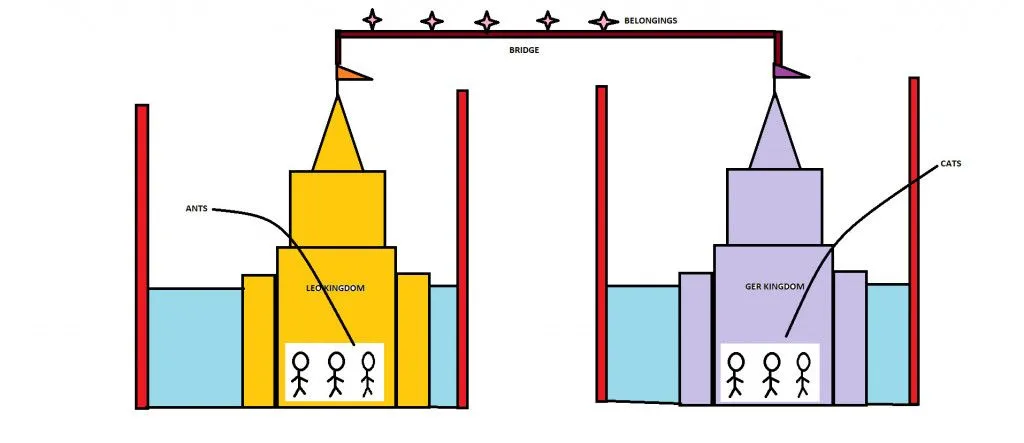
One notable quality of Ants, i.e., the people of LEO, is that they are sacrificial. They lose or sacrifice their “belongings” to the Cats. And these “Belongings” are transported through the connecting bridge. The notable quality among Cats, i.e., the people of the GER kingdom, is that they are acquirers. They accept the “belongings” given by the Ants.
The more the LEO kingdom sacrifices, the more the GER kingdom grows. Sad, but true!
The Ants Shrink while the Cats grow.
As anyone can guess, at some point there will be fewer “belongings” for the Ants to give and for the Cats to gain. Hence, the empire will stop operating.
This is the rise and fall of the Galvanic Empires!
Let’s Put That Into Science!
Now let’s translate that to the real world with the help of this little empire that we created.
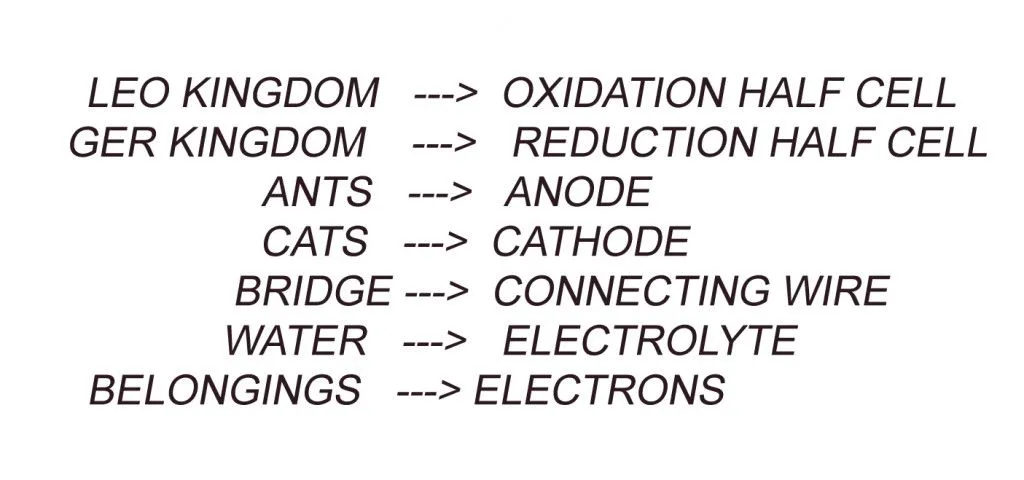
A Galvanic cell consists of 2 half cells (referred to as Kingdoms); the oxidation half-cell (LEO kingdom) and the Reduction half-cell (GER Kingdom).
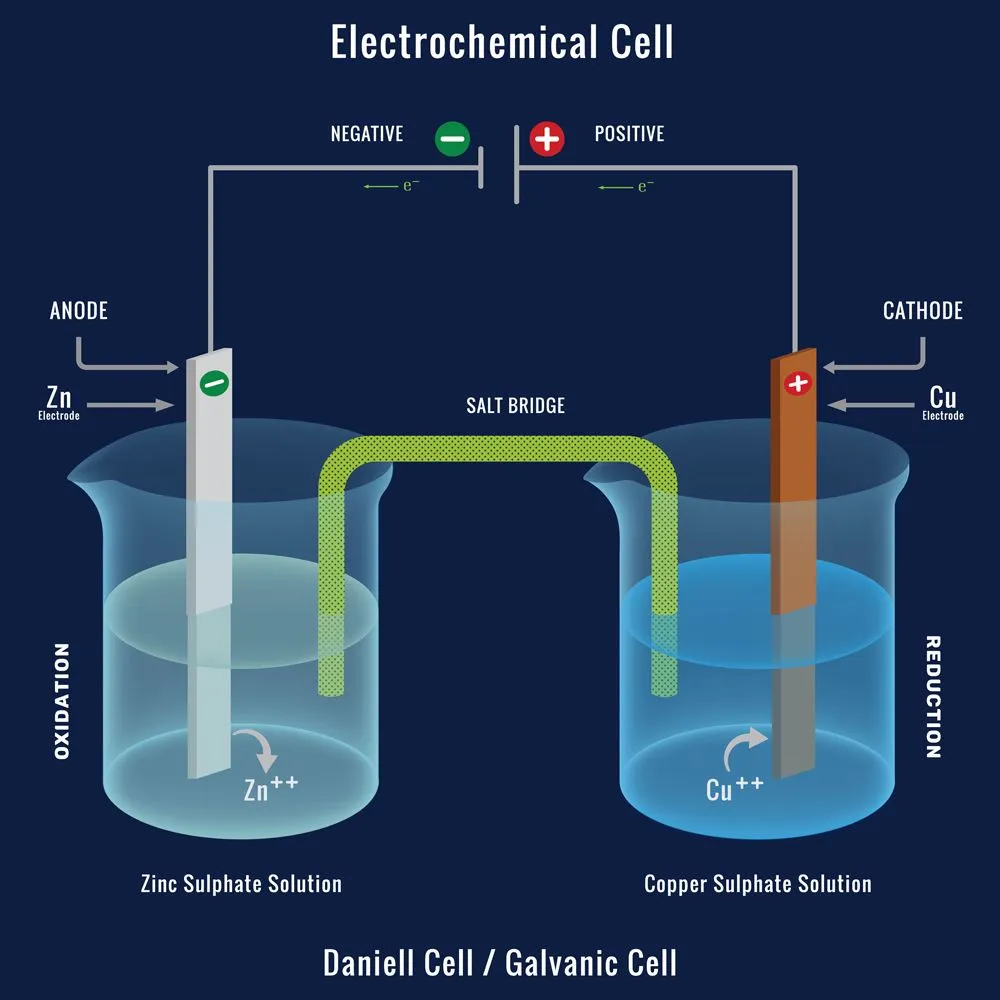
Each half cell consists of a metal (people) dipped into an electrolyte (Water). These two half cells are connected by an external wire through which electrons flow, and a salt bridge (the bridge) that allows ions to pass between the two electrolyte solutions to maintain electrical neutrality. In one of the metals, the loss of electrons (sacrifice) takes place, while the other metal gains (acquires) electrons. These electrons are transported through the external wire.
The metal where oxidation (loss of electrons) takes place is called the anode (Ants) and the metal where reduction (Gain of electrons) takes place is called the Cathode (Cats). Oxidation and Reduction cannot take place separately.
Zinc and Copper are commonly used as two electrodes dipped in Zinc sulphate and copper sulphate solutions, respectively. The Zn loses electrons and becomes Zn2+ (Oxidation), whereas the Cu2+ in the copper sulphate solution gains those electrons and becomes Cu.
The Anode corrodes, while the cathode grows. As we are already aware, the movement of these electrons is referred to as current or electricity. This is the simple working of the Galvanic cell.
How do I remember?
It’s a bit confusing to remember, which is where our acronyms come in handy.

Loss of electrons is called oxidation whereas the Gain of electrons is called reduction.
If a current requiring device, such as a bulb, is placed between the connecting wire, it glows due to the flow of electrons. This is how the Galvanic cell works as a source of electric power.
Galvanic Cell Vs. Electrolytic Cell: What’s The Difference?
So far, we have watched a galvanic cell make electricity all on its own. But it has a close cousin that works in exactly the opposite direction: the electrolytic cell. Both are electrochemical cells, which is why people mix them up so often.

A galvanic cell runs a spontaneous reaction (the Ants happily sacrifice their electrons to the Cats) and turns that chemical energy into electrical energy. An electrolytic cell does the reverse. Here you plug in an external power source, and that pushed-in electricity forces a non-spontaneous reaction to happen, converting electrical energy back into chemical energy.
Because the direction is flipped, the electrode signs flip too. In a galvanic cell, the anode is the negative terminal and the cathode is positive. In an electrolytic cell, the external battery makes the anode positive and the cathode negative. One thing never changes, though: oxidation always happens at the anode and reduction always happens at the cathode, in both types of cell.
Electrolytic cells are the workhorses of industry. They are used for electroplating, coating cheap metal objects with a thin layer of gold, silver, nickel or chromium; for extracting aluminum from its ore through the Hall-Héroult process (which alone uses roughly 5% of all the electricity in the United States); and for splitting water into hydrogen and oxygen. In fact, every time you recharge your phone or a rechargeable battery, you are briefly running a galvanic cell backwards as an electrolytic cell.
Types Of Galvanic Cells: From The Daniell Cell To Lithium-Ion
The zinc-and-copper arrangement we just built has a proper name: it is the Daniell cell, invented in 1836 by the British chemist John Frederic Daniell. It pairs a zinc electrode in zinc sulphate with a copper electrode in copper sulphate, and delivers a standard voltage of about 1.10 volts. So if you have ever wondered whether a Daniell cell and a galvanic cell are the same thing, the answer is that a Daniell cell is simply one specific example of a galvanic cell, not a different device.

Galvanic cells come in two broad families. Primary cells are the disposable, non-rechargeable kind. Their reactions are effectively irreversible, so once the chemicals are used up, the cell is dead. The alkaline dry cell in your TV remote or flashlight is the everyday example, putting out about 1.5 volts. (The tiny lithium-iodine cells that keep heart pacemakers running are primary cells too, delivering around 3.5 volts.)
Secondary cells are rechargeable. Their reactions can be reversed by pushing electricity back in, which is exactly the electrolytic trick from the previous section. The lead-acid battery that starts your car is a classic example, stacking cells of about 2.04 volts each; nickel-cadmium and lithium-ion cells (the rechargeable batteries in phones and laptops) work the same way.
There is even a special member of the family called the fuel cell. It is a galvanic cell that never runs flat, because it is fed a constant supply of fuel, usually hydrogen and oxygen, producing electricity and nothing but water as waste.
Conclusion
The concept that two metals, when in contact, can produce electricity, was discovered by Luigi Galvani. When two different metals were in contact and when both were touched at the same time to two different parts of a muscle in a frog’s leg, to close the circuit, the frog’s leg contracted.
Shortly after Galvani published his work (1791), Alessandro Volta began investigating the phenomenon and demonstrated that the frog was not necessary, using instead a force-based detector and brine-soaked paper (as an electrolyte). In 1800, Volta invented the voltaic pile, the first true battery. Hence, the terms Galvanic cells and Voltaic cells are often interchangeable and refer to the same setup.
Galvanic cells have a wide variety of applications, and are used in watches, clocks, remote controls, phones, cameras, laptops, and so many more common items. Traditional galvanic cells are primary (non-rechargeable) cells, but secondary galvanic cells (such as lithium-ion batteries) can be recharged. Being lightweight, portable, and compact are some of the key advantages of galvanic cells, which have changed the way we power our lives in countless ways!