Table of Contents (click to expand)
A pericyclic reaction is a concerted organic reaction in which bonds break and form simultaneously through a single cyclic transition state, with no intermediate. The electrons flow around a ring of π and σ bonds. The four types are electrocyclic reactions, cycloadditions (such as the Diels-Alder reaction), sigmatropic rearrangements and group transfers.
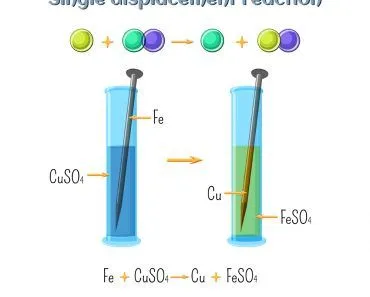
A chemical reaction is the essence of chemistry. Two or more chemicals react together to produce an entirely different product. In inorganic chemistry, there are four main types of reactions. These are combination, decomposition, single-displacement and double-displacement reactions.
Likewise, in organic chemistry, reactions are classified based on their mechanism. These three categories are polar (ionic), radical and pericyclic. You might have heard of the other two, but what about pericyclic reactions? How do they happen?
What Is A Pericyclic Reaction?
The word ‘peri’ means around, and ‘cyclic’ means circle. Thus, a pericyclic reaction refers to the continuous flow of electrons with π -bonds in the cyclic transition state (TS). The bond-breaking and bond-forming processes take place in concert, without forming an intermediate.
For the reaction to be pericyclic, a concerted system of bond formation is necessary. The bond-breaking and bond-forming take place at the same time, but not necessarily to the same extent or at the same rate. In most cases, the π-bonds enter the cyclic transition state.
Pericyclic reactions are initiated either by heat (thermal) or light (photo). These reactions are stereospecific. The stereochemistry of the product depends on the reactant’s stereochemistry. Thus, the reaction initiated by heat and light processes will yield results with opposite stereochemistry.
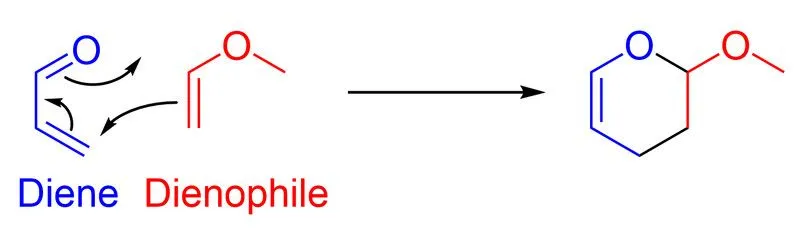
The Diels-Alder reaction is an ideal example of a pericyclic reaction. In the version shown here, acrolein (acting as the diene) and methyl vinyl ether (the dienophile) react together to form 2-methoxy-3,4-dihydro-2H-pyran, a six-membered ring. Here, three π-bonds break to form two σ-bonds and one π-bond in the product. This dihydropyran can later be hydrolyzed with acid to make glutaraldehyde, a common disinfectant, which is how the reaction is used industrially.
What Are The Types Of Pericyclic Reactions?
Though there are four basic types of pericyclic reactions, all follow the same trait of a concerted cyclic shift of electrons. The types of pericyclic reactions are cycloadditions, electrocyclic reactions, sigmatropic rearrangements and group transfer.
1. Electrocyclic Reaction
In an electrocyclic reaction, the π-bond terminals of the reactant form a σ-bond to complete the ring. Conversely, a σ-bond breaks to make an open ring system. This is a retro-electrocyclic reaction. All electrocyclic reactions are reversible reactions.
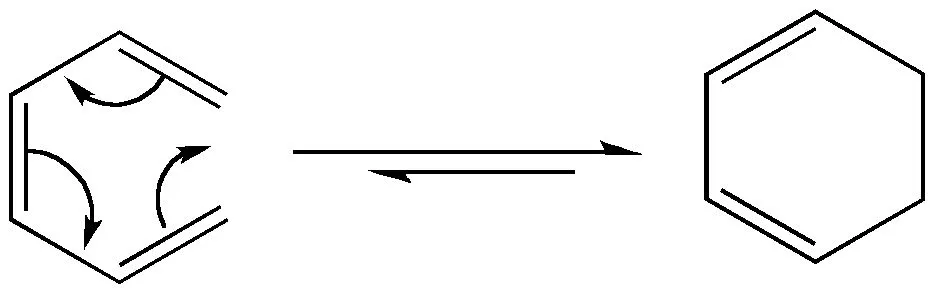
Based on the stereochemistry of the reactants, the product of the same electron system may differ in electrocyclic reactions.
2. Cycloaddition Reaction
In cycloaddition reactions, two or more components with π electrons react to form a ring. Each reactant loses a π-bond to create two new σ-bonds, which close the ring. The resulting cyclic product has two σ bonds and one π-bond.
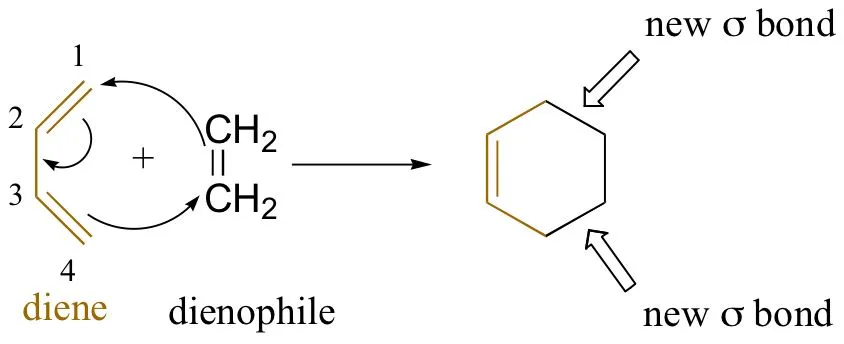
In the above reaction, buta-1,3-diene (diene) reacts with ethene (dienophile) to produce cyclohexene. The Diels-Alder reaction is the best-known cycloaddition. The reactants join through a cyclic transition state, breaking three π-bonds and forming two new σ-bonds (and one new π-bond) simultaneously.
3. Sigmatropic Rearrangements
A concerted rearrangement involves shifting electrons linked by a σ-bond to the terminal π-bond electron. This reaction is known as a sigmatropic rearrangement. It is because the σ-bond appears to move within the electron system during the reaction. The number of π and σ bonds remains unchanged.
The reaction is characterized by the double number system, i.e., [i,j]. The first number indicates the original position of the σ bond and, the second number denotes the new position of the migrating σ bond. For example, the [1,5] sigmatropic rearrangement.
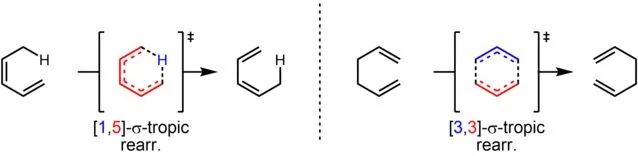
In this reaction, the migrating atom linked by a σ-bond to allylic carbon is numbered-1. The migrating atom-1 shifts to atom-5 of the alkenyl chain. Thus, the reaction is known as a [1,5] sigmatropic rearrangement.
A sigmatropic rearrangement can occur by two stereochemical processes. In the suprafacial process, the migrating group stays on the same face of the π system, whereas in the antarafacial process, it moves to the opposite face of the molecule.
4. Group Transfer
As the name suggests, this is a reaction in which one or more atoms or groups transfer from one molecule to another. The molecule is linked by a σ-bond. They might appear similar to sigmatropic reactions and cycloaddition reactions. However, it is a bimolecular reaction and does not lose a π -bond to form a ring by σ-linkage.
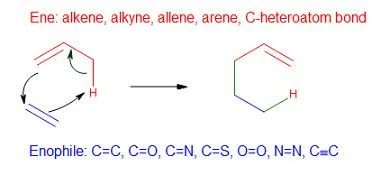
There are two kinds of group transfer reactions: ene reactions and diimide reductions. In an ene reaction, the alkene having an allylic hydrocarbon (ene) undergoes a thermal reaction with an enophile. Enophiles are compounds containing multiple bonds. In this reaction, the hydrogen atom of allylic carbon migrates from the alkene to the enophile.
The π-bond of the enophile gets replaced by two σ bonds with an alkene.
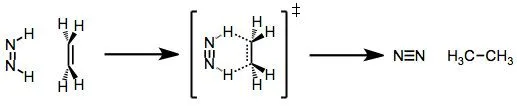
Diimide reduction is another type of group transfer reaction. In this reaction, an unsaturated hydrocarbon is reduced to an alkane by reacting with diimide (N2H2). Both hydrogen atoms transfer to the same face of the double bond in one step, and the diimide is oxidized to nitrogen gas (N2).
Theories That Predict The Pericyclic Reactions
There are three main theories to rationalize pericyclic reactions: The Conservation of Orbital symmetry, Frontier Molecular Orbital (FMO) method, and the Huckel-Mobius (HM) theory.
1. Conservation Of Orbital Symmetry
In 1965, Robert Woodward and Roald Hoffmann proposed the principle of Conservation of Orbital Symmetry. It states that in a concerted reaction, the symmetry of the molecular orbitals is conserved from reactants to products. This is also known as the Woodward-Hoffmann rules, and it predicts whether a given pericyclic reaction is allowed under thermal or photochemical conditions.
2. Frontier Molecular Orbital Theory
In 1952, Kenichi Fukui proposed the Frontier Molecular Orbital Theory (FMO). It focuses on the highest occupied molecular orbital (HOMO) and lowest unoccupied molecular orbital (LUMO). Such molecular orbitals are frontier molecular orbitals.
3. Huckel-Mobius (HM) Theory
Developed by Howard Zimmerman and Michael Dewar, this approach (the aromatic transition state theory) states that a thermal pericyclic reaction proceeds through an aromatic transition state, while a photochemical pericyclic reaction proceeds through an anti-aromatic one. Whether a transition state is aromatic depends on its orbital topology (Hückel or Möbius) and the number of electrons involved. The HM approach is also known as the perturbation molecular orbital (PMO) theory.
Conclusion
Pericyclic reactions have a significant role in several life processes. For example, chorismate in Escherichia coli undergoes a [3,3]-sigmatropic (Claisen) rearrangement to form prephenate, a key step in building the aromatic amino acids. A [1,7]-sigmatropic hydrogen shift occurs in the skin to convert previtamin D3 into vitamin D. Thus, studying pericyclic reactions can deepen our understanding of the biochemical processes at work in various organisms.
References (click to expand)
- (2018). Pericyclic Chemistry. []. Elsevier.
- Nagendrappa, G. (2004, September). Photochemistry and pericyclic reactions. Resonance. Springer Science and Business Media LLC.
- Pericyclic Reactions. Chemistry LibreTexts (University of Connecticut).
- (2016). Pericyclic Reactions. []. Elsevier.
- Woodward, R. B., and Hoffmann, R. (1969). The Conservation of Orbital Symmetry. Angewandte Chemie International Edition in English.