A double pendulum is simply two pendulums connected end to end. This system demonstrates chaos theory and how small variations lead to large changes.
A double pendulum is a system so simple that a fifth-grader could make it. Even so, this system and its motions are complex and extremely intriguing.
How a double pendulum moves around is a demonstration of chaos, a fundamental idea with far-reaching implications.
What Is A Double Pendulum?
A simple pendulum is a mass suspended from a fixed point. We see it inside pendulum clocks, relentlessly going back and forth to tell us the time. It gives us oscillatory motion, which is simple to trace. You give it a push, and it oscillates to and fro until frictional forces conspire to make it come to rest at the equilibrium position.
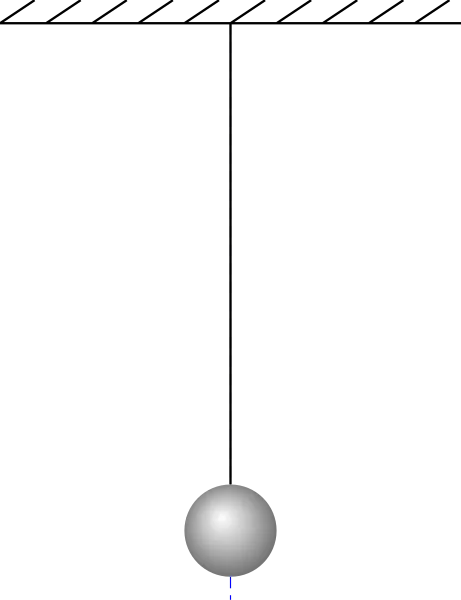
A double pendulum is exactly what it sounds like. It’s a simple system consisting of a pendulum with another pendulum attached to its end. Double the fun.
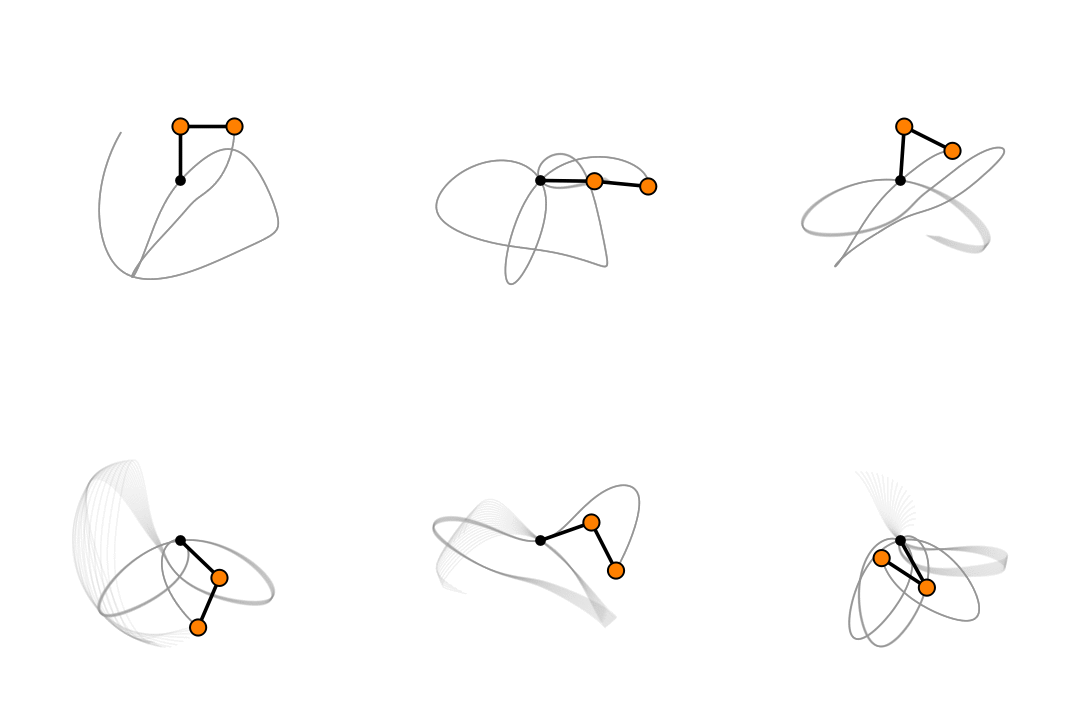
The motion of a double pendulum isn’t quite as simple as that of our single pendulum.
Simple Pendulum Vs Double Pendulum
A simple pendulum will undergo oscillatory motion and come to rest at the equilibrium position. That is as certain as the sun rises in the east, so to speak. It’s entirely predictable.
If you plot the motion of the pendulum, its angle from the vertical on the x-axis, and its velocity on the y-axis, you would get an inwardly tightening spiral. You could vary the initial conditions and make the spiral smaller or bigger, but ultimately the spiral ends at the same position. This graph is called a phase space.
Consider an ideal version of a simple pendulum, a point mass suspended by a massless rod. Friction and air resistance are not in the picture. If you plot it, you will get a loop. It doesn’t matter what the amplitude of the pendulum is, it will just be a different-sized loop.
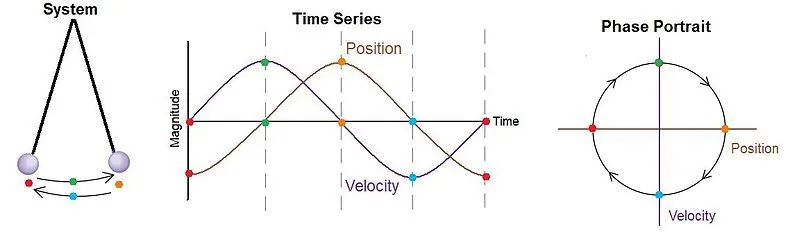
It doesn’t matter how you vary the initial conditions. If you have friction, it will always come to rest in the origin of the spiral. If you don’t, it will keep tracing a closed loop.
This means that the motion of a simple pendulum is predictable, which is exactly what a double pendulum is not.
Why the double pendulum and not the simple pendulum? A simple pendulum has only one degree of freedom. The double pendulum has two degrees of freedom. We need differential equations dependent on initial conditions to solve the motions of a double pendulum. This gives us the ingredients for chaos.
The Motion Of A Double Pendulum
The path of motion of a double pendulum looks crazy… because it kind of is! For small angles, double pendulums also give us simple harmonic motion, but for larger displacements, this is not the case. You can try out a live simulation of a double pendulum here.
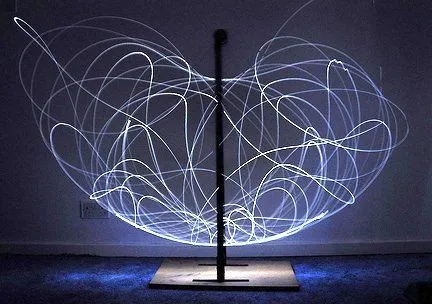
We can describe the motion of a double pendulum using a system of ordinary differential equations. We must go to Lagrangian mechanics to figure out the equations of motion for double pendulums. If you want to know how these equations are derived, check out the video below.
This may seem confusing to some readers. If we have the equations of motion, why would the system be unpredictable? Solve the equations and we can predict the motion of the pendulums, right?
The trouble is that the system of the double pendulum is extremely dependent on initial conditions. If we cannot determine the initial conditions with 100% certainty (and in physics, we don’t throw around percentages lightly), we cannot predict the behavior of the system.
Since it is impossible to achieve that level of certainty, we cannot predict the motion of a double pendulum. Two double pendulums released from the same spot simultaneously will have a slight variation in their initial conditions. This will translate into a dramatic change in trajectory in a very short time. The variation in their paths will increase rapidly and exponentially.

The complexity of a double pendulum as opposed to a single pendulum is somewhat like the infamous three-body problem. You can predict the behavior of two bodies that influence each other, but add one more, and the system becomes too complex.
The Double Pendulum And Chaos Theory
A double pendulum is one of the simplest demonstrations of chaos theory. You may know this as “the butterfly effect”, but there is much more to it. One of the defining characteristics of chaos is sensitivity towards variation in initial conditions.
In the video below, the creator has made a simulation of 500 double pendulums with slight differences in their starting angles. By slight, I mean one-millionth of a radian. Two adjacent double pendulums are initially only different by one-millionth of a radian. They start out tracing the same paths. But as you can see, within seconds, their paths diverge dramatically.
This happens because of the chaotic nature of the system.
The point to note here is that this system is chaotic, but not random. It’s just very, very sensitive to initial conditions. If you have two double pendulums with the exact same initial conditions, they would trace the same path. The system is simply very unforgiving towards even a teeny tiny change. It will most certainly make a mountain out of a molehill.
However, in reality, it is impossible to release two double pendulums with the exact same initial conditions. Therefore, it will be impossible to predict the path the pendulum will trace.
This is a peek into how all chaotic systems work. The double pendulum demonstrates how we cannot make accurate predictions about chaotic systems.
When numerous instances are taken together, chaotic systems like double pendula do form patterns, called fractals.
The Fractal Hidden In The Double Pendulum
We have called the double pendulum chaotic, but what does that chaos actually look like when you map it out? One way of drawing it is genuinely beautiful. Imagine releasing a double pendulum from rest, then doing it again and again, each time from a slightly different pair of starting angles, θ1 for the upper arm and θ2 for the lower one. For every pair, you ask a single question: how long before one of the arms swings all the way over the top and flips? Shade each starting pair according to that flip time, and an intricate picture emerges.

That picture is a fractal. Zoom into the swirling boundaries between the colored bands and you keep uncovering more detail, swirls nested inside swirls, with no smallest scale. Two starting positions sitting right next to each other can fall into completely different bands, one arm flipping almost at once while its near-twin waits through thousands of swings. It is the same sensitivity that drives the butterfly effect, here turned into a map you can actually see.
The calm white region in the middle is the exception. Those starting angles simply do not give the pendulum enough energy to ever throw an arm over the top, so it never flips, no matter how long you watch. The edge of that region can even be written down exactly, as the tidy condition 3 cos θ1 + cos θ2 = 2. Step outside it, and the chaos takes over. Physicists still map these fractal basins today to gauge just how chaotic the pendulum becomes as you change the weight of each arm.
Why Can’t We Just Solve The Equations?
By now a reasonable objection might be nagging at you. The double pendulum obeys ordinary physics, so why can’t we just write down its equations and solve them once and for all? We can certainly write them down. The system has two degrees of freedom, the angles θ1 and θ2, and pouring its kinetic and potential energy into Lagrangian mechanics hands us two equations of motion, one for each arm.

The trouble is their shape. The two equations are coupled, so the motion of the upper arm shows up inside the equation for the lower arm and vice versa, and they are nonlinear, stuffed with sines and cosines of the angles. A lone simple pendulum rewards you with a clean formula you can solve once and reuse forever. The double pendulum offers no such gift. For anything beyond tiny swings, no closed-form solution, no formula that simply returns θ1 and θ2 at some future moment, is known to exist.
So how does anyone simulate one? We hand the equations to a computer and let it inch forward in tiny time steps, a method called numerical integration (the popular workhorse is the fourth-order Runge-Kutta scheme). It works, but it carries the same curse as the real pendulum. Any tiny rounding error in the starting numbers grows exponentially, so even the computer’s forecast eventually wanders away from the truth. That is the real sense in which a double pendulum is “impossible”. It is not that we don’t know the rules, it is that the rules refuse to be solved ahead of time.
The Unpredictability Of The World
We see how chaotic behavior makes a system as simple as two balls on two strings nearly impossible to predict. What patterns would a million double pendulums released together make? What about triple pendulums?
Our world comprises a number of such impossible-to-predict and chaotic systems. Even our solar system exhibits chaotic behavior when you consider longer periods of time. Through the double pendulum example, we see chaos theory in action and can understand how difficult it is to predict the world around us!
References (click to expand)
- Shinbrot, T., Grebogi, C., Wisdom, J., & Yorke, J. A. (1992, June). Chaos in a double pendulum. American Journal of Physics. American Association of Physics Teachers (AAPT).
- Double Pendulum -- from Eric Weisstein's World of Physics. Wolfram Research, Inc.
- The Simple Pendulum - Graduate Program in Acoustics. The Pennsylvania State University
- Double Pendulum - Course:PHYS350. University of British Columbia (UBC Wiki).
- Double pendulum. Wikipedia.
- Qin, B., & Zhang, Y. (2024). Characterizing the fractal basins of attraction and the level of chaos in a double pendulum. Chaos, Solitons & Fractals, 189.