Table of Contents (click to expand)
The Higgs boson, nicknamed the God particle, is a ripple in the Higgs field, the field that gives elementary particles their mass. Particles that interact strongly with it are heavy, while massless ones like the photon do not interact at all. It was discovered at CERN in 2012 with a mass of about 125 GeV.
Have you ever wondered how everything around us came to have mass, why photons (which make up the light we see) are massless, or what would happen if nothing in the universe had any mass?
These were the types of questions that ultimately lead the way to the particle we now know as the Higgs Boson.
The Idea Of Higgs
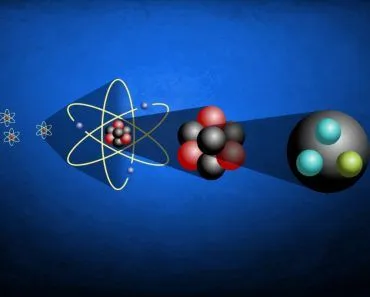
The story starts in the 1960s, when scientists were just beginning to understand elementary particles. These particles are the basic building units of matter and energy in our universe. Scientists had begun working on a model that helped them sort out and study these particles, which they called the ‘Standard Model’.
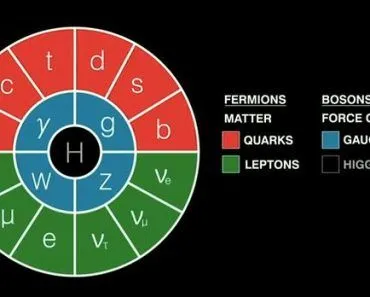
This model has two main types of particles: matter particles and force carrier particles.
In total, there are four fundamental forces, of which three are acknowledged in the Model (electromagnetic, strong, and weak nuclear forces). Furthermore, each fundamental force relies on its own set of rules defined by mathematics, quantum physics, and the special theory of relativity.
In general terms, these rules are called quantum field theories. So technically, for three forces, we must have three sets of rules or three quantum field theories.
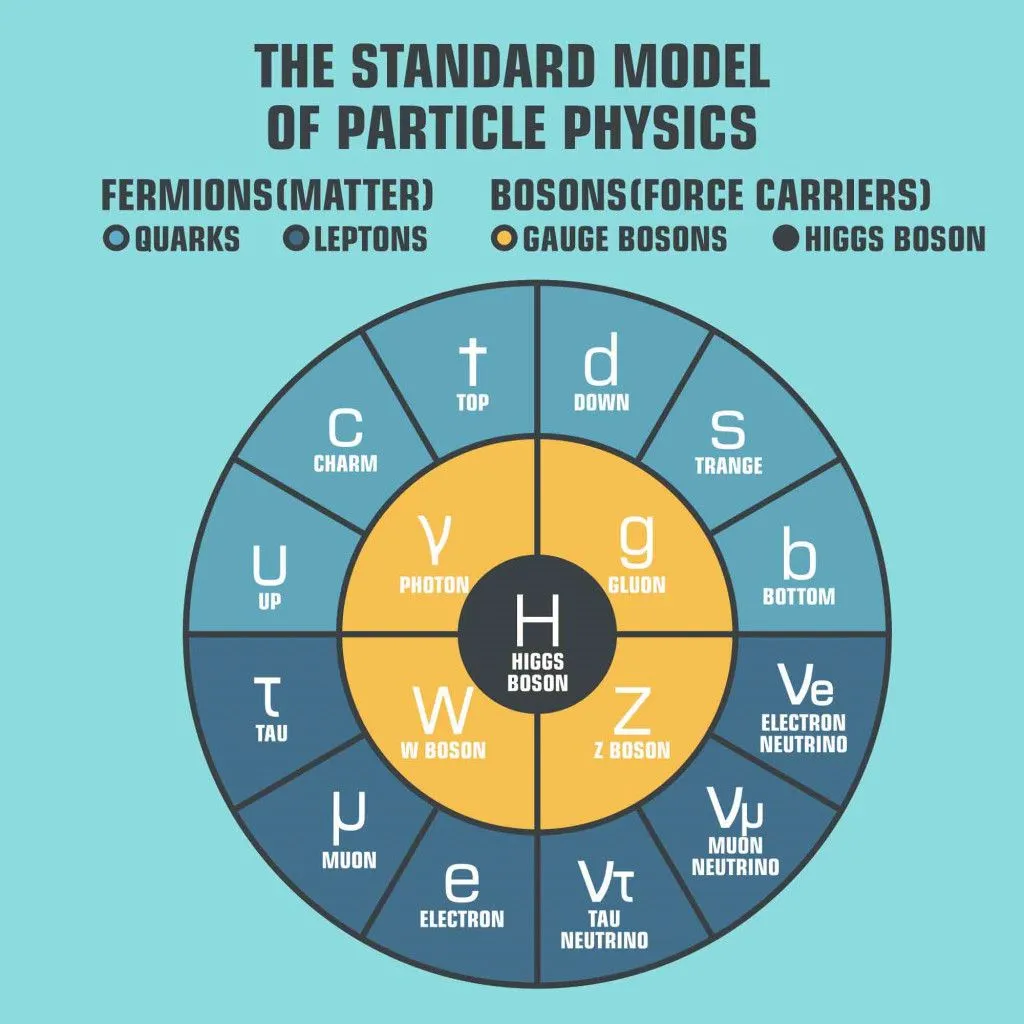
But it was while working on this Standard Model, building quantum field theory for each force, that scientists realized something strange… Two of the fundamental forces, electromagnetic and weak, turned out to have the same quantum field theory. This meant that both forces had the same origin, which they named the electroweak force.
However, this was quite strange, because a photon, which is a force-carrier of electromagnetic force, is massless. On the other hand, W and Z bosons, the force carriers of weak force, had some of the highest masses in the model.
If they had the same origin, what made the two forces split, such that one gained mass and the other did not?

Physicists Robert Brout, François Englert, and Peter Higgs proposed that the mass must have come from another force that is also responsible for splitting the electroweak force. They called this force field the ‘Higgs Field’ source.
What Is The Higgs Field?
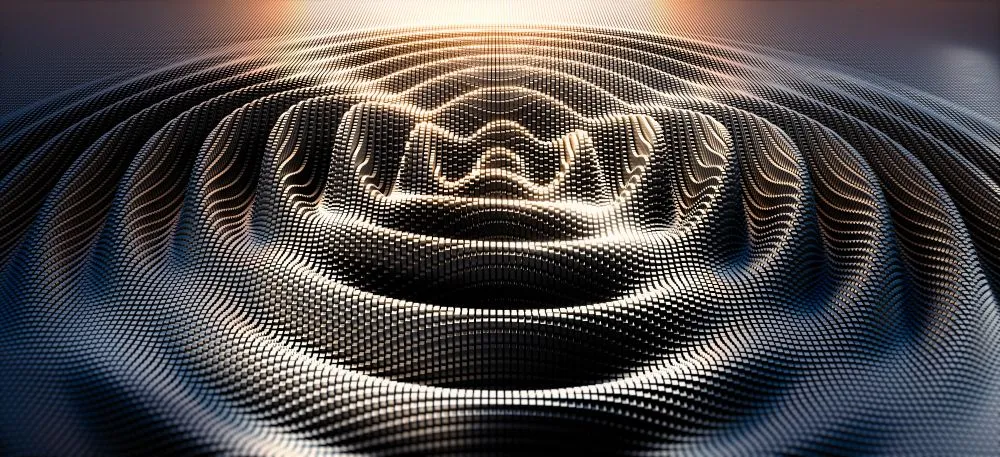
Imagine a sheet of fabric as the Higgs field. Any kind of disturbance in this field (a crease, a wave, or a dent) will be the Higgs boson.
Now, let’s imagine a particle as a marble moving on this field. We all know how a marble would shift the fabric and create a slight dent or shift in it. Any kind of disturbance, which in this case is the shift in the fabric, is seen as the Higgs boson particle itself. In short, any kind of disturbance in the Higgs field is what we know as the Higgs boson. Therefore, when a particle interacts with the Higgs field or disturbs it in any way, it is interacting with Higgs boson, the particle.
The larger the disturbance a particle creates, the more its motion is hindered. Think of dragging a marble through thick honey: the more it interacts with what surrounds it, the harder it is to get it moving and the more sluggish it feels. For elementary particles, that resistance to being accelerated is exactly what we measure as mass.
So the more a particle disturbs the Higgs field, the harder it is to push around and the more mass it gains. When we look at the mass of particles, then, the more massive ones are interacting a lot with the Higgs field, while the massless ones are not interacting with it at all.
But how is the Higgs field different than the other force fields? For this, we need to understand the two types of force fields – scalar and vector.
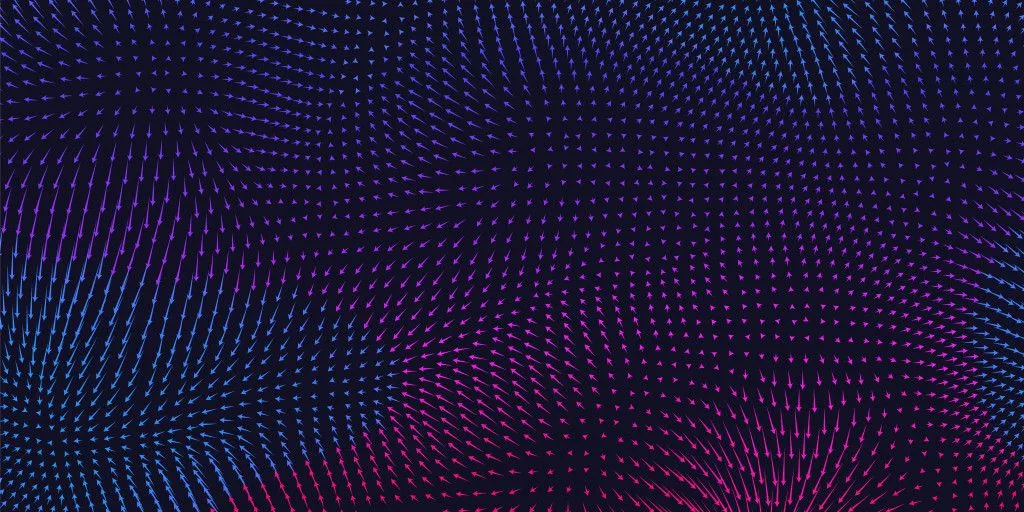
Vector fields have direction, i.e., we know that a force is moving from one direction to the other, like the case in a magnetic field.
However, in the case of scalar fields, there are no directions at all. Before the discovery of the Higgs field, we did not know of any scalar field. So, this is the most unique field of its kind, one that is also responsible for the special work of providing mass to the particles.
This also answers a question many people ask: is the Higgs boson a force carrier? Not in the usual sense. The familiar force carriers (the photon, the W and Z bosons, and the gluon) are spin-1 particles that ferry the electromagnetic, weak, and strong forces. The Higgs boson is different. It is the only known elementary scalar particle, with zero spin, and rather than mediating one of the four fundamental forces, it is simply the visible ripple of the field that hands out mass.
How Did Higgs Give Mass To The Universe?
The moment after The Big Bang, the temperature of the universe was extremely high. It was nothing but a densely packed sea of elementary particles that had no mass. This was when the electroweak force was intact and photons, W, and Z particles were massless. The question is, where was the Higgs field during this time?
Believe it or not, the Higgs field was there since the beginning, but for it to come into action, the universe needed to cool down to a certain temperature (source).
Quickly, the universe began cooling down and expanding. After the universe reached the threshold temperature for the Higgs field, the effects kicked in. Every particle interacting with the field gained mass. The more the particle interacted with the Higgs Boson, the more it slowed down; that slowing down is what we know as the mass of the particles.
Particles such as the W and Z boson interacted a lot with the Higgs boson and therefore had a large mass, whereas photons did not interact at all, leaving them massless and free to travel at the fastest speed in the universe, the speed of light. Photons were like tiny marbles that never touched the Higgs field and hence never gained mass from it. On the other hand, W and Z bosons were heavier marbles that interacted too much with the fabric of the Higgs field.
This is how the electroweak force was split into electromagnetic and weak forces.
What Happens If There Is No Higgs Field?
There is a reason why the Higgs boson is called the God particle. Imagine the very atoms of which we are made. Those atoms have electrons orbiting a heavy nucleus. Now imagine if there were no Higgs field. The electron gets its mass from the field, so without it the electron would be massless and would race around at the speed of light, never settling into an orbit around the nucleus.
(Curiously, the nucleus itself would still be heavy. Most of a proton's mass comes not from the Higgs but from the energy of the strong force binding its quarks together. The Higgs hands out mass to the elementary particles, such as the electron and quarks, not to the bulk of the nucleus.) Even so, with massless electrons, atoms could not hold together, which means no chemistry, no molecules, and nothing in the universe as we know it… no stars, no planets, no living things. Thus, the Higgs field is essential to ordinary matter as we know it, which is why the boson tied to it is aptly called the God particle. In its absence, the universe would be, quite literally, formless.
Conclusion
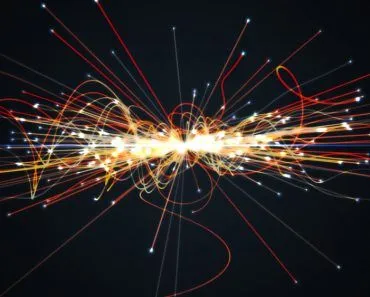
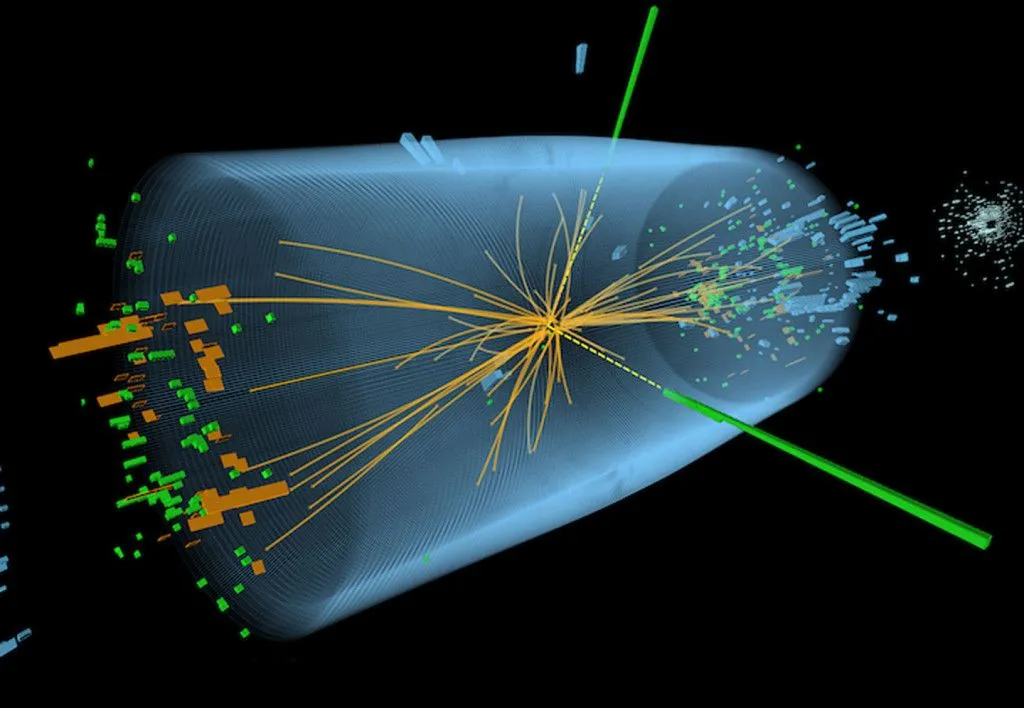
Even though the theory of the Higgs boson was proposed back in 1964, it took nearly half a century before scientists finally discovered the particle in the lab. In the Large Hadron Collider (a 27 km (17 mi) ring where particles are smashed into each other to create new ones) at CERN, the ATLAS and CMS experiments first glimpsed this particle. They collided protons head-on to observe the fleeting formation and decay of the Higgs boson.
On 4 July 2012, with observations finally precise enough, CERN announced the discovery, pinning the Higgs boson's mass at roughly 125 GeV (about 133 times the mass of a proton). The find completed the Standard Model, and in 2013, François Englert and Peter Higgs shared the Nobel Prize in Physics for predicting the mechanism behind it.
Now, physicists are looking into other hypothetical particles, or rather, particles that currently exist only in theory, such as dark matter and magnetic monopoles. Who knows, perhaps one day we’ll have the chance to celebrate the discovery of a new particle again!
References (click to expand)
- The Higgs boson - CERN. The European Organization for Nuclear Research
- A New Map of All the Particles and Forces | Quanta Magazine. Quanta Magazine
- What's So Special About the Higgs Boson? - CERN. The European Organization for Nuclear Research
- Quigg, C. (2015). Electroweak Symmetry Breaking in Historical Perspective. Annual Review of Nuclear and Particle Science.