The Tyndall Effect is the phenomenon of the scattering of light by colloidal solutions and suspensions. It is responsible for our blue skies, the scattering of light in fog and many other fascinating events that we easily take for granted!
After beginning its 8-minute journey to reach the surface of our planet, sunlight goes through many physical spaces that change it in certain aspects. Aside from the sun’s rays, the light generated and emitted by electronic instruments is also subjected to many changes in our atmosphere.
For instance, the color of the sky changes as light moves through the atmosphere. Driving on a cold blue winter night full of fog, people often use the fog lights present in their vehicles. These instruments release rays that illuminate the path ahead, regardless of the amount of fog present.
The mysteries of light mentioned above and many more can be unravelled by studying the simple concept of the Tyndall Effect. However, to understand this phenomenon, one should first be acquainted with the process of scattering light.
What Is The Scattering Of Light?
The scattering of light implies distributing it in all directions. When a parallel beam of rays strikes a particle of appropriate size (smaller than its own wavelength), the particle absorbs the rays and emits (or releases) them in all the directions, except the direction by which the rays arrived; this entire phenomenon is known as the scattering of light. The size of the particle, as mentioned earlier, is a key aspect of this phenomenon, as particles of all sizes cannot scatter light of all wavelengths.
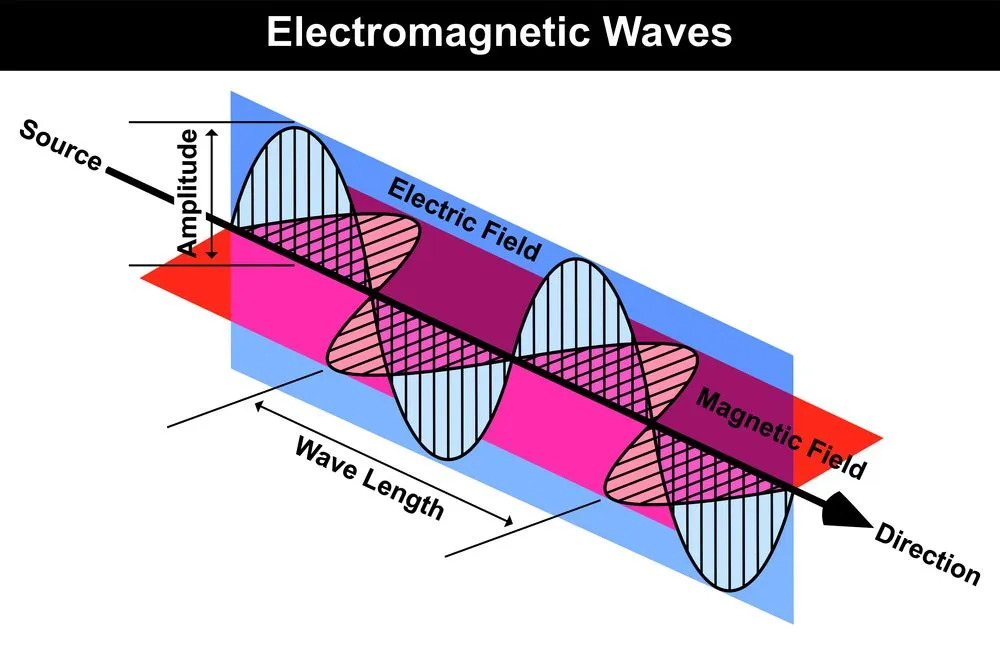
Light beams are nothing but electromagnetic waves (radiation). A ray of light has many properties that define its characteristics. Two of the most important of these are its frequency and wavelength. The size of light waves is measured as the wavelength, which is the distance between any two corresponding points on successive waves (we typically measure this as the distance between two continuous peaks or crests of a wave). The frequency of a beam, on the other hand, is the number of waves that pass a particular point in space every second.
What Is The Tyndall Effect?
The Tyndall Effect is the phenomenon of the scattering of light by the particles present in a colloid or very fine suspension. To be classified as a colloidal solution, a material must have particles with dimensions (length, width, thickness) in the range of 1-1000 nanometers. Suspensions are heterogeneous mixtures composed of solid particles that do not dissolve in the liquid or gas present. The particles in a suspension are larger than about 1000 nanometers (1 micrometer); they are often visible to the naked eye and settle out under gravity if left to stand. The only difference between a colloid and a suspension is the size of the particles.
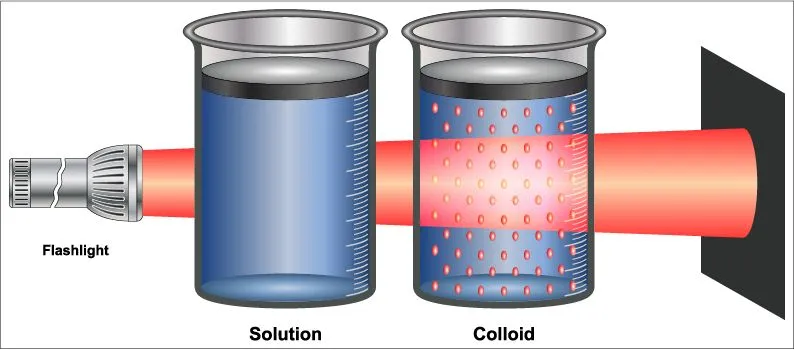
Some common examples of colloids used in our everyday life are whipped cream, mayonnaise, butter, milk, gelatin and paper. Examples of suspensions include muddy water, flour stirred into water, chalk powder in water, and calamine lotion. (Salt water and sugar water are true solutions, not suspensions, because the salt and sugar fully dissolve at the molecular level.)
The light emitted from a particle after the scattering occurs appears to be of different colors, depending on its wavelength. The reason behind this selective scattering is the relationship between the intensity of the light being scattered and its wavelength. For particles much smaller than the wavelength of light (the regime called Rayleigh scattering), the amount of light scattered is inversely proportional to the fourth power of its wavelength. This means that shorter wavelengths (such as violet or blue) are scattered far more than longer wavelengths (such as red or yellow). For the larger colloidal particles that produce a true Tyndall beam, the wavelength dependence weakens and is described by Mie theory; the scattered light tends to look whiter than the strongly blue tint of a sunlit sky.
The Tyndall Effect On A Molecular Level
When light strikes a molecule that is smaller than its wavelength, it’s absorbed by the particle. The electric fields of this ray temporarily polarize the molecule by pushing the electrons in one direction. This leads to the formation of a weak net electrical charge (positive on one side and negative on the other), which is known as a dipole moment. As light propagates inside the molecule, the direction of the dipole keeps changing, and as it re-interacts with the electric fields of the rays, the molecule emits them in all directions.
Tyndall Or Rayleigh? Why The Sky Is Blue
You will often see the blue sky cited as a textbook example of the Tyndall effect, and in popular usage that is fine. Strictly speaking, though, chemistry textbooks reserve "Tyndall" for scattering by colloidal particles (roughly 1–1000 nm) and use Rayleigh scattering for scattering by individual molecules, which is what makes the sky blue.
Our atmosphere is mostly nitrogen (N₂) and oxygen (O₂) molecules, with traces of carbon dioxide and argon. These molecules are far smaller than the wavelengths of visible light, so they scatter sunlight in classic Rayleigh fashion: the shorter waves (violet and blue) are scattered roughly sixteen times more than the longer ones (red and orange). Our eyes are more sensitive to blue than to violet, so the sky reads as blue.
Similarly, during sunrise and sunset, sunlight travels a much longer slanted path through the atmosphere before reaching our eyes. The short blue wavelengths get scattered away along the way, leaving the longer red and orange wavelengths to reach us. That is why the horizon glows orange and red at dawn and dusk. In foggy weather, light rays strike the much larger water droplets that make up fog (a true colloid), and the resulting Tyndall scattering sends light in every direction, which is exactly why a flashlight or headlamp beam in fog looks like a visible shaft of light.

A Final Word
When John Tyndall discovered the phenomenon of scattering light from colloids, he probably didn’t think that it would lead to the foundation of a new branch of science: Spectroscopy. This area of study deals with detecting the properties of an unknown substance by analyzing the spectrum of light emitted by it.
Similarly, many small discoveries have led to the beginning of something much larger that has helped humanity’s quest for understanding this universe. In other words, our imagination should not be limited by the scale of an idea. Keep learning and keep thinking; these are two of our greatest gifts!