To you (the shooter inside the train), the bullet behaves exactly as it would on a stationary platform. To an outside observer standing still on the ground, however, the bullet’s speed is the train’s speed plus the bullet’s muzzle velocity (if you fire it forward), or the muzzle velocity minus the train’s speed (if you fire backward). It’s a textbook example of Galilean relativity.
After watching the dozens of action movies where a hero fires a gun from a moving train at his adversaries, have you ever thought about how all those bullets would appear to bystanders that are standing still on the ground?
Obviously, watching a shootout would be pretty scary, but how would the physics of two bodies in motion (train and bullet) affect the situation?
Relative Velocity
First off, we have to make an assumption that will apply throughout this article. We have to assume, for this article, that the bullet in question has the same velocity as the train (although in reality, most bullets travel faster than a train).
If you are in the front compartment of a train that is standing still, and you shot a bullet traveling at 1000 miles per hour, sure enough, the bullet would move away from you at a speed of 1000 miles per hour. Furthermore, the bullet would appear to travel at the same speed to anyone standing still on the ground (facing the direction in which you shot the bullet). This is because you are at rest (as is anyone standing still on the ground), so the relative velocity of the bullet remains the same as its original velocity – 1000 mph!
However, if you shot a bullet in the forward direction while standing in a train that is also traveling at 1000 mph, would the bullet still appear to travel as fast as it did when the train was standing still?
The answer is Yes!
Shooting A Bullet In The Forward Direction
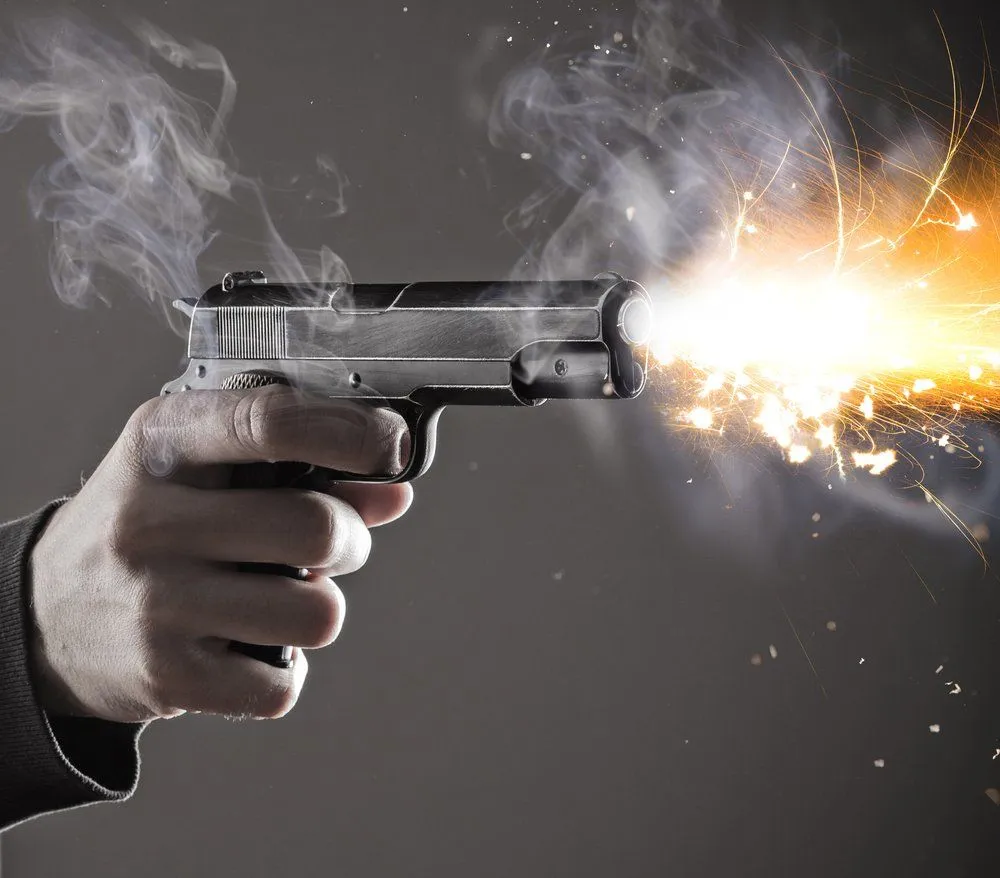
In the previous case, you were standing still in a train that was not moving at all, so the relative velocity between you and the train was zero. In this case, the train is moving at 1000 mph; since you are standing in the train itself, you are also traveling at the speed of the train (1000 mph). Effectively, the relative velocity between you and the train once again comes out to be zero. This is why, to you, the bullet would appear perfectly normal as it moved in the forward direction.
However, consider the individual standing still on the ground when you shoot the bullet in the forward direction. What would they observe? Would it be any different from what you observe?
Yes, it will be! To a person standing still on the ground, the bullet would appear to travel at 2000 mph. Since the person is standing still on the ground, the relative velocity between them and the train (moving at 1000 mph) is 1000 mph. In addition, relative to the train, the speed of the bullet is 1000 mph. Therefore, relative to the ground, the bullet’s speed is 2000 mph (1000 mph+1000 mph).
Shooting A Bullet In The Opposite Direction
Now, to complicate matters, what if the bullet were to be shot in the opposite direction of the train’s movement?
In that case, to a person standing still on the ground, the speed of the bullet would appear to be zero. This is because when the bullet and the train travel with equal speed, but in opposite directions, their resultant relative velocity cancels out and becomes zero.
How Fast Does A Bullet Actually Travel?
Throughout this article we pretended the bullet and the train both move at 1,000 mph (about 1,600 km/h, or 447 m/s) so the numbers stay tidy. In the real world that assumption breaks down badly, because a bullet is much faster than any train you could ride. A typical 9mm pistol round leaves the barrel at roughly 352 m/s (1,155 ft/s, or about 790 mph). Heavier handgun rounds like the .357 Magnum push past 440 m/s (1,450 ft/s).

Rifles are faster still. A .223 Remington round travels at around 988 m/s (3,240 ft/s), and a .308 Winchester at roughly 838 m/s (2,750 ft/s). Forensic ballistics references group these speeds into bands: low velocity is below 1,000 ft/s (305 m/s), medium is 1,000 to 2,000 ft/s, and high velocity is anything above 2,000 ft/s (610 m/s). Most rifle bullets sit firmly in the high band, which is why the schlieren image above shows a visible shock wave: the bullet is moving faster than sound (roughly 343 m/s in dry air at 20 °C).
Now compare that to a train. The Shanghai maglev, one of the fastest passenger trains ever to run in service, hit about 431 km/h (120 m/s, or 268 mph) during its high-speed windows before its everyday cruising speed was lowered to 300 km/h. Even that record-setting train was roughly three times slower than a humble pistol bullet, and about eight times slower than a rifle round. So in any realistic shootout, the train's speed is a small correction on top of the bullet's muzzle velocity, not an equal partner. The forward shot would look fast to a bystander, while the backward shot would not hang motionless in the air, because the bullet's real muzzle velocity dwarfs the train's speed by hundreds of metres per second.
What About The Recoil On The Train?
So far we have only tracked the bullet. But there is a second body in this story that the movies never mention: you, the shooter. When a gun fires, the bullet does not simply appear with a velocity out of nowhere. The expanding gases push the bullet one way and shove the gun (and your shoulder) the other way. This is the conservation of linear momentum at work, and it is the same principle that makes a gun recoil whether you fire it on a train, on a boat, or on solid ground.

Before you pull the trigger, the gun and bullet together are at rest relative to the train, so their combined momentum (measured from the train) is zero. After firing, that total must still be zero. If the bullet carries momentum mbvb forward, the gun must carry an equal and opposite momentum backward, so its recoil speed is vg = mbvb / Mg. Take an 8-gram bullet leaving at 350 m/s from a 5-kg rifle: the recoil works out to (0.008 × 350) / 5, or about 0.56 m/s. The bullet flies off at 350 m/s while the gun lurches back at barely half a metre per second, simply because the gun is hundreds of times heavier than the bullet.
What does this mean for the train? In principle, firing a bullet backward gives the train a tiny forward nudge, and firing forward nudges it backward, since the train, the shooter, and the rails are all part of one connected system. But the numbers are laughably small. A single bullet's momentum is a rounding error next to the momentum of a train weighing hundreds of tonnes. So no, you cannot speed up a train by firing a gun out the back of it. The recoil you feel in your shoulder is real and follows directly from momentum conservation, but the train itself barely notices.
Relative velocity is just a single constituent of a vast field dealing with the relative motions between different physical quantities. It turns out that you deal with these every day in some form. Look at the world around you and try to spot as many of these fascinating physical relationships as you can!
References (click to expand)
- Relative Motion. Georgia State University
- H Semat. Physics, Chapter 2: Motion of a Particle (Kinematics). The University of Nebraska–Lincoln
- Firearms Tutorial: Ballistics (muzzle velocity tables and low/medium/high velocity classification). WebPath, University of Utah
- R. Merlino. Impulse and Momentum; Conservation of Momentum and Recoil. Department of Physics and Astronomy, University of Iowa
- Shanghai maglev train (operational speed figures). Wikipedia