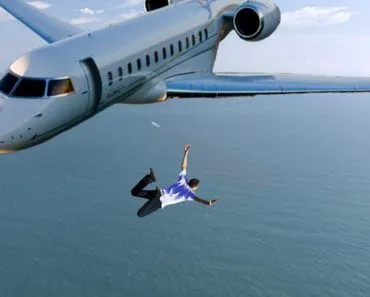
Water stops most bullets within a few feet, because drag rises with the square of a bullet’s speed. Counterintuitively, fast rifle rounds (even a .50 caliber) shatter within about 1 m (3 ft), while slower pistol rounds like a 9mm can stay lethal down to roughly 2.4 m (8 ft). Fired at a shallow angle, just 0.9-1.5 m (3-5 ft) of water is usually enough cover.
In many movies, there are scenes where people jump into the water to avoid getting hit by a bullet. For instance, remember the infamous scene of Saving Private Ryan, when Allied forces were pinned down by heavy machine-gun fire from the bunkers on Omaha Beach so that they jumped over the sides of the boats into the water to avoid being hit by bullets?
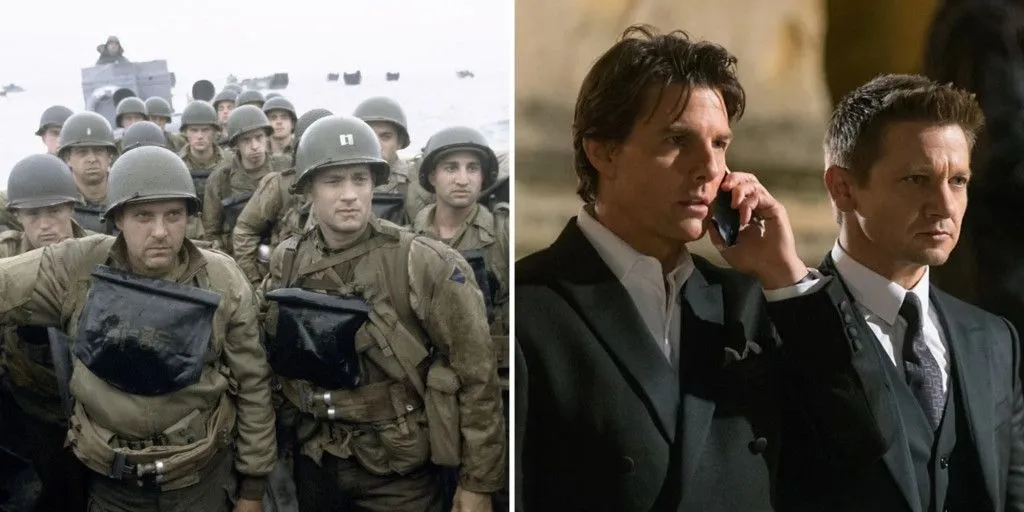
Similarly, Ethan Hunt and William Brandt crash into the water in Mission Impossible: Ghost Protocol after their car gets shot. These scenes are just a few examples of how movies show that diving into a body of water, such as a pool, canal, or ocean, can protect against bullets.
The portrayal of this ‘underwater myth’ in movies is inconsistent, sometimes suggesting that being underwater saves you, while other times it does not.
Therefore, it is time to end this debate and clarify once and for all whether this is a fact or a fiction.
Speed Versus Drag
You may already know that every medium offers some resistance to the movement of an object as it moves through it.
Thus, the air surrounding us offers resistance to our everyday movements, such as walking or running, as we move through it. We have become so accustomed to not feeling this resistance as strongly as we feel the resistance of water when swimming.
This resistance, or a liquid’s resistance to the movement of an object moving through it, is called drag.
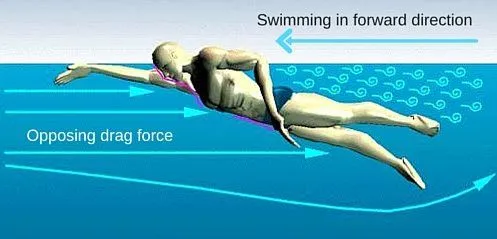
Water resistance acts as a force that hinders your swimming speed and slows you down. This same force also works against the forward movement of a ball in games like cricket.
When a ball is thrown through the air, it quickly reaches its target. But once it enters the water, it has to contend with the natural resistance of the water, which makes it more challenging to move forward.
As a result, most bullets do not travel more than a few feet when submerged in water.
Check out the image below from a Discovery Channel documentary of D-Day in Omaha Beach.

The bullet is discharged from an MG-42 machine gun, which is a very powerful firearm. The bullet exits the gun at an astonishing speed of about 2,480 feet per second, but it decelerates and stops within a distance of less than a yard (2.5 feet at most)!
Factors That Influence The Speed And Range Of An Underwater Bullet
The drag is the biggest obstacle for a bullet trying to move quickly and deeply underwater. However, does the resistance exerted by water remain the same for all objects that move through it?
The drag force is influenced by several factors, such as the type of projectile, its velocity when fired, the drag coefficient of the projectile, and the duration spent in water. Additionally, it is affected by the density of the fluid, which is water in this particular instance.
For people who have a thing for formulas, here is the drag equation:
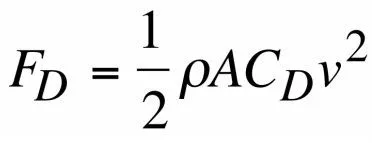
where FD is the drag force, ‘p’ (rho) is the mass density of the fluid, v is the flow velocity relative to the object, A is the reference area, and CD is the drag coefficient.
As you can see from the formula, water’s drag force (FD) is proportional to the square of the bullet speed (v²). This means that doubling the bullet speed quadruples the drag force, so faster bullets actually decelerate much more rapidly in water.

Precisely!
Also, the denser the fluid is, the slower a bullet will get as it moves forward. For instance, the density of water is higher than air, so a bullet will slow down much more quickly in water.
A TV Show Has Tested This In Reality!
In one of its episodes, Mythbusters, a popular program on the Discovery Channel, put water’s “bullet-proof” ability to test. They fired several rifles, including a 9mm pistol, shotgun, M1 Garand semi-automatic rifle, and a 50-caliber rifle into the water. They concluded that water could provide protection from most rifles during an underwater attack.
In real life, however, a bullet is rarely fired from a position directly above the water. So if the bullet is shot from an angle of 30 Degrees, then being underwater in the range of 3-5 feet (0.9-1.5 meters) can ensure your safety from most guns.
As it turns out, most films are scientifically accurate when they show the protagonist jumping into a pool of water to escape the hail of bullets that the villain fires at them.
How Far Does A Bullet Travel In Water?
If you have ever wondered exactly how deep you would have to dive to be safe, here is the short answer: most bullets give up within the first 1 to 2.5 m (roughly 3 to 8 feet) of water. The interesting part is which bullets stop soonest, because it is the opposite of what most people guess.
Here is the twist: the faster and more powerful the gun, the shorter the distance its bullet survives underwater. When the MythBusters team fired a range of weapons straight down into a pool, every supersonic round, right up to a .50 caliber rifle, broke apart or stopped within about 1 m (3 feet). The humble 9mm pistol was the real menace, staying dangerous all the way down to roughly 2.4 m (8 feet).
It all comes back to that v² in the drag equation. A bullet that enters the water at supersonic speed slams into so much resistance that it deforms, tumbles, and tears itself apart almost instantly. A slower pistol round meets far gentler drag, holds its shape, and keeps pushing forward. In water, faster really does mean shorter.
| Round fired into the water | Approx. muzzle speed | How far it stays dangerous underwater |
|---|---|---|
| .50 caliber rifle | ~890 m/s (2,900 ft/s) | Under ~1 m (3 ft); shatters on impact |
| Rifle round, e.g. M1 Garand (.30-06) | ~850 m/s (2,800 ft/s) | Under ~1 m (3 ft) |
| 9mm pistol | ~360 m/s (1,180 ft/s) | Up to ~2.4 m (8 ft) |
One caveat: these depths are for rounds fired vertically into still water. Fire at a shallow angle instead, and the bullet has to bore through a much longer column of water to reach the same depth, which is exactly why ducking just a few feet under the surface works so well in the movies.
Can A Bullet Kill You Underwater?
Strip the question right down and what people really want to know is this: at what point does a bullet stop being able to hurt you? The answer rests on a number from forensic ballistics. A projectile needs to be moving at around 70 m/s (about 230 feet per second) to punch through skin and bury itself in the tissue beneath; drop below roughly 45 m/s (150 ft/s) and it can touch you and do little more than leave a welt.
Water strips a bullet past that threshold remarkably quickly. A high-velocity rifle round falls below skin-breaking speed within the first meter, and a meter or two later it is essentially harmless. A 9mm round clings to its lethal speed longer, which is why it can still kill at a depth of about 2.4 m (8 feet). So yes, a bullet can absolutely kill you underwater, but only in that narrow band close to the surface, and only when it is fired steeply enough to drive straight down toward you.
There is one exception worth a mention. Militaries have built special supercavitating rounds that sheathe themselves in a bubble of gas to slip through water with a fraction of the usual drag, letting them reach targets up to about 60 m (200 feet) away. But that is exotic, purpose-built hardware. An ordinary bullet from an ordinary gun cannot come close.
Is Water Bulletproof?
Water can significantly slow down bullets, meaning that if an object is more than 10 feet deep underwater and a bullet is fired at a shallow angle, the object will likely remain safe.
Using this knowledge, can we confidently claim that water is bulletproof?
No!
Whether or not an object or living thing would be safe from a bullet underwater depends on several factors, including whether the bullet is fired from outside or underwater, if it’s fired from outside, then at what angle is it fired, what kind of bullet it is, etc. If an object is less than 3 feet underwater, a bullet fired from a gun outside the water can easily hit it. So, it’s not right to claim that water is bulletproof.
References (click to expand)
- Shallow angle water entry of ballistic projectiles.
- Leslie, C. B. (1964, June 1). Underwater Noise Produced by Bullet Entry. The Journal of the Acoustical Society of America. Acoustical Society of America (ASA).
- https://dspace.mit.edu/handle/1721.1/50584?show=full
- Truscott, T. T., Epps, B. P., & Belden, J. (2014). Water Entry of Projectiles. Annual Review of Fluid Mechanics.
- DiMaio, V. J. M. (1981). Penetration and perforation of skin by bullets and missiles. A review of the literature. PubMed.
- MythBusters Episode 34: Bulletproof Water. mythresults.com.