Curving a bullet around an obstacle like in the movie Wanted is not physically possible. A bullet flies in a straight line (with a slight drop from gravity); the Magnus effect is too weak at bullet speeds to bend its path.
Half an hour into the movie Wanted, we witness James McAvoy struggling to hit a target obstructed by a pig slaughtered and suspended in mid-air. He attempts to bend a bullet around it but fails miserably, hitting the flesh every time.
That is until Angelina Jolie takes over.
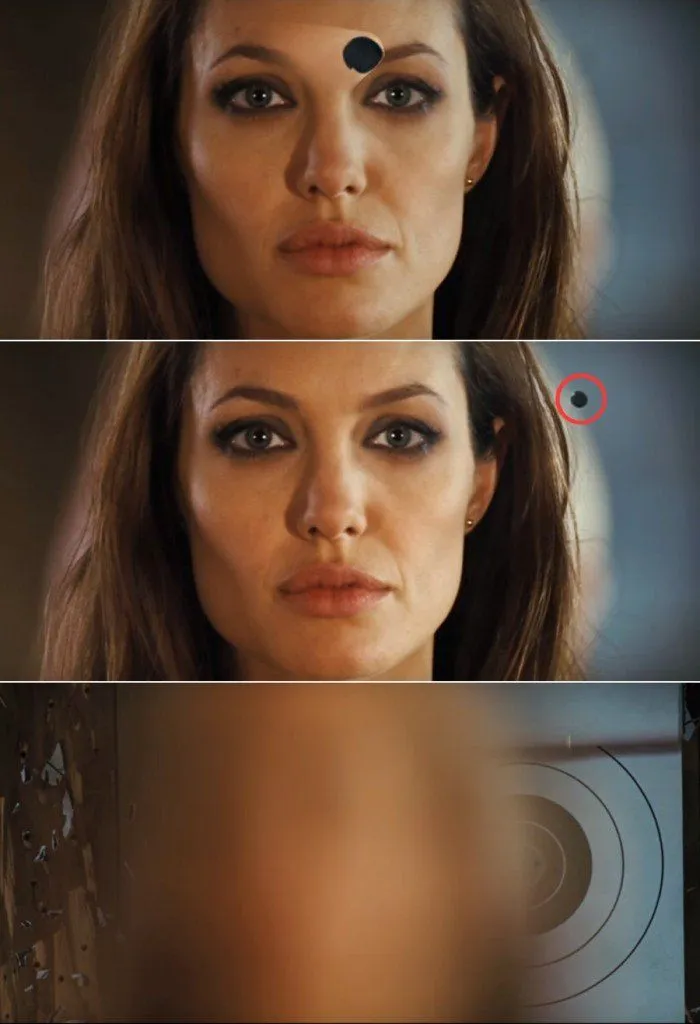
She stands between the target and the bullet, and the bullet bends around her, hitting the concentric circles on the wall behind her.
Everyone probably thought the same after seeing something so monstrous: Who would want to waste so much bacon?
The second question, of course, is whether it is physically possible to bend a ball around an obstacle.
The Physics Behind A Bending Bullet
Newton’s first law of motion states that an object will remain in a state of rest or uniform motion in a straight line unless acted upon by an external force. In simpler terms, an object will continue to move or stay still unless a force changes its state of motion.
So, to curl a bullet around a given point, the bullet would require an external force to change its current linear course to a nonlinear one, a centripetal force, to be more precise.
A centripetal force binds an object in a circular motion by pulling it toward its center during the entire motion. An object does not necessarily have to form a circle; it can form instantaneous arcs or “almost” circles by rotating in different directions.
Only two forces impede a sphere’s movement: the earth’s gravity and air resistance. Air molecules eventually dissipate the immense kinetic energy of a bullet as it pierces them at such a monumental velocity, and the bullet will eventually nose dive to the surface of the ground due to gravity.
That being said, can gravity manifest as the centripetal force to pull the bullet in a curve?
Well… No.
A bullet travels around 1000 m/s, so its low mass and high energy (as it exits the gun) negate gravity’s attempt to lure it in any direction.
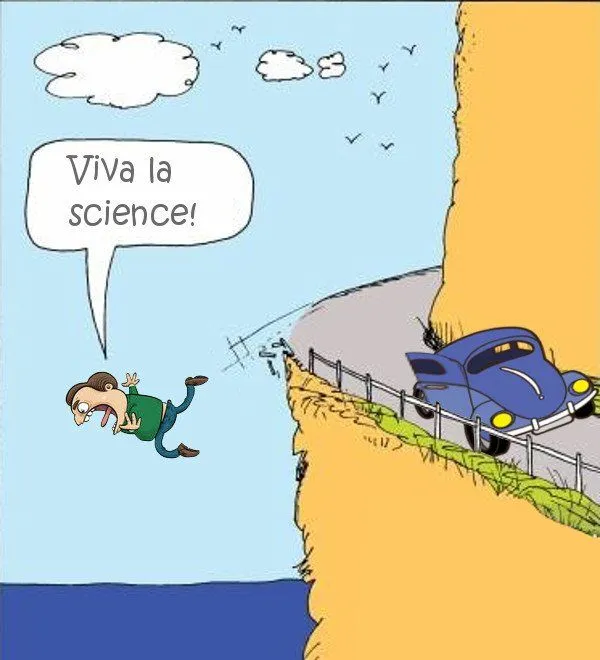
No matter how sharp a curve a fast-moving train or other vehicle makes, jumping from one of its doors would not cause you to turn the same curve. Once you jump, no force pulls you toward the center of the arc that would force you to turn. You would drive along the tangent to the arc’s starting point.
Some experts believe this would be a bit dangerous, especially if you try it while driving the vehicle, but even if you do, make sure you close the door on the way out. Read more about tangential velocity here.
As a result of what we know, the bullet will only travel straight in the direction of the tangent to the point where you shoot it, even if you’re idiotically twisting your wrists.
So, yes, although your love interest standing valiantly in front of you will luckily survive, you’ll still probably end up killing someone else (hopefully not another pig).
The Role Of The Magnus Effect
There is another way in which a sphere could be rotated – the Magnus effect. This is the consequence of a rotating object in motion exerting a net force on the surrounding air, which, according to Newton’s Third Law, exerts an equal and opposite force on the moving and rotating object, thereby changing its trajectory.
This effect occurs when a football player curls the ball around a 4-man wall or a baseball pitcher throws a breaking ball pitch.
The Magnus effect requires the moving object to spin, which a bullet does! Bullets do not simply bust out of guns but are forced to move through an oddly shaped barrel, giving the bullet a slight spin. The spin has been proven to improve the range and performance of firearms. This is known as rifling. You can read more about rifling here.
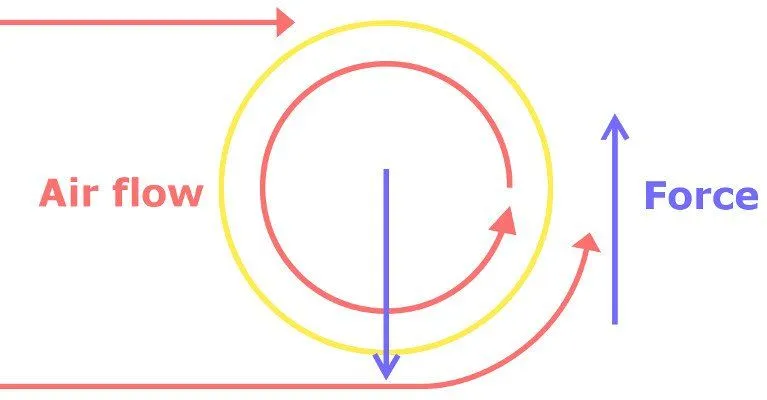
The Magnus effect results from the combinatorial play between a spinning object and the flow of the liquid in which it rotates.
Current-like air is then dragged along in the direction of motion and whirls the spinning object upwards in a non-linear trajectory, as shown above.
As a result of this effect, a baseball that rotates around its vertical axis experiences a horizontal force that deviates from the otherwise expected linear path to a non-linear path.
However, bullets don’t allow the Magnus effect to work magic due to their low mass and huge kinetic energy.
The bullet cannot deviate its path to such an extent that it makes an ‘S’ curve around an object. The bullet would be moving so swiftly that the effect is negligible. It is so negligible that the strongest force amongst all those acting on the bullet is still gravity! In other words, the answer is still NO… mostly.
Note: long-range shooters do see a small sideways drift, called spin drift or gyroscopic drift, that becomes noticeable past about 600 yards. It is mostly caused by gyroscopic precession of the spinning bullet, not the Magnus effect itself, and even at 1,000 yards it shifts the impact by only inches, nowhere close to bending around a person.
The only thing turning in that film were the physicists… in their graves.
I’m sure any science enthusiast would be highly frustrated after watching the absurdity portrayed in the movie Wanted. If the bending of bullets wasn’t enough, the protagonist’s excess adrenaline slowed down his perception of time to the point where he could pluck the wings off a housefly… with a bullet!
Despite the countless deaths in the movie, what bothered me the most was the disregard for scientific principles – and, of course, the treatment of animals.
Nonetheless, no one can deny that the bending bullets looked incredibly cool!
Which Movie Curves Bullets? Meet ‘Wanted’ (2008)
The bending-bullet scene that sends everyone hunting for the title is from Wanted, the 2008 action thriller directed by Timur Bekmambetov and loosely based on the 2003–2005 comic book miniseries by Mark Millar and J.G. Jones. James McAvoy plays Wesley Gibson, a jittery office drone who discovers he belongs to a thousand-year-old secret society of assassins called the Fraternity. Angelina Jolie plays Fox, the mentor who first shows him the trick, and Morgan Freeman plays the Fraternity’s leader, Sloan.

In the film, curving a bullet is a taught skill. Assassins swing the arm and flick the wrist as they fire, supposedly whipping the round into an arc so it can loop around an obstacle, or, in Fox’s showpiece kill, circle an entire room and come back. It looks spectacular. It is also the single most physically impossible thing in a movie that also stars a giant loom that spells out assassination targets in coded thread.
So if you have been searching for “the movie where they bend bullets,” this is it. The next section covers whether anyone has ever pulled the stunt off in real life.
Did MythBusters Try To Curve A Bullet?
They did, and it did not go well for Wesley Gibson. In an episode titled “Curving Bullets” (Episode 123, first aired 10 June 2009), the MythBusters build team set out to reproduce the Wanted stunt. First they tried it the movie way, swinging their arms and flicking their wrists as they fired a handgun. Every bullet flew dead straight.

Suspecting that human arms were simply too slow, they bolted the gun to a robotic arm that could swing it faster than any person, and lined up sheets of paper (checked with a laser) to trace the bullet’s path. Still a straight line. As a last resort they fired deliberately unbalanced bullets from a smooth-bore, de-rifled barrel to coax some wobble out of them. The rounds tumbled through the air but stubbornly refused to curve.
The verdict was busted, for exactly the reason we have been describing: once the bullet leaves the muzzle, there is no sideways force to pull it off a straight line, so Newton’s first law wins. A swinging arm changes where the bullet starts and which way it points, but not the straight path it follows once it is airborne.
Last Updated By: Ashish Tiwari
References (click to expand)
- Magnus Effect | Thermodynamics | Physics Demos.
- Johnson, W. (1986, January). The Magnus Effect—Early investigations and a question of priority. International Journal of Mechanical Sciences. Elsevier BV.
- Effect of Rifling Grooves on the Performance of Small-Caliber ....
- INGRAM, C., LUSARDI, R., & NICOLAIDES, J. (1972, August 16). Effects of rifling and N-vanes on the Magnus characteristics of bodies of revolution. 2nd Atmospheric Flight Mechanics Conference. American Institute of Aeronautics and Astronautics.
- Wanted (2008 film) - Wikipedia.
- MythBusters (2009 season): Curving Bullets - Wikipedia.