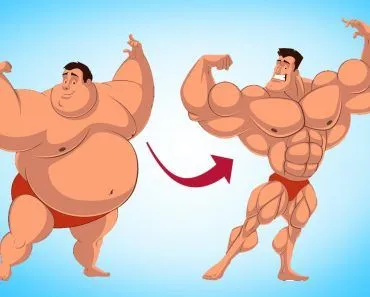
Lactate (the dissociated form of lactic acid at physiological pH) is produced whenever glycolysis runs faster than the mitochondria can keep up with pyruvate — usually during intense exercise, but not only when oxygen is short. The conversion of pyruvate to lactate by lactate dehydrogenase regenerates NAD+, which lets glycolysis (and therefore ATP production) keep running. Despite the popular myth, lactate itself doesn't cause muscle soreness; it's actually used as fuel by the heart, brain, and other muscles via the lactate shuttle.
The health and exercise industry is all about getting the most out of your workouts. That includes the best ways to rest and let your body recover from the stress of exercising. Invariably, many exercise and fitness blogs will mention lactic acid, its accumulation in the muscles, and its effect on performance.
What exactly is lactic acid and why do we only produce it when we exercise?

What Is Lactic Acid?
Everything is made of chemicals, a series of atoms joined to each other to create molecules. Lactic acid is a molecule composed of atoms of carbon, hydrogen and oxygen, like many other organic molecules. It is an acid, which means that it changes the pH of its surroundings by donating a proton (H+ ion) to the water.
Bacteria and microbes that ferment foods, the same ones that convert sugar into alcohol, are also responsible for creating lactic acid. These microbes ferment when there is a lack of oxygen, meaning that they are anaerobic.
This fermentation is a way for the microbes to produce energy. They eat the sugar and then, through a series of chemical reactions (called metabolic pathways), that sugar is broken down to produce energy. This is similar to how burning wood creates heat energy that you can use to cook your food (cooking could be considered as work being done by the fire on the food).
However, humans—and by extension our muscles—are not anaerobic microbes. We breathe in oxygen and breathe out carbon dioxide. In that case, how does lactic acid end up in our muscles?
How Do Cells (Muscles) Produce Energy?
For living organisms, energy comes in the form of a molecule—ATP. Commonly called the energy currency of the cell, the cell chemically spends ATP (by breaking the chemical bond and releasing energy) to get work done, similar to how you might spend money for a service.
Humans, and aerobic organisms, need oxygen to produce ATP. When the body has a plentiful and healthy supply of oxygen, the muscles (and other cells in the body) break up glucose to produce energy in a process called glycolysis (glyco = glucose and lysis = break up). The process of glycolysis produces some ATP, and a molecule called pyruvate (pie-roo-vate).

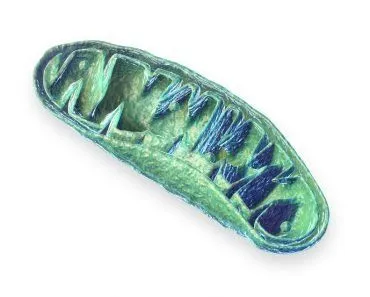
That said, the cell can get much more ATP by sending the pyruvate molecule to the mitochondria. The mitochondria is called the powerhouse of the cell for a good reason; it is equivalent to a power plant in a city. One of the mitochondria’s primary purposes in the cell is to create ATP and supply it to the rest of the cell. It is here, in the mitochondria, that oxygen is involved in creating energy.
This entire process, from glycolysis to the chemical reactions in the mitochondria, is called cellular respiration; you can read more about it here!
How Do Muscles Produce Energy Without Oxygen?
When you're sprinting (either on a treadmill or away from a Smilodon), your muscles are demanding ATP faster than the mitochondria can deliver it using oxygen alone. The cell's response: turn pyruvate (the end-product of glycolysis) into lactate instead of feeding it to the mitochondria.
This isn't purely an "emergency, no oxygen" plan, by the way. Muscles produce some lactate all the time, even at rest, because glycolysis is fast and the rate at which pyruvate is made often outpaces the mitochondria. During intense exercise, that production simply explodes — and lactate, far from being a dead-end waste product, gets shuttled out of the working muscle and used as fuel elsewhere (a process discovered and popularized by physiologist George Brooks, now called the lactate shuttle).
Crucially, the pyruvate-to-lactate conversion doesn't directly make ATP, but it lets glycolysis keep running — which does make ATP.
For Those Who Want Biochemistry Details
How does converting pyruvate into lactic acid help glycolysis continue? This is because of a chemical called NAD. During several chemical reactions of glycolysis, the NAD+ (Nicotinamide Adenine Dinucleotide) accepts electrons, converting into NADH. In the presence of oxygen, this NADH would end up in the mitochondria and help generate energy. However, with little oxygen, the NADH can’t do much.
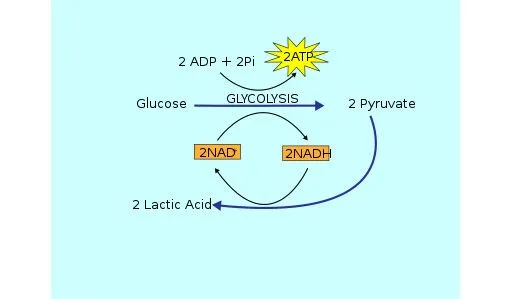
At the same time, the amount of NAD present in the cell is decreasing. Without NAD, the cell cannot continue to accept electrons during glycolysis, so the process stops. However, the reaction that converts pyruvate to lactic acid converts NADH to NAD, thereby increasing the concentration and allowing glycolysis to continue to produce ATP, which the muscle cell can use to do work.
Why Does Lactic Acid Accumulate In The Muscles When You Exercise?
When you exercise for long durations, the muscles continue to experience the lack of oxygen, so they keep creating more lactic acid. This quick and easy form of energy keeps your muscles pumping, but also leads to lactic acid accumulating in the muscles.
Is Lactic Acid Actually Bad For You?
For decades, the standard story was: lactic acid disturbs muscle pH, and that drop in pH causes the burning, the fatigue, and the soreness you feel the next day. Generations of athletes were told to "flush out the lactic acid" with a cool-down or a massage. It turns out almost none of that holds up.
The "burn" you feel during hard exercise tracks more closely with the buildup of hydrogen ions (H+) and inorganic phosphate from rapid ATP breakdown than with lactate itself. Lactate production actually consumes a proton, so labeling lactate as the cause of acidosis is exactly backwards (Robergs, Ghiasvand & Parker, AJP 2004).
And the next-day soreness — DOMS (delayed-onset muscle soreness) — is now firmly attributed to microscopic muscle damage and subsequent inflammation from unfamiliar or eccentric exercise, not lingering lactate. Lactate is fully cleared from the bloodstream within an hour or two of finishing a workout, long before DOMS kicks in 24-72 hours later.
Far from being a metabolic villain, lactate is now understood as an important inter-organ fuel. The heart, the brain, slow-twitch muscle fibers, and the liver (which converts it back to glucose via the Cori cycle) all happily burn lactate produced by hard-working fast-twitch fibers. The popular advice to "flush out lactic acid" is mostly outdated.
References (click to expand)
- (1986) Muscle fatigue and lactic acid accumulation. The United States National Library of Medicine
- Westerblad, H., Allen, D. G., & Lännergren, J. (2002, February). Muscle Fatigue: Lactic Acid or Inorganic Phosphate the Major Cause?. Physiology. American Physiological Society.
- Nielsen, O. B., Paoli, F., & Overgaard, K. (2001, October). Protective effects of lactic acid on force production in rat skeletal muscle. The Journal of Physiology. Wiley.
- Control of Lactic Acid Metabolism in Contracting Muscles... : Exercise and Sport Sciences Reviews - journals.lww.com
- Biochemistry of exercise-induced metabolic acidosis (Robergs, Ghiasvand & Parker, AJP Regulatory, 2004)
- The Science and Translation of Lactate Shuttle Theory (Brooks, Cell Metabolism, 2018)