Table of Contents (click to expand)
No ordinary magnet has just one pole. Every magnet is a dipole with a North and a South pole, and breaking one in half simply yields two smaller dipoles. A true single-pole magnet, called a magnetic monopole, is predicted by theory but has never been observed. Physicists are still hunting for one at the LHC, and have created monopole-like quasiparticles in spin ice.
Magnets. We see them in countless different shapes and sizes, and in so many different devices. This was such a common part of our childhood that we all know the most basic and common properties of magnets.
One is that they attract materials with iron in them.
Second is that they have two poles (dipoles), North and South.
And last, when we try breaking a magnet apart to separate each pole, we still end up with two magnets with two poles. The poles are just inseparable!
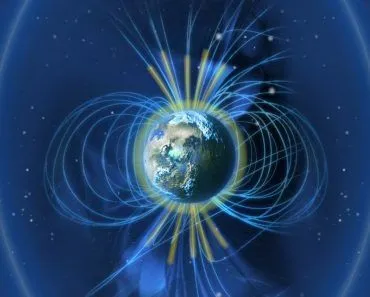
In the old days, we called such things “magic,” but in physics, a magnet just demonstrates the property of magnetic field lines. These field lines are closed loops between the two opposite poles. In short, we have never found a magnet with just one pole and therefore believe that magnets can only exist in dipoles.
Well, we now know that’s only partially true. We can never separate dipoles…but what if I told you that magnetic monopoles do exist? Extensive research and expensive experiments are being conducted for this very purpose!
Surprisingly, talks about monopoles have been going on for a long time, dating back to the late 19th century, when Pierre Curie noted that nothing in physics actually forbids them. However, it took a long time for the idea to take root, and now that we have substantial theoretical work in place, the real search for monopoles has begun. Let’s look at how the idea of monopoles came about, and where we’re at now.

Dirac’s Monopole
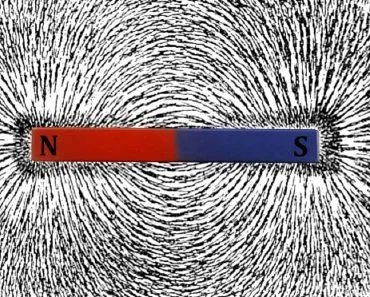
In 1931, Paul Dirac was the first person to use actual physics and mathematics to describe a monopole. He wasn’t even looking for one. He was trying to explain why electric charge always comes in neat multiples of the charge on an electron, and he found that if even a single magnetic monopole exists anywhere in the universe, then electric charge must be quantized. That was a strong enough hint for him to take the idea seriously. His picture of the monopole looked very simple. He first imagined a solenoid (a device made of coiled wires with a larger length than diameter). When an electric current is passed through these wires, a magnetic field is generated. These magnetic field lines look similar to those we have seen for bar magnets.
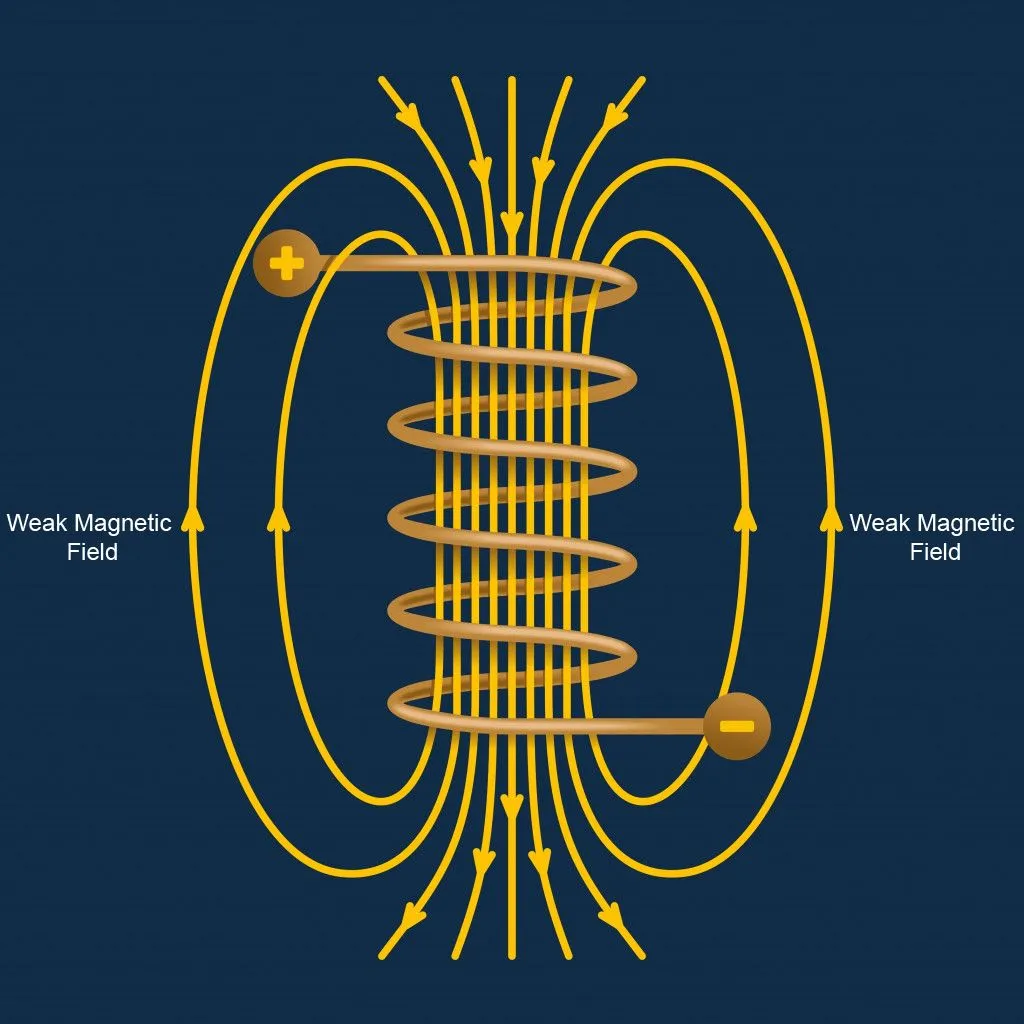
You will notice that the field lines are very far away from each other near the center (outside) of the magnet, which means that the magnetic field is the weakest here.
Now, Dirac imagined his solenoid to be infinitely long, so long that the magnetic field lines are very far apart, making the magnetic field practically non-existent. This almost disconnects the two poles, but the field lines running inside the solenoid still exist, thus connecting the two poles.
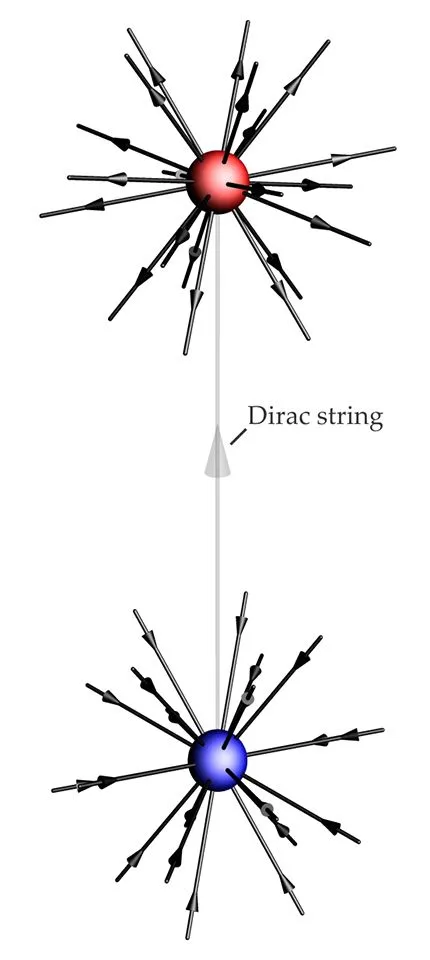
To address that, Dirac imagined the solenoid to be so thin that it was practically impossible to see, so thin that there are no field lines connecting the two poles. This is how he conceived the image of monopoles, and this picture is what is called the Dirac string.
This may seem absurd to think about, but Dirac was such a firm believer in monopoles that the idea of monopoles not existing was absurd to him.
However, his theory had one big flaw. The energy of his monopole was infinite.
When Dirac stretched his imaginary solenoid in length and thinned it to nothing, theoretically, all of this infinitely large magnet’s magnetic field would be concentrated at its two poles. This is how his imaginary monopoles had an infinitely large amount of energy.
Thankfully, this was just a proposed model of a monopole. Obviously, there is no way to manufacture such a magnet and no particle with infinite energy can exist. Even so, the very idea of monopoles was so intriguing that others also tried to prove their existence in theory.
The GUT Monopole
It was Gerard ’t Hooft and Alexander Polyakov who, in 1974, put forward a far better picture of the monopole. Working independently, they showed that a certain class of theories called Grand Unified Theories (GUTs) must contain monopoles. The monopole isn’t something you add by hand; it falls out of the math whether you like it or not.
To understand what that means, we first need a basic understanding of quantum field theory (QFT).
Imagine QFT to be a house where a family made of different field theories of elementary particles lives.
The building blocks of this house (QFT) are quantum mechanics, special relativity, and field theory. Simply put, QFT gives shelter to different sciences of elementary particles. The Grand Unified Theory (GUT) is what you get when you replace all the family members with a single figure that plays all of their roles.
So, instead of different field theories for different types of particles, we have one theory for all particles in GUT. (The first such theory was proposed by Howard Georgi and Sheldon Glashow, also in 1974.)
’t Hooft and Polyakov took this kind of unified theory and showed that magnetic monopoles are baked right into it.
According to GUT, monopoles exist! This theory also predicts that they are staggeringly heavy, with a rest energy of around 1016 GeV. You may need help visualizing how much energy that is.
One electron volt (eV) represents the energy an electron gains passing through one volt of potential. Now one GeV is a billion times that. Now imagine 1016 (a one followed by 16 zeros) times the energy of one billion electrons. Quite a large amount! For comparison, that is hundreds of billions of times the energy reached by the most powerful particle collisions at the LHC, which is exactly why no accelerator can ever hope to manufacture one directly.
That is the energy of one monopole.
If we were somehow able to manufacture a magnet with this monopole, only Thor would be able to handle it!
Today, these are aptly called supermassive monopoles, since we also now have theories for less energetic monopoles.
Where Are We Now?
So have we caught one yet? Not the real thing, no. As of 2026, a genuine fundamental monopole (a single particle carrying nothing but magnetic charge, the kind Dirac and ’t Hooft imagined) has never been observed, despite decades of looking.
That said, two pieces of news are worth knowing.
The first is that physicists have made something that behaves like a monopole, even if it isn’t a true one. In 2009, researchers studying a frosty crystal called spin ice (the material dysprosium titanate, Dy2Ti2O7, cooled to within a couple of degrees of absolute zero) found that the tiny atomic magnets inside arrange themselves so that isolated North-like and South-like points can appear and wander through the crystal independently. These are called emergent, or quasiparticle, monopoles. Here is the important catch: they are a collective effect of countless ordinary dipoles working together, not a new elementary particle. Pull a single atom out of the crystal and there is no monopole on it. So while spin ice gives us a real, measurable monopole-like object to play with in the lab, it is not the free magnetic charge Dirac was after.
The second is that the hunt for the real thing is very much alive. At CERN’s Large Hadron Collider, a dedicated experiment named MoEDAL (the Monopole and Exotics Detector at the LHC) sits and waits for a genuine monopole to come flying out of a particle collision and get trapped in its detectors. So far it has come up empty, but every empty-handed search tightens the net, ruling out monopoles below certain masses and charges. Other experiments scan the cosmos instead, looking for ancient supermassive monopoles left over from the Big Bang as they sail through giant detectors buried in ice and rock.
In short: a true monopole magnet still hasn’t shown up, but we now have both a lab stand-in and the most sensitive searches in history quietly running in the background.
Conclusion
Since supermassive monopoles were conceived, there have been predictions of intermediate and smaller monopoles as well, but the question is, if not in our natural world, where would we even find them?
The answer, like so many, lies up in the sky.
Supermassive monopoles are said to have existed in abundance during the early time of the universe, and both intermediate and supermassive monopoles likely exist out in space.
It was only due to abundant research that the search for this particle has begun. The theories are so convincing that some extremely expensive experiments are happening around the globe to catch these hypothetical particles.
However, this isn’t the first time that such costly experiments have been conducted on the basis of theories. You might know the most famous of these cases. The Higgs Boson theory was first proposed in 1964! There was a long period of extensive research on this topic, after which came the expensive experiments. Years of these experiments later, it was finally concluded that it does exist.
So, in short, the typical protocol is being followed. We just have to wait for the day when they announce the existence of monopoles and then who knows… someday we might even have a monopole magnet to play with!
References (click to expand)
- Rajantie, A. (2012, December 28). Magnetic monopoles in field theory and cosmology. Philosophical Transactions of the Royal Society A: Mathematical, Physical and Engineering Sciences. The Royal Society.
- Castelnovo, C., Moessner, R., & Sondhi, S. L. (2008). Magnetic monopoles in spin ice. Nature, 451, 42-45.
- Morris, D. J. P., et al. (2009). Dirac Strings and Magnetic Monopoles in the Spin Ice Dy2Ti2O7. Science. PubMed.
- Magnetic Monopoles and Spin Liquids. NIST Center for Neutron Research (NCNR).
- MoEDAL zeroes in on magnetic monopoles. CERN.