Table of Contents (click to expand)
Earth’s magnetic field is generated deep inside the planet by a process called the geodynamo. Convection currents of molten iron and nickel in the liquid outer core, driven by heat escaping from the inner core and twisted into spirals by Earth’s rotation (the Coriolis effect), act as a giant natural electric generator. The electric currents they produce create the global magnetic field that wraps around the planet and deflects the solar wind.
On some freezing nights, nature paints the dark canvas above the Arctic circle with light strokes of yellow and green. The wavering, fluorescent hues are recognized to be one of the most beautiful and cherished of nature’s innumerable works of art. This exhibition of rippling lights is commonly referred to as the northern lights.
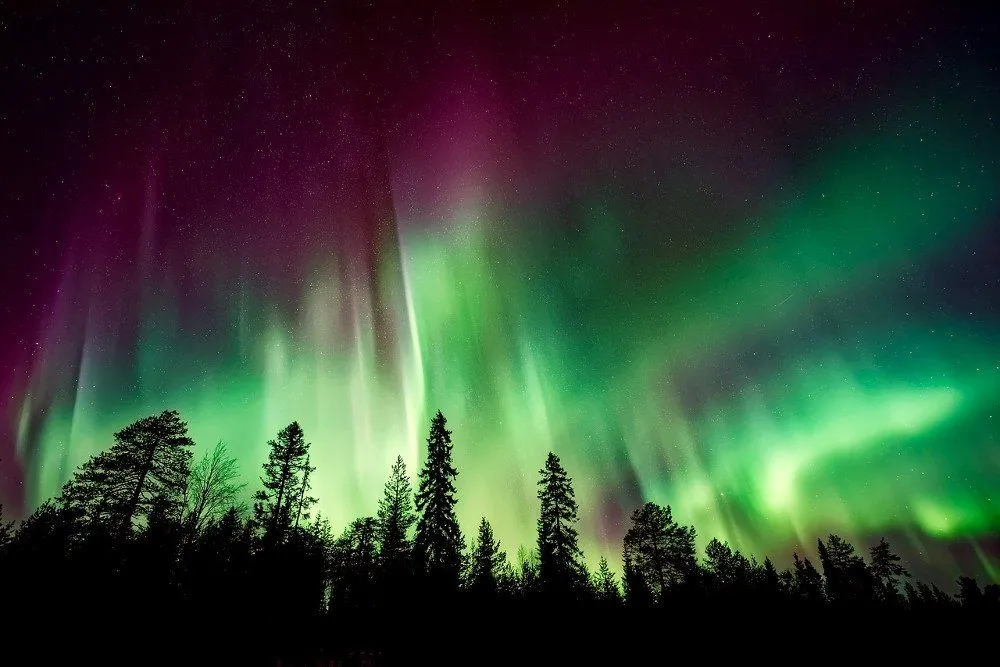
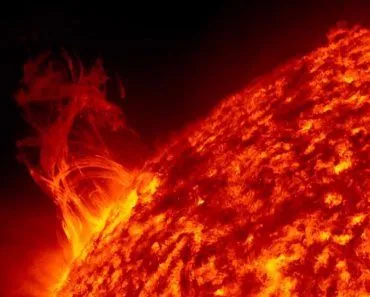
The splendid display is actually the result of charged particles streaming out from the Sun (the solar wind) interacting with the Earth’s magnetic field. If this field did not exist, the ozone layer would have been burnt to shreds and we would have been mercilessly fried. This is what happened with Mars when its magnetic field gradually dwindled and expired. So, what causes this magnetic field?
The Basics: Ampere’s And Faraday’s Law
The magnetic field does not protect the Earth like the thick walls of a fort, it rather resembles a thin curtain or a blanket shrouding the blue dome. It is often hard to believe that, measured at the surface, it’s about 100 times weaker than a typical fridge magnet, only around 25–65 microteslas depending on where you’re standing.
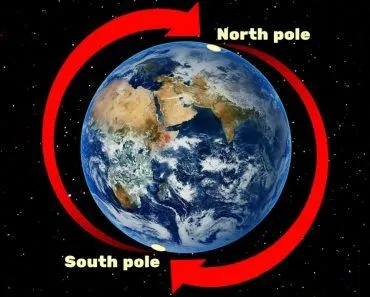
The Earth’s magnetic field behaves as if a vertical column between the poles was hollowed out and a standard bar magnet was planted in the cavity. However, the magnet is not aligned perfectly with the poles, it is marginally inclined. What’s more, we found that the magnetic lines run from the south pole towards the north pole. This implies that the magnetic north is situated beside the geographical south, while the magnetic south resides along the geographical north.
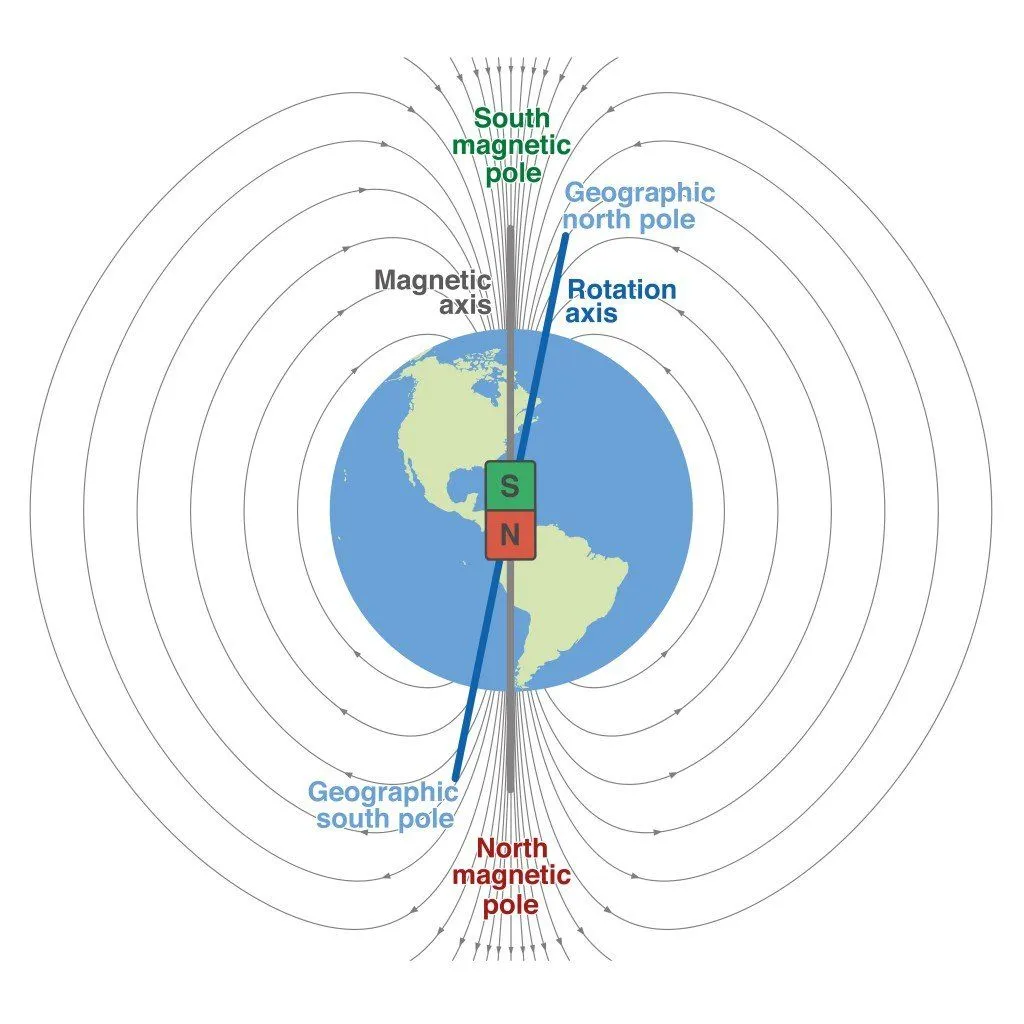
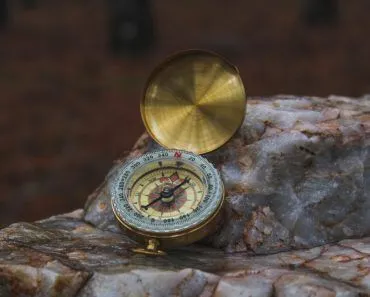
Now, because opposite sides of a magnet attract, when the red needle or north magnetic pole of a compass deflects and points towards the geographical north, it is actually being attracted by the south magnetic pole of the Earth’s imaginary bar magnet.
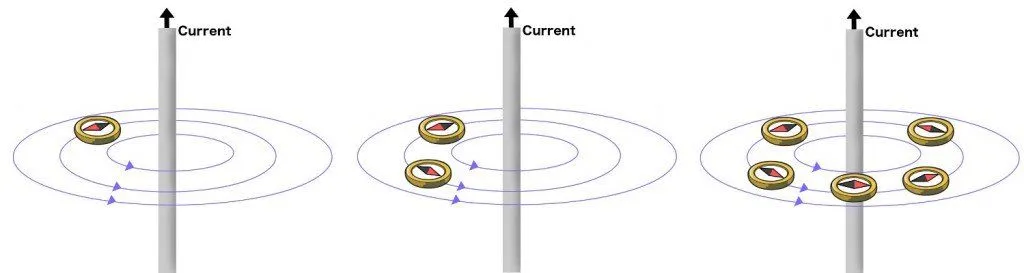
What physicist Ampere discovered was that such a deflection can also be observed around a current carrying wire. By placing the compass at different locations in a wire’s vicinity, he discerned the direction of the magnetic field. He found that the lines run around the wire in concentric circles. The major implication is that electricity or moving charges generate a magnetic field.
People believed the relationship was unidirectional until Faraday showed that electricity and magnetism are two sides of the same coin. Faraday observed that current is induced in a wire when a magnet is moved around it. Movement is the stressed word. It is not the presence of a stationary magnet, but a moving magnet, a changing magnetic field that induces the electric field.
But according to Ampere, an electric field generates a magnetic field, which, as we learned, generates an electric field, which then generates a magnetic field and so on. What is created is a self-sustained cycle of electric and magnetic fields. This is how a dynamo light mounted on a bicycle works: when we pedal, essentially, either a wire is rotated around a fixed magnet or a magnet is rotated around a fixed coil of wire – no matter what configuration you use, the dynamo or generator relies on a symbiotic relationship between moving charges and magnetism. Earth’s magnetic field is also generated by the same principle.

The Dynamo Theory
If you were to open the lid on Earth like a Kinder Joy, you’d find inside a solid core dipped in a viscous liquid. Together they constitute the Earth’s core: the hellish molten liquid is known as the outer core while the solid core which is two-thirds the size of the moon sunk in it is called the inner core.
The inner core burns at around 5,400 °C (and possibly as high as 6,000 °C), which is comparable to the surface of the Sun; counterintuitively, the inner core stays solid rather than melting because the immense pressure deep inside Earth keeps it crystallised. It is mostly iron, with smaller amounts of nickel and lighter elements such as oxygen, sulfur and silicon. The outer core, sitting above it, runs at roughly 4,000–5,400 °C and is a churning ocean of molten iron-nickel alloy. We believe it is this molten iron that generates Earth’s magnetic field.
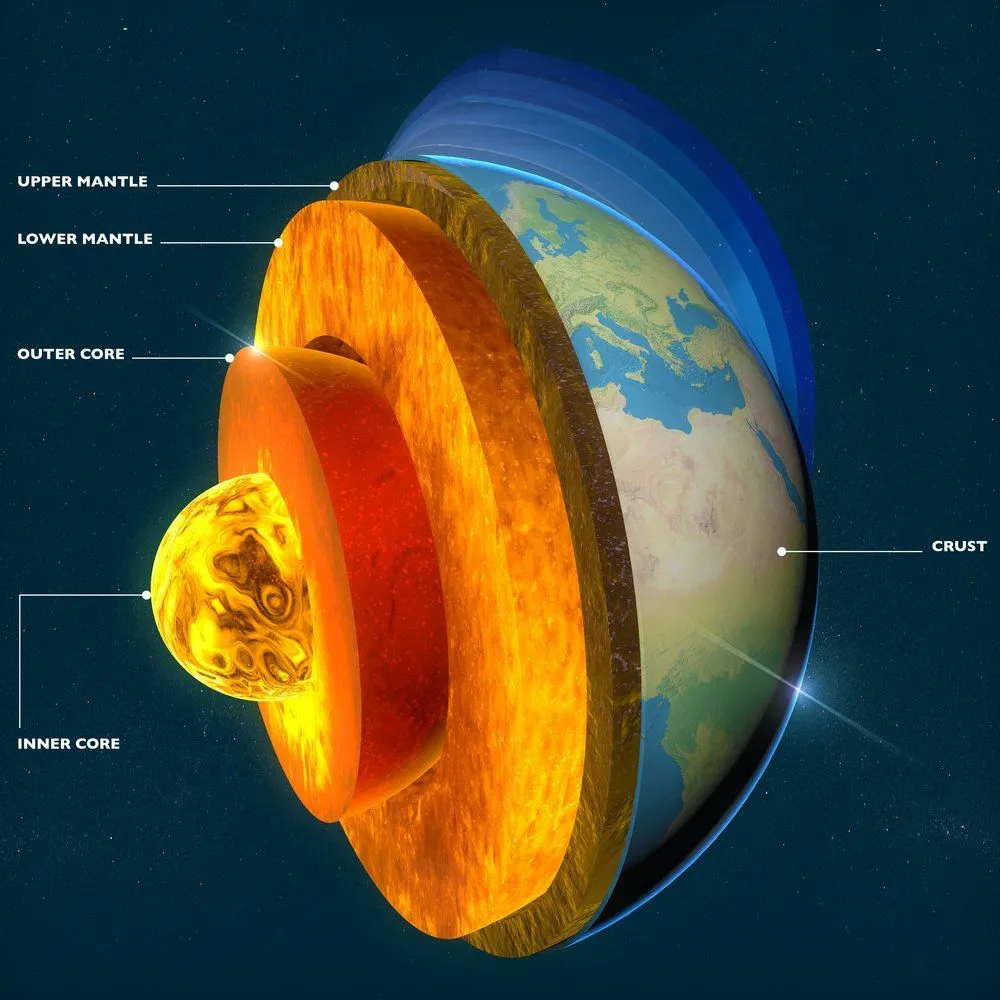
Now, because we cannot peek inside the core, we can only infer the causes of its magnetic properties based on theoretical physics and studying igneous rocks. The most plausible theory is analogous to, as mentioned, a dynamo. According to it, it is the motion of molten iron — an excellent conductor for it is an ocean of electrically charged particles – that gives form to a magnetic field. The resulting magnetic field interacts with the flowing charges to generate an electric field and the cycle goes on to sustain a perpetual magnetic field. This is known as a geomagnetic dynamo.
However, the dynamo mounted on a cycle requires the energy of the cyclist to rotate the pedal. Similarly, the movement of molten fluid can only be achieved at the expense of energy, but what is the source of this energy? We currently believe that the energy arises from the convection or heat currents in the outer core when lighter iron sinks towards the inner core and eventually condenses into the solid. Condensation is essentially a loss of heat, and it is this heat that fuels the waves of molten iron. The magnitude of Earth’s magnetic field is so small because 99% of it is confined to the core. Only a meager portion escapes it to form the outer veil.
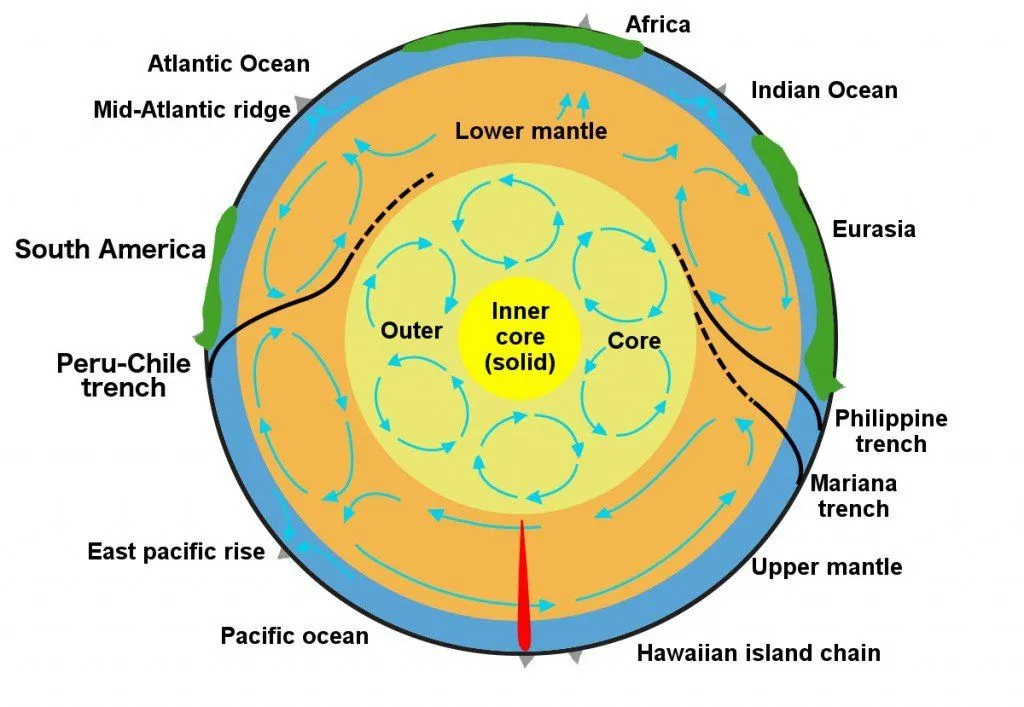
The disturbances in the outer core spread like the disturbances in weather. Their trajectories curve, curl and spiral as they spread outwards like whirlpools, thereby distorting the generated magnetic field. However, Earth’s rotation instills symmetry in their patterns. The rotation aligns the haphazard magnetic fields as it causes the current to be somewhat symmetrical around the axis. This force is called the Coriolis force. The alignment combines the plethora of minute fields to form one giant magnetic field, a semi-uniform magnetic field that is reminiscent of the field emanating from a bar magnet.
So, Earth’s magnetic field is produced by the combinatorial effects of convection currents and Earth’s rotation. Despite rotating at almost the same speed as Earth, Mars isn’t shielded by a field because it doesn’t foster a dynamo like Earth does. The non-linear differential math involved in understanding the disturbances, like the math involved in making weather predictions, is tremendously difficult and has therefore limited our understanding of the Earth’s magnetic field. Still, supercomputers have allowed us to simulate the probable mechanisms and behavior of turbulences that not only synthesize it but once in a blue moon, flip or reverse the poles!
References (click to expand)
- What causes the Earth's magnetic field?| Explore | physics.org - www.physics.org
- NOVA | What Drives Earth's Magnetic Field? - PBS. The Public Broadcasting Service
- Generation of the Earth's magnetic field. Natural Resources Canada
- What causes the periodic reversals of the earth's magnetic .... Scientific American