When you break the water’s surface, you will decelerate at an extremely high rate. The force exerted on your body due to the abrupt and rapid change of velocity would be too high to handle.
If you find yourself in a situation where you must jump out of an aircraft, it is important to have a parachute. However, if a parachute is not available, jumping without it should only be considered a last resort when there are no other options for escape.
If you have to jump, try to locate a large body of water, such as a sea or river, and aim your fall toward it. Even if you follow all these recommendations, the chances of survival are still uncertain.
In this article, we will investigate what happens when a person has to jump off an airplane without a parachute into a water body.
What Is Wreckage Riding?
Before jumping out, you should try to find a large object you can ‘ride’ during your imminent free fall. In other words, be a ‘wreckage rider’ (a term coined by Jim Hamilton, a historian who compiled an online database of every imaginable human plummet).
Your chances of surviving such a deadly plunge might improve slightly when you’re somehow padded by semi-protective debris that will absorb some of the enormous amount of energy you’ll experience when you land on the water’s surface.

Imagine this: Vesna Vulovic, an air hostess from Yugoslavia, defied all odds and survived a 10,160-meter (a little more than 10 kilometers) fall when a DC-9 exploded in mid-air. Her incredible feat earned her a place in the Guinness Book of World Records. She was wedged between a catering trolley, the body of another crew member, and the tail section of the aircraft, all of which played a crucial role in absorbing the impact energy that would have been fatal had she fallen without these protective elements.
And here’s the kicker-the first thing she asked for upon waking from her coma was a cigarette!
Terminal Velocity
Free falling from a moving aircraft cruising at a standard height will eventually cause an individual to reach their terminal velocity, i.e., the velocity at which there is no increase in the velocity of the downward motion of a free-falling body.
An average skydiver, who jumps from a height much lower than where commercial airplanes usually fly in a ‘belly-to-Earth’ position, has a terminal velocity of around 120-140 mph (54 to 63 m/s). Therefore, it’s fair to assume that that could be the minimum value of the speed you would have (depending on your mass) during the free fall.
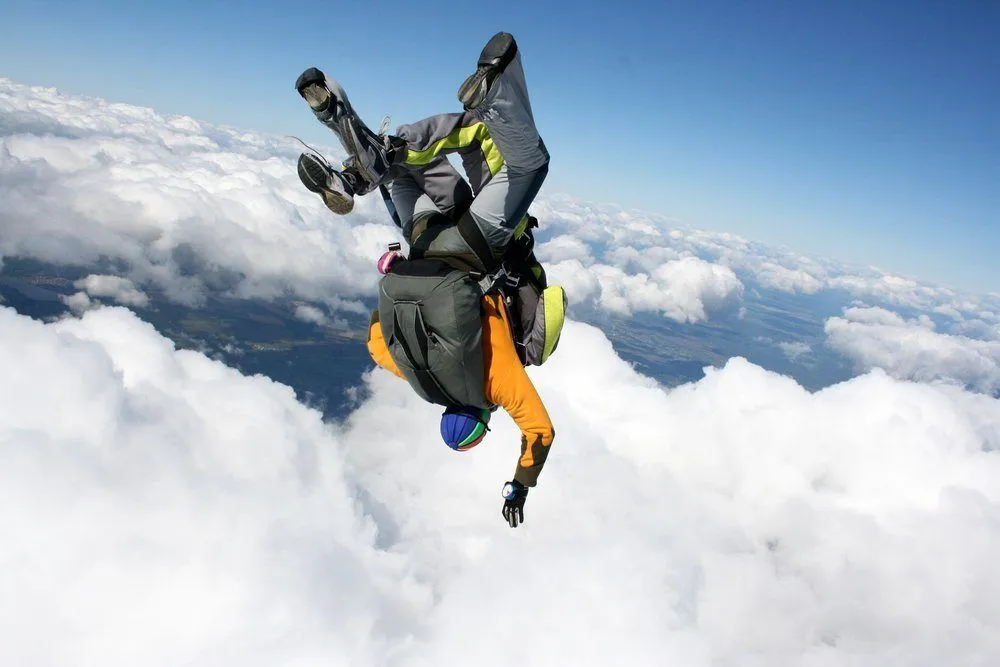
Hitting the water’s surface at such speeds is not much different than jumping from a building and hitting the sidewalk. Although water is not as rigid as the sidewalk, it has surface tension, so water tends to stay together. This also means it exerts a force on anybody that lies on its surface.
Body’s Position Before The Impact Makes A Difference
Since we’re talking about a human (with considerable mass) falling from thousands of feet in the air, water’s reactive force upon contact would be enormous.
However, this force is influenced by mass and the cross-section of the object falling into the water. You can’t possibly change your mass during a free fall (or at any other point, really), but you can change the cross-section area of your body.
This means that you can assume a position that offers the minimum surface area of your body to bear the brunt of the huge force. You can do this by assuming a feet-first position to ensure a knife-like entry into the water or a head-down position, just like divers do.
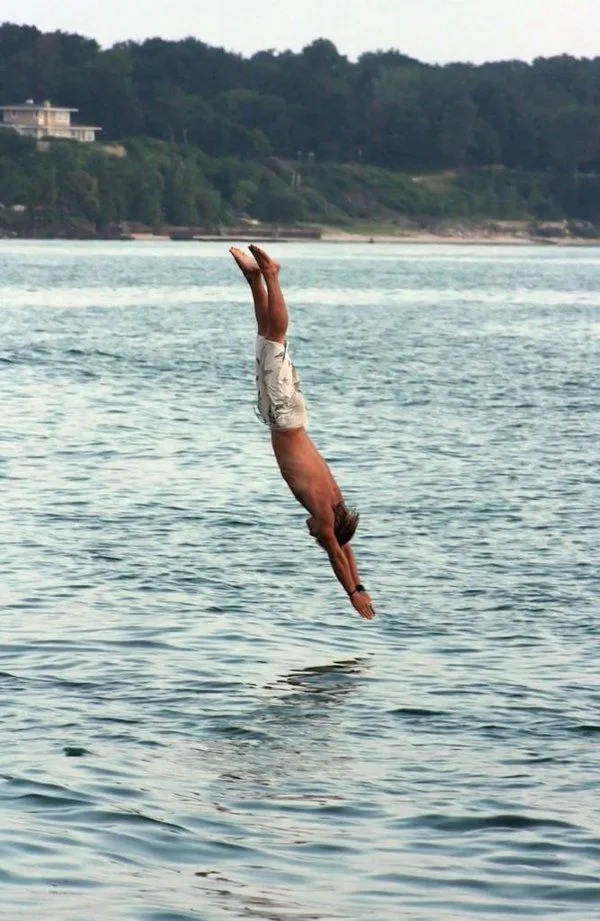
Note that assuming these positions necessarily bumps your impact velocity as your body becomes more streamlined against air drag.
Once you break the water’s surface, you will start decelerating at an extremely high rate; in fact, the force exerted on your body due to such an abrupt and rapid change of velocity would be too much to handle. Human beings can sustain 100 G’s for short bursts of time (a race car driver named Kenny Bräck survived a racing accident in 2003 wherein a deceleration of 214 G’s was measured), but in the case of falling from a plane, it would be fairly higher than that (around 300 G’s). No human could survive that… not a regular Homo sapiens, at least.

Such a huge force would cause an immense amount of internal hemorrhaging and would also throw vital organs into complete disarray, causing fatal injuries to the individual.
Is Water Any Softer Than Land?
This is the big one, isn’t it? Aiming for the sea feels like the smart move because water is a liquid and the ground is, well, rock-hard. Unfortunately, that intuition falls apart at high speed. Water is almost incompressible, so when you hit it at terminal velocity, it simply cannot move out of your way fast enough. For that split second of contact, it pushes back almost as hard as a slab of pavement would.

The physicist behind Ask a Mathematician / Ask a Physicist frames it neatly: at these speeds, the collision energy is so enormous that it dwarfs the forces holding your tissues together, so your body behaves more like a fluid than the water does. You don’t slip cleanly through the surface; you splash apart against it. There is nothing magic about water here, and surface tension is a side note rather than the main cause.
The numbers make the point bluntly. The Guinness-recognized record for the highest cliff jump belongs to Laso Schaller, who went feet-first off a 58.8-meter (193-foot) cliff in Switzerland in 2015. To make even that survivable, his team scuba-surveyed the landing pool and pumped it full of air bubbles to soften the surface, and he still hurt his hip and leg. A jetliner cruises near 11,000 meters (around 36,000 feet), roughly 190 times higher. So no, the sea is not a soft option. The most you can say is that calm, deep water is marginally less unforgiving than concrete, which is why this article still suggests aiming for it as an absolute last resort.
Can You Jump Out Just Before The Crash?
Plenty of action movies sell the idea that you can leap clear of a doomed plane at the last second and walk away. It is a tempting plan, but physics says otherwise, and the reason is the law of conservation of momentum. When you jump out of a moving aircraft, there is essentially no horizontal force acting on you in the brief moment after you let go, so you keep the plane’s forward speed. You don’t shed it by stepping out the door.

That speed is brutal. Even on final approach, an airliner is still doing roughly 250 km/h (around 155 mph), and at cruise it is moving far faster. Jumping out a few seconds before impact means hitting the ground at that horizontal speed, on top of whatever vertical fall you add. To cancel it out, you would have to launch yourself backward at the same speed the plane is flying, which no human can do.
Counterintuitively, staying buckled inside is usually the better bet. An aircraft fuselage and seats are designed to crumple and absorb energy in a survivable crash, a little like the crumple zone of a car, so they can soak up some of the deceleration that would otherwise be delivered straight to your body. You also avoid the high-altitude problem: per BBC Science Focus, the FAA gives a “time of useful consciousness” of just 30 seconds or so at around 10,000 meters, after which thin air leaves you groggy and you soon black out. So the honest answer to “can you jump out right before it crashes” is no, and trying to is almost always worse than riding it down.
Has Anyone Actually Survived Such A Fall?
Astonishingly, yes, a handful of people have. The historian Jim Hamilton’s Free Fall Research Page catalogs more than 100 long-fall survivals and sorts them into useful buckets: “free fallers,” who tumbled through open air with no parachute at all, and “wreckage riders,” who fell while still wrapped in part of the aircraft. Vesna Vulovic, mentioned earlier, was a wreckage rider, which is exactly why she lived.

The free-faller stories are even harder to believe. In January 1942, Soviet airman Ivan Chisov bailed out of his Ilyushin Il-4 bomber from about 7,000 meters (roughly 23,000 feet) and deliberately held off opening his parachute to avoid being shot at, only to pass out in the thin air before he could pull the cord. He struck the edge of a snowy ravine at an estimated 190 to 240 km/h (120 to 150 mph), then slid and rolled to the bottom. He broke his pelvis and injured his spine, yet he was flying again within a few months.
The common thread in almost every survival is the same: something absorbed the impact over a longer distance or time, whether it was aircraft wreckage, deep snow, a tree canopy, or a marsh. That is the entire game in a fall like this, stretching out the deceleration so your body is not asked to stop all at once. In general, though, jumping into the sea without a parachute leaves your chances of survival meager. If you ever face the impossible choice, keeping a few of these techniques in mind and staying as calm as you can may, at the very margins, tilt the odds.
Last Updated By: Ashish Tiwari
References (click to expand)
- How To Fall 35000 Feet and Survive.
- The physiology of free fall through the air.
- What Is Skydiving? - United States Parachute Association.
- Kiel, F. W. (1965, October 18). Parachuting for Sport. Jama. American Medical Association (AMA).
- Q: Why is hitting water from a great height like hitting concrete? - Ask a Mathematician / Ask a Physicist.
- Laso Schaller Completes The Highest Cliff Jump Ever Attempted - Guinness World Records.
- Conservation of Momentum - Douglas College Physics 1107 (OpenStax).
- If I Fell Out Of A Commercial Aircraft, Would I Be Dead Before I Hit The Ground? - BBC Science Focus.
- The Free Fall Research Page - Jim Hamilton, Green Harbor Publications.
- Ivan Chisov - Wikipedia.