Table of Contents (click to expand)
Yes. Chess is a finite, two-player zero-sum game, exactly the kind game theory was built to analyze. Zermelo’s theorem proves that one side can always force a win or a draw, and tools like the Nash equilibrium and a sequential game tree help you pick the move with the best payoff against your opponent’s best reply.
For over a millennium, chess has been a favorite pastime (or obsession) among war strategists, geniuses and anyone who values the art of competition. Today, we might play chess for self-interest and tactical development, but more than 1,400 years ago, it was invented after being inspired by war strategies, with pieces that inspired modern-day chess. Horses, elephants, and the advisor (the ‘vizier’ that later became the queen) continue to echo through the chess pieces used in various countries and regions.
We have played, critically assessed and reformed the game for over 1,400 years. A 32-piece modern-day chess game is far more complicated than the 6th-century Chaturanga, meaning “four limbs” in Sanskrit (it later became Chatrang in Persian). However, its characteristics as a “game” have not changed. To win, we still need impeccable tactical game knowledge. Simply put, you need to know the game theory.
What Is Game Theory?
Mathematically, games are a competition of pure strategy between ‘n’ number of players to follow the rules for a pay-off (a reward). Game theory analyzes such games to predict or calculate winning moves.
Imagine it as an issue of probability, but better.
Although the name came later, the ideas behind game theory date back roughly to 500 AD, when the Talmud described how to fairly divide a contested estate. It was also heavily implemented in:
- Two-person game-of-chance strategies
- Theory of Wealth in the Economy
- Charles Darwin’s theory of Natural Selection
- Determining trade outcomes in Duopoly
- Zermelo’s history of the Game Theory (using chess)
- Prisoner’s dilemma
- Poker, business and war strategy
- Battle planning of World War 2
- The Logic of animal conflict
… in that chronological order!
Here, we have an old war-time example of Game Theory and how we can build a strategy using it. During the Battle of the Bismarck Sea (March 1943), American General George Kenney knew the Japanese Navy would send a convoy either along the Northern or the Southern route around New Britain to reach New Guinea.
Where Kenney sent his search planes, and where the convoy sailed, decided how long his bombers could attack.
Plotting it as a game matrix, the four outcomes look like this: if Kenney searched North and the convoy also went North, poor visibility cost him a day, leaving 2 days of bombing; if he searched North while the convoy slipped South, he still managed about 2 days; if he searched South while the convoy went North, that was his worst case at just 1 day; and if he searched South while it went South, he got the most, 3 days. Searching North was therefore Kenney’s safest play, since it guaranteed at least 2 days no matter what Japan did. For the Japanese, the Northern route was the better reply, since going South only exposed the convoy to more bombing. History shows that’s exactly how the battle went down: the convoy took the northern route, and the Allies devastated it.
Such zero-sum games are useful for predicting moves, in both war and chess.
Surprisingly, the first ‘Theorem’ of games was made by Zermelo to mathematically analyze how either of the players can win in a given round of chess.
Zero-sum Games
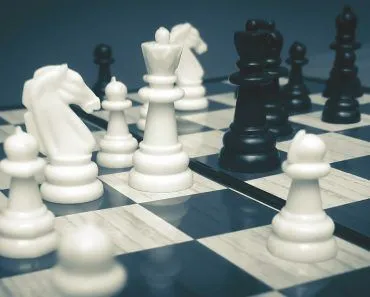
Chess begins with 32 pieces on a 64-square board, 16 per side. The queen is the most powerful, and each player has a king and a queen, 8 pawns, 2 bishops, 2 rooks (castles), and 2 knights. The objective is to trap the opponent’s king by rationalizing and executing strategies.
Now, what does it mean to behave rationally? Intelligent thought in people is known as rationality. In 1928, John von Neumann proved the minimax theorem and launched the formal study of two-person zero-sum games (he later co-wrote the founding text of game theory with economist Oskar Morgenstern in 1944). Chess is the perfect example of such rational behavior: a player can force the best outcome they can guarantee, provided they play rationally.
In chess, each rational player has an opposite interest, i.e, the zero-sum game. One player tries to maximize their chances of winning using a strategy, while the other player’s strategy changes simultaneously to minimize their chances of winning. There are also simultaneous games, wherein players know the possible outcomes and their opponent’s moves before making their own moves.
How can they make the right decisions that will guarantee a win? We can use either Nash Equilibrium or Prisoner’s Dilemma.
Nash Equilibrium
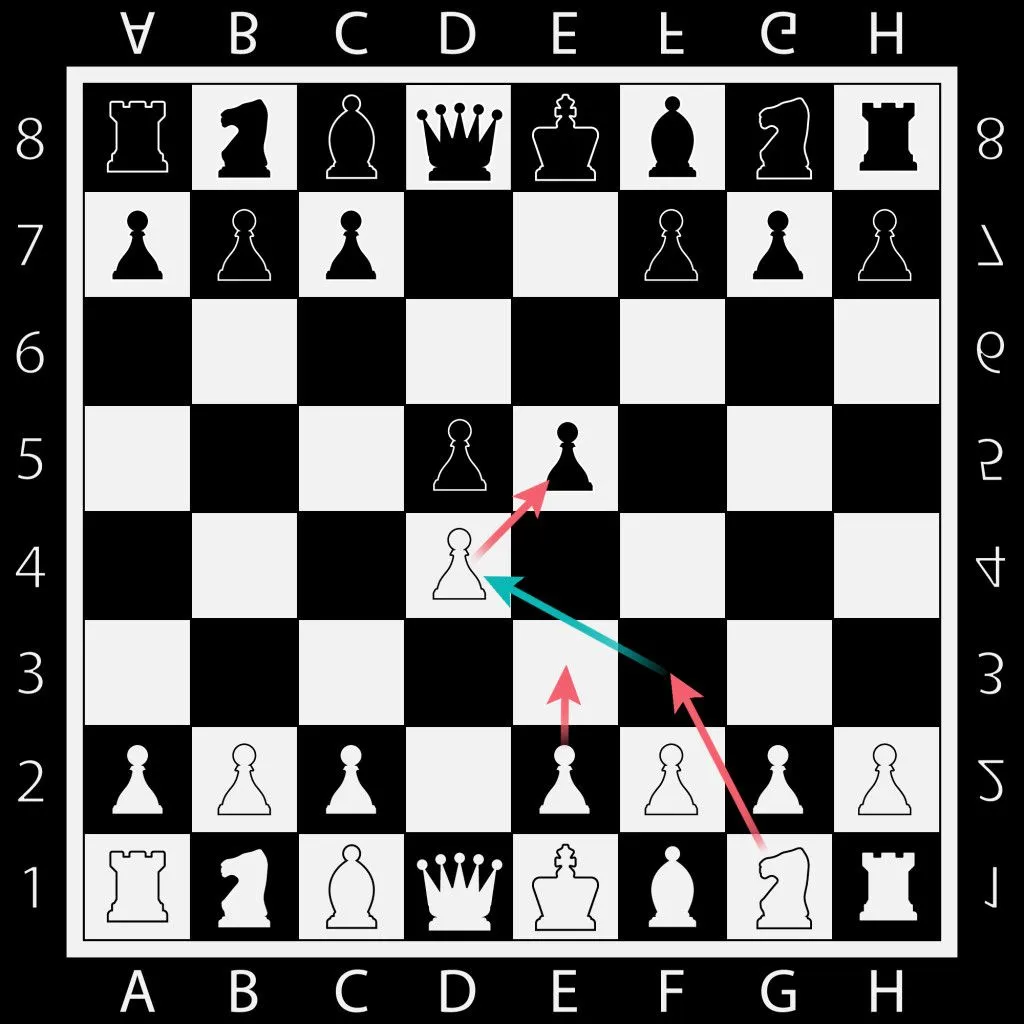
Let’s assume black as player 1 and white as player 2.
Given a select number of decisions of player 1, they know the number of possible moves that player 2 can make. Player 1 will either have a better pay-off against the predicted move of player 2 (e.g., capturing the opponent’s queen) or have to settle for the least bad pay-off (sacrificing a bishop to save the king). We can build a Game Tree with such sequential moves by calculating multiple equilibria.
Prisoner’s Dilemma
The original layout of the Prisoner’s dilemma is between two people who might go to jail for a crime. Here, if both refuse to confess and remain silent, they are imprisoned for a year (A:-1, B:-1).
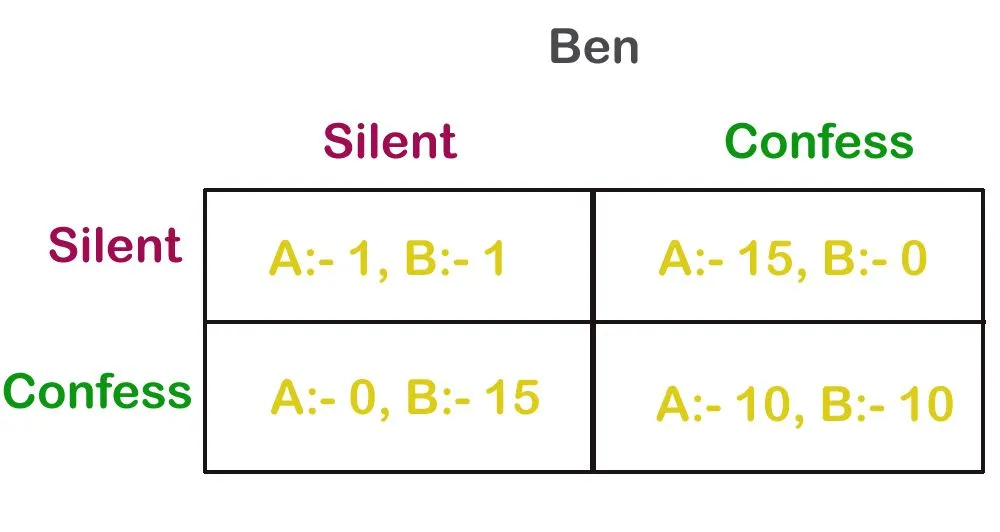
If only Ben or only Alan confesses and blames the other, either one of them gets 15 years, depending on who confessed first. Whoever confesses first gets a lesser sentence when both Ben and Alan choose to confess. If both confess simultaneously, they get 10 years each. Their pay-offs depend on the opposite person’s decision.
Similarly, in chess, we can build a similar table to calculate winning moves, given the opponent’s predicted move.
Zermelo’s Theorem: Answering The 2 Questions In Chess
Now you know the process to strategize a game of chess, but the most important questions remain unanswered:
Can we predict a player’s winning position? Or, when can it happen in the game, mathematically speaking?
We need a non-empty set of all moves required to win a game for white, not considering black’s moves, in sequential order. If it is an empty set, there is a draw. White can also have another set containing moves that can postpone their chances of losing. However, according to the rules, a game cannot last forever. They must reach a point where the position of the pieces is repeated thrice, causing a draw. Now we consider this set to be empty too. This implies White must make a finite number of moves to postpone their losing probability. When this happens, Black can use the opportunity to win.
So, either of the players can force their win with a strategy if they know the finite number of moves their opponent has to postpone losing.
When they reach this winning position, how many moves would it take for them to win?
According to Zermelo, it takes as many moves as the number of positions in the game to win, or even fewer, at times, but never more. Let’s prove this by contradiction.
If Black can win with more moves than there are positions on the board, then their winning move must have been repeated at least once. However, if they have repeated the position before, they should have won then. This proves that when Black plays the winning strategy, the game ends with no repeated position, so it takes a number of moves less than or equal to the number of possible positions.
As for you, there’s no need for contradiction. Try building a Game Tree using Nash Equilibrium to build a personalized (and unbeatable) strategy to win in all the chess games you play in the future!
References (click to expand)
- JC White. A MATHEMATICAL ANALYSIS OF THE GAME OF CHESS. Southeastern University
- P Walker. (2012) Chronology of Game Theory. University of California, Los Angeles
- History of Chess · International Games Day ·. University of Maryland, College Park
- Chess and its Relation to Game Theory - Cornell blogs. Cornell University
- Game Theory in World War 2 - Cornell blogs. Cornell University
- M Fava. What is... Game Theory?. Ohio State University