Münchhausen’s trilemma, named by German philosopher Hans Albert in 1968, argues that every attempt to prove a claim collapses into one of three flawed outcomes: circular reasoning, infinite regress, or an unproven axiomatic starting point. No argument can be fully justified from the ground up.
Ever heard one of your friends tell a story which just wasn’t true? Ever heard someone make a wild claim very confidently? Or have you ever heard someone state a fact that doesn’t sound right? What is the next step to this? How would you respond to these “wrong” claims/stories?
You look for evidence, which in turn helps you prove that your claim was right. This is the basic structure that all of us follow while we reason in our daily lives. We look for evidence to support our arguments and, the same evidence can be used to refute arguments.
But what if there is no way you can prove an argument to be true? What if what you think is evidence and proof, is just your method of convincing yourself that you’re right?
Karl Friedrich Freiherr Von Münchhausen
Hieronymus Karl Friedrich, Freiherr von Münchhausen (1720–1797) was a German nobleman born in Bodenwerder. (Freiherr is a title roughly equivalent to “baron”.) Alongside his military service, he had a flair for spinning stories he had “collected through his travels.” Many suspected that those tales were highly exaggerated, if not outright fabrications.
One of his best-known tales has him galloping into a swamp and sinking fast. Münchhausen claimed he pulled himself (and the horse) out of the bog by yanking up on his own pigtail. The point of the image, of course, is the absurdity of self-bootstrapping: lifting yourself out by using only yourself as the support.

Munchhausen’s Trilemma
Referencing that German baron, a debate in epistemology (the branch of philosophy concerned with the nature of knowledge) is called “Münchhausen’s trilemma.” The term was coined by the German philosopher Hans Albert in his 1968 book Traktat über kritische Vernunft (Treatise on Critical Reason), and the idea itself is a modern restatement of a much older skeptical argument, Agrippa’s trilemma, drawn from the five modes of Agrippa the Skeptic recorded by Sextus Empiricus in the 2nd century CE. Both versions argue that any attempt to prove the truth of a claim collapses into one of three equally unsatisfying outcomes, so the validity of an argument can never be fully justified.
Munchhausen’s trilemma puts forth three ways in which our methods of justifying arguments are flawed. These three methods are-
- Circular Reasoning
- Infinite Regress
- Dogmatic (or axiomatic) argument
Circular Reasoning
Circular reasoning is an incorrect form of using logic. It is a method of reasoning in which you end up with the argument that you were trying to make in the beginning. There is a cause and effect relationship assigned to such a reasoning, but in reality, it’s just going round in circles.

The template for this kind of reasoning is-
A is valid because of B
B is valid because of A
Let’s take examples to understand this better-
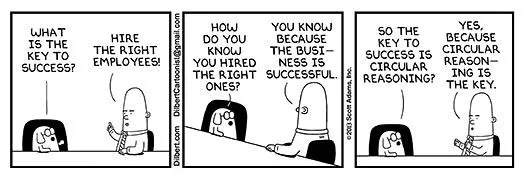
In the above example, the conclusion of the argument (a successful business) is the first argument as well. Hence, we see that instead of providing evidence to answer the question (what is the key to success), the argument ends at the same thing: a successful business. Let’s take another popular example, consider this conversation;
A: Our teacher told us that lying is bad.
B: Why is lying bad?
A: Because our teacher says so.
A: Therefore, lying is bad.
Circular reasoning is considered to be invalid because often while stating the premises, it assumes them to be true.
Infinite Regress
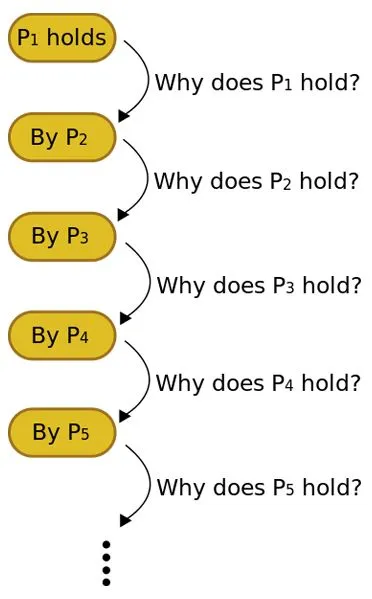
Have you ever heard a conversation between a child and their parent? Have you heard them questioning everything the parent says in order to learn more about the world? Eventually, a situation arises in which the parent has no answer. This is because the child has asked something which has no answer. This method of disproving the validity of an argument is known as infinite regress.
Dogmatic (Axiomatic) Arguments
A dogmatic (or axiomatic) argument is one that doesn’t require any further proof; it’s simply taken to be self-explanatory. How are these arguments self-explanatory?
They depend on existing knowledge/notions/views that people have about the world or certain things.
Common sense is a great example of such pre-existing knowledge. Common sense demands that you should be familiar with various things around you.
So if you hear the sentence, “World War II was a fight between the Axis and Allied powers.” That statement is self-explanatory because it assumes the reader already knows about World War II and the Axis and Allied powers.
Munchhausen’s trilemma determines that this idea of pre-existing knowledge is problematic and cannot determine validity. Consider the statement, “A mango is the most flavorful fruit”. That statement will only be true without requiring any proof if it is presented to another person who already holds the same opinion.
Hence any statement can be passed off as valid without having to prove validity.
A Worked Example: One Claim, Three Dead Ends
The quickest way to feel the trilemma is to pick a single claim and keep asking “How do you know?”. Suppose someone says, “Stealing is wrong.” Ask them why, and they might answer, “Because it harms other people.” Fair enough, but how do we know that harming other people is wrong? Perhaps because it reduces everyone’s wellbeing. And why does wellbeing matter? You can already sense where this is heading.
At this point, the person defending the claim has only three moves available, and each one is a horn of the trilemma:
- Keep answering. Every reason is handed a fresh reason behind it, and the questions never stop. That is infinite regress, and the justification is never actually completed.
- Loop back. Eventually they say, “Harming people is wrong because stealing is wrong,” quietly reusing the very claim we started with. That is circular reasoning.
- Plant a flag. They declare, “Causing needless harm is simply wrong, full stop,” and refuse to justify it any further. That is a dogmatic (axiomatic) stopping point, accepted without proof.
Notice that this trap does not care what the claim is about. Swap “stealing is wrong” for “the Earth orbits the Sun” or “this equation is correct,” and the same three exits appear. That is the unsettling power of Münchhausen’s trilemma: the problem lives in the structure of justification itself, not in the particular topic being argued.
What Are The Ways Out Of Münchhausen’s Trilemma?
If every justification runs into these three dead ends, how does anyone claim to know anything at all? Philosophers have not simply thrown up their hands. Instead, most epistemologists pick one of the three horns and argue that it is not as bad as it first looks. Each of the three main theories of justification is, in effect, a decision to live with one horn.

Foundationalism bites the dogmatic horn. It holds that some beliefs are basic, or foundational, and are justified without depending on any other beliefs. These non-inferential starting points (think of simple perceptual beliefs, such as “I see something red”) sit in the foundation and hold everything else up, so the regress has a principled place to stop.
Coherentism bites the circular horn, but insists the circle is virtuous rather than vicious. Coherentists reject the idea that justification runs in a straight line from premise to conclusion. Instead, it is entire systems of belief that are justified, and a single belief counts as justified when it fits into a large, mutually supporting web of beliefs that hang together coherently. On this view, the linear regress never even gets started.
Infinitism, defended most prominently by the philosopher Peter Klein, bites the regress horn. It argues that an endless, non-repeating chain of reasons is not vicious at all and can be exactly what justification requires. The obvious complaint is the “finite minds” objection: we have finite lives and finite brains, so we can never actually lay out an infinite series of reasons.
There is also a fourth response, and it belongs to the skeptic: accept the trilemma at face value and conclude that no belief is ever fully justified. That is precisely the uncomfortable option Münchhausen’s trilemma was designed to spotlight in the first place.
Is Münchhausen’s Trilemma Self-Refuting?
Here is the sharpest objection of all. If Münchhausen’s trilemma says that no claim can ever be fully justified, then what about the trilemma itself? It, too, is a claim. Does it not saw off the branch it is sitting on, running into the very same infinite regress, circle, or dogmatic assumption it accuses everyone else of? Skeptical arguments have long faced this charge of being self-refuting, though philosophers still disagree over whether the charge actually sticks.

Hans Albert, who popularized the trilemma, had an answer. His argument was never aimed at knowledge in general, but at one specific ideal: the principle of sufficient justification, the demand that we supply conclusive grounds for the truth of everything we believe. The trilemma shows that this particular demand can never be met. Crucially, Albert did not claim to have proven the trilemma from certain foundations, because that would walk straight into the same trap.
Instead, Albert and his fellow critical rationalists (following Karl Popper’s lead) simply give up the demand for ultimate justification. In its place they put critical testing: we treat our beliefs as fallible conjectures, expose them to criticism and evidence, and provisionally keep the ones that survive. A conjecture that has withstood serious testing is a reasonable thing to hold, and it does not have to be conclusively justified to earn that standing. Seen this way, the trilemma is not a self-defeating dogma at all. It is a diagnosis of why the old dream of proving everything from the ground up was always going to fail.
Conclusion
This trilemma falls under the field of epistemology. Epistemology is a field in philosophy, which is concerned with the theory of knowledge. It studies the structures, methods and ways through which we acquire knowledge or justify our arguments. It provides us the tools by which we can reason accurately, and make valid arguments.
The study of epistemology also disbands our traditional views of validity, accounts for bias and through a methodological analysis, provides us with accurate information. But why is this important in contemporary times?
We live in times where we are surrounded by all kinds of news. Media is playing a strong role on the global platform. Epistemology as a field, stresses on the importance of research and fact-checking for the individual. While we have the presence of media to provide us with information and shape our opinions, we should not alienate ourselves from this process.
By having precise methods of acquiring knowledge and presenting it, we eliminate the possibility of semi-literate arguments and opinions. In times where we have so much of information around us to build our opinions, it is extremely important to know how we are justifying ourselves, if we are lacking, and what we need to work on.
References (click to expand)
- (2002) Circular reasoning - Psychology - Northwestern. Northwestern University
- (2015) Formal Epistemology - Stanford Encyclopedia of Philosophy. The Stanford Encyclopedia of Philosophy
- (2018) Infinite Regress Arguments. The Stanford Encyclopedia of Philosophy
- Karl Friedrich Hieronymus, Freiherr von Münchhausen. Encyclopædia Britannica.
- Ancient Skepticism. The Stanford Encyclopedia of Philosophy.
- Albert, Hans. (1985). Treatise on Critical Reason. Princeton University Press.
- Foundationalist Theories of Epistemic Justification. The Stanford Encyclopedia of Philosophy.
- Coherentist Theories of Epistemic Justification. The Stanford Encyclopedia of Philosophy.
- Epistemology, Infinitism in. Internet Encyclopedia of Philosophy.
- Skepticism. The Stanford Encyclopedia of Philosophy.
- Karl Popper. The Stanford Encyclopedia of Philosophy.