Attachment styles describe how secure we feel in close relationships, romantic or otherwise. Attachment theory sorts people into four patterns: secure, anxious (preoccupied), avoidant (dismissing), and fearful-avoidant. These styles are shaped partly by our early bond with caregivers, but they are not fixed and only modestly predict adult relationships.
Therapy content on social media is littered with references to attachment theory, from what type of romantic partner you are to how essential is to know your crush’s attachment style before you fall head over heels. However, what is an attachment style and how does it affect our interactions with others?

How Are Attachment Styles Formed?
Online, attachment styles seem to primarily be about romantic relationships. However, the origin of our attachment style (and ultimately, its connection to our love lives) is based on our level of security in a relationship with another person: be it romantic, platonic, or parental. Attachment styles are born of our interactions with our parents and the bond we share with them, and they subsequently affect every relationship in our lives.
Our interaction with our parents shapes our attachment styles, as they are usually the first people we are in contact with after birth. From a young age, we have an inclination to interact with other people, and it is these interactions that shape our social relationships with others throughout our lives.
Edward John Mostyn Bowlby, a British psychologist, was known for his contribution to the concept of attachment theory. He and his colleague Ainsworth carefully studied the interactions between mothers and infants and developed the idea of set attachment styles.
According to Bowlby (seen as the pioneer of the field), infants develop two basic attitudes while interacting with an adult in their early years of life. The first is the infant’s attitude about themselves and their self-esteem. How the caretaker (a parent, grandparent, or guardian) behaves and emotionally responds to the infant shows the infant whether they are loved as an individual or are without value, unloved and unimportant.
The second attitude relates to the expectations and beliefs one has about others in their life, also referred to as interpersonal trust. Is the caretaker seen as someone who is trustworthy, reliable and dependable? Or as someone who is untrustworthy, unreliable, and undependable?
Based on these two basic attitudes, people can be roughly classified into having a particular style of being involved in relationships with others. Think of self-esteem as one dimension and interpersonal trust as another.
Based on this binary, there are four possible patterns that exist: someone who is high on both dimensions, someone low on both dimensions, and two others in which the person in question is high in one dimension and low in the other. We will discuss the four contrasting attachment styles next.
What Are The Different Types Of Attachment Styles?
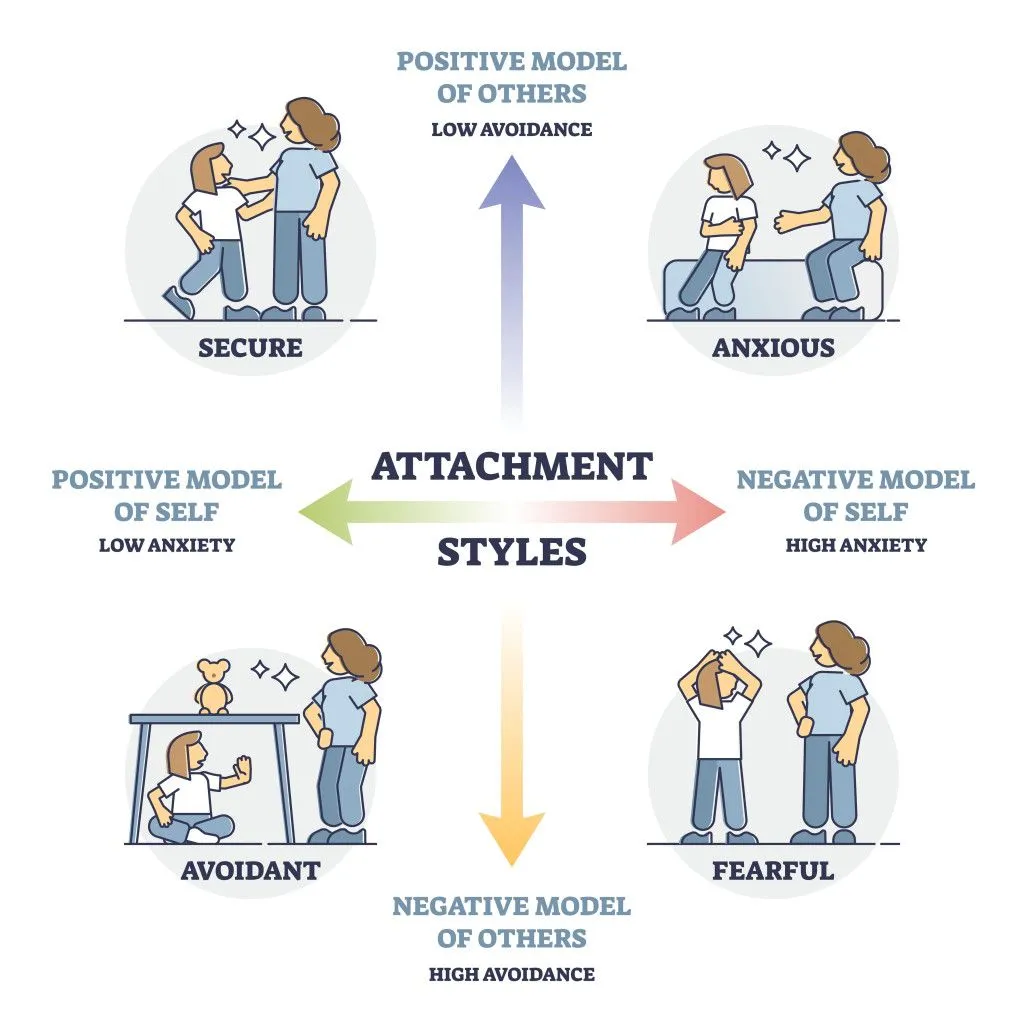
High self-esteem + high interpersonal trust = secure attachment style. These individuals are able to sustain committed and satisfying relationships.
High in self-esteem + low interpersonal trust = dismissing (avoidant) attachment style. This combination leads individuals to believe that they deserve good relationships, but they don’t trust others and fear genuine intimacy.
Low self-esteem + high interpersonal trust = preoccupied (anxious) attachment style. Because of low self-esteem, these individuals can become needy and cling onto others because they fear rejection.
Low self-esteem + low interpersonal trust = fearful-avoidant attachment style. This is sometimes called the anxious-avoidant style (and, in clinical and research settings, disorganized attachment), because it pairs the anxiety of the preoccupied style with the avoidance of the dismissing one. These individuals deeply crave closeness yet fear and distrust it, often feeling unworthy of love while also expecting others to let them down. The result is a push-pull pattern: they reach for connection, then pull away once it gets real.
How Do Attachment Styles Affect Our Relationships?

People With Different Attachment Styles Respond Differently In Romantic Relationships (Photo Credit : DreamyNatalie_doodles.J/Shutterstock)
Securely attached individuals are what we would call “emotionally healthy”. As the theory goes, these individuals probably had loving, warm, and emotionally responsive caretakers. As a result, they have a healthy degree of self-esteem and trust in others. They report having happy and trusting relationships, both romantic and platonic, and are themselves loving and dependable people. They can be vulnerable with their partners, they communicate effectively, and are available to meet their partner’s needs.
People who show avoidant attachment styles, on the other hand, are uneasy with getting emotionally close to others. They tend to see their parents as harsh and uncaring, and project that onto other relationships. They see emotional intimacy as suffocating, or believe that it will take away their freedom or independence, and have a negative overall picture of love, believing that it never lasts.
Preoccupied or anxious attachment styles desire intimacy, but view their relationships as being fragile. They also report their parents as being either too involved or extremely absent. Anxiously attached people are the ones who worry if their partners don’t call when they say they will, or if they arrive home late without any explanation. They view these situations as being “dangerous” for their relationships. People with anxious attachment styles find it easy to fall in love, but difficult to sustain it.
Fearful-avoidant individuals sit awkwardly between these two camps. They want intimacy as badly as anxiously attached people do, but they distrust it as much as avoidant people do. So they tend to send mixed signals, pulling a partner close one week and creating distance the next. Because both their craving for closeness and their fear of it run high, their relationships can feel like the most turbulent of the four styles.
Are Attachment Styles Set In Stone? Do They Ever Change?
Our attachment styles have an impact on our life’s outcomes. Young adults with an insecure attachment style have poorer performance in school, as compared to those with a secure attachment style. They have fewer friends, and feel more like an outcast in social situations. They also report having higher levels of stress and conflicts in their relationships. Insecure attachment is also linked, on average, with a higher risk of suicidal thoughts and behavior, with the fearful-avoidant pattern showing the strongest association of the insecure styles. These are correlations rather than proof that an attachment style causes any single outcome, and the effects tend to be modest.
Fortunately, they are not set in stone. Someone with a secure attachment style who experiences a painful breakup can become temporarily insecure due to the blow that the breakup has on their self-esteem.
Let’s take an example of someone named AyeBee who has an anxious attachment style. Through therapy and self-reflection, they managed to challenge the negative beliefs they held about love, and addressed the root cause of their anxious attachment style. This helped them develop a secure sense of self. Gradually, their attachment style shifted, leading to healthier relationships, increased self-worth, and a greater sense of stability and satisfaction.
Challenges/Alternatives To Attachment Theory
The attachment theory has gained huge acceptance among psychologists and psychiatrists, but it is not without its critics. One of the most common is that the popular, social-media version of attachment theory vastly overstates its predictive power. The research is clearer than the memes: an infant's attachment pattern only modestly predicts their later childhood or adult outcomes, and it is one influence among many (peers, later relationships, life events, and temperament all matter too) rather than a fixed script for your love life. Some alternate theories also propose a different explanation for how human relationships and attachments are formed.
Social support theory is one alternative. This theory emphasizes the importance of social networks, community, and other support systems like friendships and workplace relationships in shaping our well-being and emotional security. The main argument of this theory is that attachment is not just related to our early relationship with our caregivers, but actually encompasses all sorts of social interactions that we encounter in our lives.
One of the reasons why attachment theory is popular among psychologists and psychiatrists is because it is a comprehensive framework for understanding behaviors, emotional development, and relationship dynamics of humans. It also provides them a lens through which they can analyze and address attachment-related issues in their therapeutic sessions. Since the theory emphasizes early life experiences, internal working models, and the impact these attachment styles have on mental health, they ultimately influence the course of psychotherapy.
While the attachment theory has its limitations and alternative perspectives do exist, its popularity cannot be denied and its impact cannot be minimized.
References (click to expand)
- Miall, D. S., & Dissanayake, E. (2003, December). The poetics of babytalk. Human Nature. Springer Science and Business Media LLC.
- Bowlby, J. (1979). The Bowlby-Ainsworth attachment theory. Behavioral and Brain Sciences, 2(4), 637-638. doi:10.1017/S0140525X00064955
- Bretherton, I. (1992, September). The origins of attachment theory: John Bowlby and Mary Ainsworth. Developmental Psychology. American Psychological Association (APA).
- Shaver, P. R., & Brennan, K. A. (1992, October). Attachment Styles and the "Big Five" Personality Traits: Their Connections with Each Other and with Romantic Relationship Outcomes. Personality and Social Psychology Bulletin. SAGE Publications.
- Tidwell, M.-C. O., Reis, H. T., & Shaver, P. R. (1996). Attachment, attractiveness, and social interaction: A diary study. Journal of Personality and Social Psychology. American Psychological Association (APA).
- Whiffen, V. E., Aube, J. A., Thompson, J. M., & Campbell, T. L. (2000, June). Attachment Beliefs and Interpersonal Contexts Associated with Dependency and Self-Criticism. Journal of Social and Clinical Psychology. Guilford Publications.
- Carvallo, M., & Gabriel, S. (2006, May). No Man Is an Island: The Need to Belong and Dismissing Avoidant Attachment Style. Personality and Social Psychology Bulletin. SAGE Publications.
- Shaver, P. R., & Brennan, K. A. (1992, October). Attachment Styles and the "Big Five" Personality Traits: Their Connections with Each Other and with Romantic Relationship Outcomes. Personality and Social Psychology Bulletin. SAGE Publications.
- Klohnen, E. C., & Bera, S. (1998). Behavioral and experiential patterns of avoidantly and securely attached women across adulthood: A 31-year longitudinal perspective. Journal of Personality and Social Psychology. American Psychological Association (APA).
- Green, J., Berry, K., Danquah, A., & Pratt, D. (2020). The role of psychological and social factors in the relationship between attachment and suicide: A systematic review. Clinical Psychology & Psychotherapy. Wiley.
- (PDF) Divorce through the Lens of Attachment Theory. ResearchGate
- Feeney, B. C., & Collins, N. L. (2014, August 14). A New Look at Social Support. Personality and Social Psychology Review. SAGE Publications.