The Seven Wonders of the Ancient World are the Great Pyramid of Giza, the Hanging Gardens of Babylon, the Statue of Zeus at Olympia, the Temple of Artemis at Ephesus, the Mausoleum at Halicarnassus, the Colossus of Rhodes, and the Lighthouse of Alexandria. Listed by Greek writers, only the Great Pyramid still stands; the other six were lost to earthquakes, fire, or neglect.
One of Socrates many excellent quotes states that, “Wisdom begins in wonder.” He wasn’t wrong, as wonder truly is nourishment for the soul. As humans, we can look at a sunset and be moved to tears, unlike any other animal on the planet, as far as we know. Studies show that awe-induced wonder can bring about more profound cognitive abilities, boost our empathy, and help us connect with the world around us in a much more meaningful way. The Wonders of the World have always piqued the interest of anyone who has laid eyes on them. In this article, we will take a closer look at the seven wonders of the ancient world. Early lists were drawn up by the historian Herodotus and by the poet Callimachus of Cyrene, who served as a scholar at the Library of Alexandria, although those works survive only as references; the earliest extant list comes from Antipater of Sidon around 140 BCE. Since six of the seven ancient wonders no longer exist, there are also Seven Wonders of the Modern World, but we’ll get to those another day!
Great Pyramid Of Giza
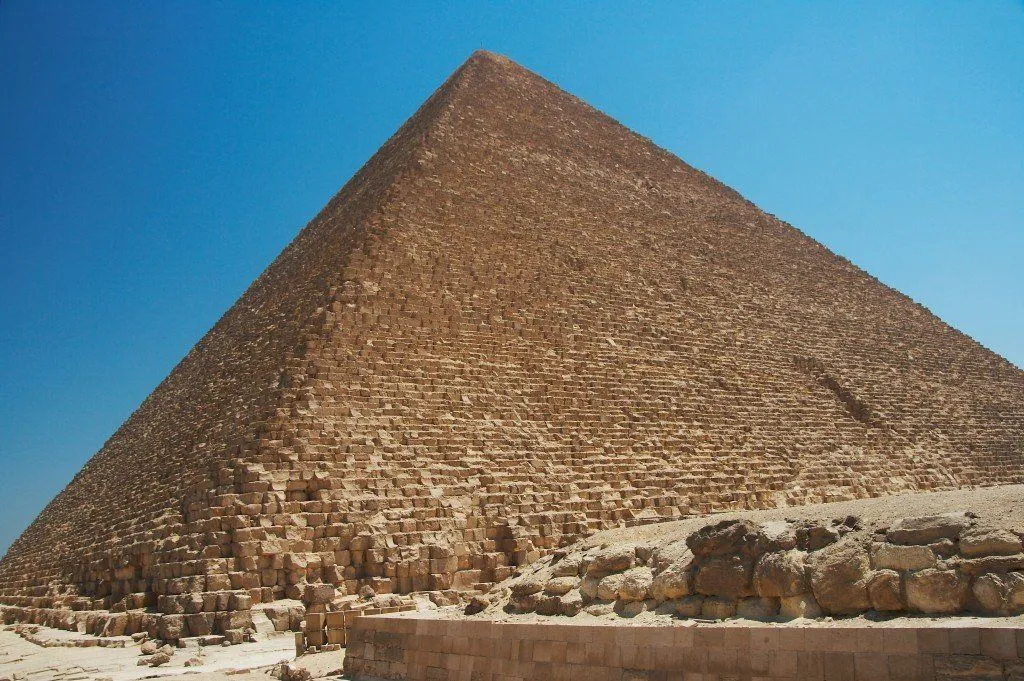
The Great Pyramid of Giza is the oldest and largest of the three pyramids of the Giza Pyramid Complex. It is the oldest of the seven wonders and the only one that remains largely intact and standing. Egyptologists believe that the Great Pyramid was built as a tomb for the Fourth Dynasty Egyptian pharaoh Khufu, who ruled in the early 25th century BCE. The timeline of construction is estimated to be roughly 20 years. The pyramid consists of about 2.3 million blocks of stone, weighing a combined 5.75 million tons. Spread evenly across two decades, that works out to roughly 13 blocks placed every hour, day and night, for 20 years.
The pyramid also remained the tallest man-made structure for close to 3,800 years. It was surpassed by Lincoln Cathedral in England only in 1311 CE, when its central spire was completed. It isn’t simply the height that the ancient Egyptians achieved which made the pyramid such a marvel, but also its engineering precision. The four sides of the base differ by only about 58 millimeters (2.3 inches) in length, and the corners are squared to within roughly 12 seconds of arc. That this was achieved more than 4,500 years ago, without any modern instruments, is genuinely staggering.
Colossus Of Rhodes
The Colossus of Rhodes was a giant bronze statue of the Greek sun god Helios, built on the Greek island of Rhodes by the sculptor Chares of Lindos between roughly 294 and 282 BCE. The people of Rhodes commissioned it to celebrate their successful defense of the city against a year-long siege by Demetrius I Poliorcetes in 305 BCE, melting down the abandoned siege engines to help cast the bronze plates. Standing about 33 meters (108 feet) tall, it was the tallest statue in the ancient world, roughly two-thirds the height of the modern Statue of Liberty from feet to crown.
The Colossus stood for only about 54 years. In 226 BCE, an earthquake struck Rhodes and the statue snapped at the knees, toppling onto the ground. According to the geographer Strabo, an oracle warned the Rhodians against rebuilding it, and even a generous offer from Ptolemy III of Egypt to fund its reconstruction was politely declined. The ruins lay in place for nearly nine centuries, becoming a tourist attraction in their own right, until around 654 CE, when Arab forces who had captured the island reportedly sold the bronze for scrap. The debris is said to have required hundreds of camel loads to cart away.
The Hanging Gardens of Babylon

(Image Credit: Flickr)
The Hanging Gardens of Babylon are best described as a remarkable feat of engineering, as they consisted of an ascending series of tiered gardens. These bifurcated gardens contained a variety of trees, shrubs, and vines that made the whole structure look like a large green mountain constructed on bricks. This marvelous construction was built in Babylon, which today is a place named Hillah, situated in Iraq. The reason why the Hanging Gardens were built seems to be a perplexing tale. According to legend, the Neo-Babylonian King Nebuchadnezzar II (who ruled between 605 and 562 BC) built it for his Median Wife Queen Amytis, because she missed the green hills and valleys of her homeland. However, strangely enough, even though the Hanging Gardens have earned a place as one of the Seven Ancient Wonders of the World, it is unclear as to where exactly this wonder existed. It is never mentioned in any of the ancient Babylonian texts, let alone its location, which leaves one to wonder whether the Hanging Gardens of Babylon existed at all or whether it was all just a mythical invention. More recently, Oxford scholar Stephanie Dalley has argued that the gardens were real, but were actually built by the Assyrian king Sennacherib at Nineveh, roughly 480 km (300 mi) north of Babylon, around 700 BCE. Her case rests on Sennacherib’s own inscriptions, which describe a tiered palace garden fed by a long aqueduct, and on Assyrian palace reliefs showing exactly such a garden.
Lighthouse of Alexandria

(Photo Credit : Dawidbernard/Wikimedia Commons)
The Lighthouse of Alexandria was built by the Ptolemaic Kingdom of Egypt on the small island of Pharos, located on the western edge of the Nile Delta. In 332 B.C. the city of Alexandria was founded, opposite the small island of Pharos. Alexandria and Pharos were connected by a small mole. A mole is a massive stone structure that connects two places usually separated by water. The lighthouse was constructed in the 3rd century B.C. After Alexander the Great died, the first Ptolemy (Ptolemy I Soter) announced himself king in 305 BC and commissioned its construction shortly thereafter. The building was finished during the reign of his son, the second Ptolemy (Ptolemy II Philadelphus). Most accounts of the lighthouse are taken from Arab traveler logs of the time. From these logs, we can estimate that the lighthouse was anywhere from 103-118 meters tall. The lighthouse no longer exists. It was severely damaged by a sequence of earthquakes between 956 and 1323 CE, the worst striking in 1303, after which it became an abandoned ruin. In 1480, the Mamluk sultan Qaitbay used the last of its stones to build a fortress (the Citadel of Qaitbay) on the same site, which still stands today.
Mausoleum at Halicarnassus

(Photo Credit : Zee Prime/Wikimedia Commons)
The Mausoleum at Halicarnassus was a tomb built between 353 and 350 B.C. The present-day location is in Bodrum, which is situated in Turkey. It was built for Mausolus, a satrap (provincial governor) in the Persian Empire who ruled the region of Caria from Halicarnassus, and for his sister-wife Artemisia II, who oversaw most of the construction after his death in 353 BCE. The Mausoleum was approximately 45 meters in height, and all four sides were adorned with sculptural reliefs. The tomb was erected on a hill overlooking the city. The whole structure sat in an enclosed courtyard, and at the center of the courtyard was a stone platform on which the tomb sat. A stairway flanked by stone lions led to the top of the platform, which bore on its outer walls many statues of gods and goddesses.
At each corner, stone warriors mounted on horseback guarded the tomb. At the center of the platform, the marble tomb rose as a square tapering block to one-third of the Mausoleum’s 45 m (148 ft) height. This section was covered with bas-reliefs showing action scenes, including the battle of the centaurs with the Lapiths, and the Greeks in combat with the Amazons, a race of warrior women. A sculptural relief is a kind of sculpture in which the sculptures are attached to a solid background, in this case, a wall. Each side of the Mausoleum was created by one of the four famous Greek Sculptors of the time, Leochares, Bryaxis, Scopas of Paros and Timotheus. However, the structure no longer stands. A series of earthquakes between the 12th and 15th centuries CE gradually toppled it, making the Mausoleum the last of the six destroyed wonders to fall. In 1494, the Knights of St. John of Rhodes quarried the remaining stones to fortify their castle at Bodrum, which is why so little survives today.
Statue of Zeus Olympia and The Temple of Artemis

(Photo Credit :Quatremère de Quincy /Wikimedia Commons)
The Statue of Zeus was commissioned by the Eleans (the people of the district of Elis in Greece) and sculpted by the celebrated Greek master Phidias around 435 BCE. It stood inside the Temple of Zeus at Olympia, the same sanctuary that hosted the ancient Olympic Games. The statue was a chryselephantine sculpture, meaning it had a wooden framework covered in carved ivory plates for the skin and sheets of gold for the robes. It depicted Zeus seated on a cedar throne inlaid with ebony, gold, and precious stones, and rose to about 12.4 meters (41 feet) tall, nearly filling the temple it occupied. The statue was regularly anointed with olive oil to keep the ivory from cracking in the humid climate. When the Roman emperor Theodosius I banned pagan worship in 391 CE, the Olympic Games and the temple’s rituals were shut down. The statue’s exact fate is uncertain. The most common account, from the Byzantine historian Georgios Kedrenos, says it was carried off to Constantinople and destroyed in the great fire of the Palace of Lausus in 475 CE; an alternative tradition holds that it perished when the temple at Olympia itself burned in 425 CE.
(Image Credit: Flickr)
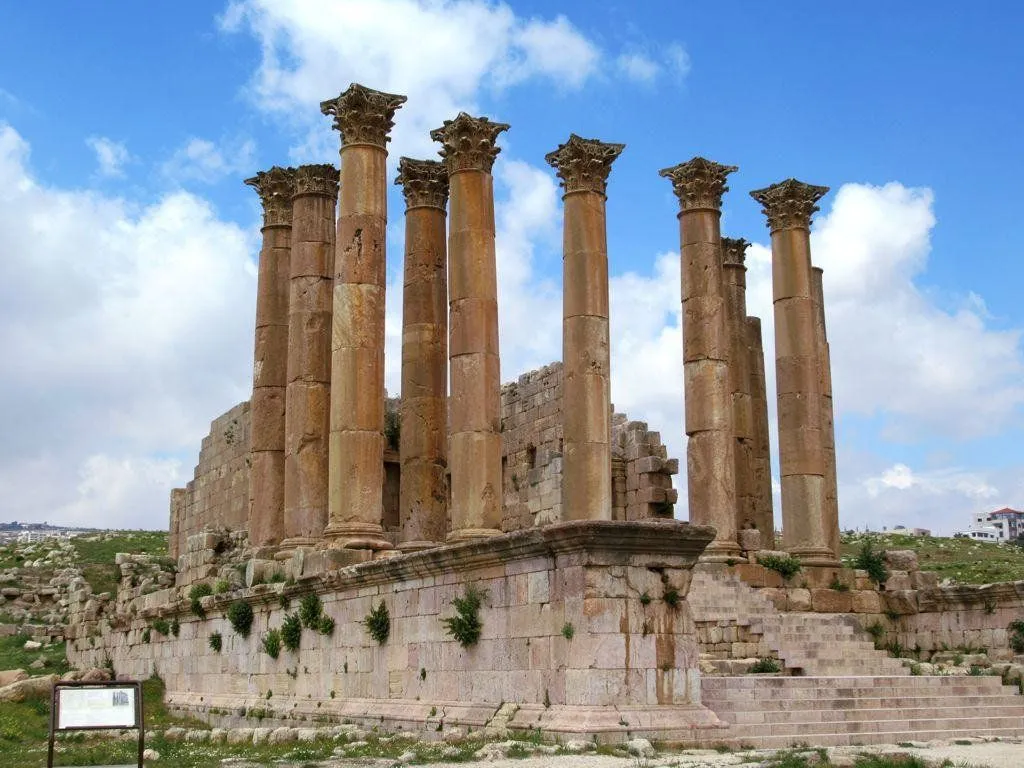
The final wonder on the list is the Temple of Artemis at Ephesus (in modern-day Turkey), dedicated to the Greek goddess of the same name. It was rebuilt three times. The first version was an early Bronze Age shrine destroyed by a flood. The second, a far grander marble structure begun around 550 BCE under the Lydian king Croesus, took roughly a decade to complete and was the one that earned the Temple its place on the list. That version was deliberately burned down on the night of 21 July 356 BCE by a man named Herostratus, who reportedly set the fire purely to make his own name famous. A still grander third temple was then built on the same site, with 127 marble columns and reliefs by some of the leading sculptors of the day. It was sacked by raiding Goths in 268 CE and never fully recovered; whatever remained was finally pulled down during the late Roman crackdown on pagan worship, and its stones were quarried over the following centuries for other buildings.
In conclusion, of all the wonders of the ancient world, the Great Pyramid of Giza is the only one to stand the test of time. Each of the other six left behind only fragments, drawings, and the wonder of having once existed at all.
References (click to expand)
- Seven Wonders of the World. Encyclopaedia Britannica.
- Great Pyramid of Giza. Encyclopaedia Britannica.
- Hanging Gardens of Babylon. Encyclopaedia Britannica.
- Statue of Zeus. Encyclopaedia Britannica.
- Temple of Artemis. Encyclopaedia Britannica.
- Mausoleum of Halicarnassus. Encyclopaedia Britannica.
- Colossus of Rhodes. Encyclopaedia Britannica.
- Lighthouse of Alexandria. Encyclopaedia Britannica.
- Hanging Gardens of Babylon... in Assyrian Nineveh. Biblical Archaeology Society.