Table of Contents (click to expand)
The word “OK” first appeared in print on March 23, 1839, in the Boston Morning Post as a jokey abbreviation of “oll korrect,” a deliberate misspelling of “all correct.” It stuck a year later when supporters of Martin Van Buren (“Old Kinderhook”) adopted O.K. as a campaign slogan, and it has been repurposed ever since.
In our ultra-modern, fast-paced world, it seems impossible for someone to write a text message or an email without abbreviating a word or using an acronym instead of a full phrase (LOL, g2g, brb, ROFL, TTYL… just to name a few). There simply isn’t enough time to write things out or even say them out loud!
However, for those who think this is a modern phenomenon, I have some bad news for you… this tradition of cleverness (or laziness) dates back hundreds of years, if not longer. “OK”, one of the most ubiquitous words in the English language (even boasting a universal hand symbol), has tangled origins that remain hotly debated to this day. So… what’s the real story of OK?
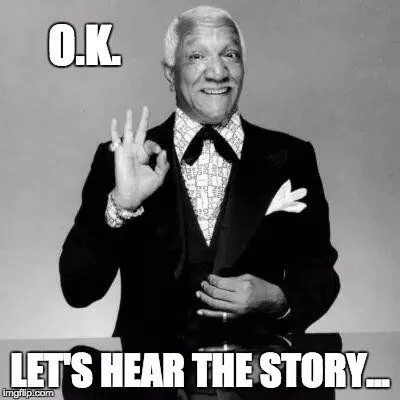
Short Answer: It began as a joke, became famous as a campaign slogan, and was then repurposed in hundreds of different ways. The full story is also very satisfying…
The Origin Of OK
This tale begins on March 23, 1839, in the Boston Morning Post, when a particularly clever editor named Charles Gordon Greene slipped it into a satirical article poking fun at a frolicsome group called the Anti-Bell-Ringing Society. In one line, he wrote “o.k. – all correct -“, which does look a bit strange, given that all doesn’t begin with “o” and correct doesn’t start with “k”. And that was exactly the joke: “o.k.” was shorthand for “oll korrect,” a deliberately misspelled version of “all correct.” Intentionally mangling a phrase and then abbreviating it was a fad among young, educated Bostonians back in those days. “No go,” for example, was abbreviated to K.G. (“know go”), and “all right” became O.W. (“oll wright”). Greene was simply cracking a joke, and most people would have forgotten the phrase, or it would have fallen out of style, had this editorial piece not landed right before the presidential campaign of Martin Van Buren.
For those who aren’t fresh on their 19th century presidential trivia, Martin Van Buren had a nickname, Old Kinderhook, as he was a native of Kinderhook, NY. Some of Van Buren’s rabid supporters decided to form their own club to support their candidate during the 1840 election, and using his initials as a basis, they formed the O.K. Club.
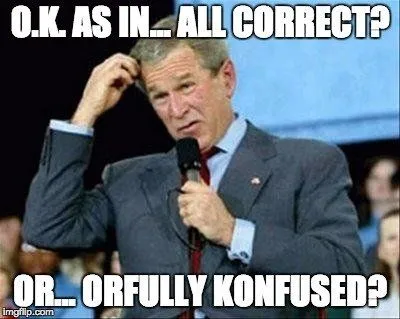
Given that this was only one year after o.k. had a passing brush with fame as a pop culture abbreviation, the two applications became intertwined and indistinguishable during the campaign. Opponents of Van Buren used the initials in less than complimentary ways, such as “Out of Kash”, “Orfully Confused”, and a number of other less-than-brilliant mudslinging. The pundits and critics of the day had their fun with the phrase, injecting O.K. into the national vernacular, although with a bit more tact than this…
However, the unclear definition of what it meant, ranging from “all correct” to a tongue-in-cheek criticism of someone’s abilities/intelligence, lent it a certain intrigue that helped it stick in people’s mind – and mouth.
From Tongue To Telegraph
Just as the timing of the newspaper piece lined up nicely with Van Buren’s presidential run, it also fit in historically well with the rise of the telegraph in the 1840s. Given that any message was costly and time intensive, a simple “reply message” was required, and operators grasped onto O.K. as a sign that the transmission had been received and that it was “all correct”. This use of O.K. lasted far longer than Van Buren’s nickname, or a passing joke by an editor, and became common parlance among telegraph operators around the country.
That same telegraph transmission spread O.K. outside America and to the English-speaking world as a whole, and from there, the simplicity of the term, and its fluid meaning, appealed to countless other cultures. As a simple word for affirmation, a way to express tepid enthusiasm, or even a means of insulting something with a bit of tact, O.K. is one of the most versatile words in the English language – and beyond. Just think about the flexibility of the word (and mind, these are only a few of the seemingly endless uses):
“Okay! Let’s go!” – Excitement
“That meal was okay.” – Neutrality
“Okay… I guess I’ll go.” – Reticence
“This looks okay to me!” – Approval
See? Pretty useful, huh?
It’s “O.K.” To Cross Language Barriers
Once the word became an international call sign, it gradually slipped into common speech, and clever humans even came up with a hand gesture to accompany it. For some reason, however, many different groups of people have staked their claim of possession on it, and in some cultures, people date back the use of okay hundreds of even thousands of years. Whether there is any validity to this, or just cultural amnesia, still remains unclear, which is why O.K. remains a point of discussion and fascination for many scholars and those with lots of time on their hands.
To give you some idea of the confusion centered around this word, here are a few of the rival origin stories that scholars have since debunked. Some are charming, some are wildly improbable, but none of them hold up the way the Boston joke does:
German – Ober-kommando (O.k.)
Choctaw – okeh
Latin – omnes korrecta
Scotland – och aye
Greek – ola kala
Civil War – soldiers reporting “Zero (0) Killed” after a battle (impossible, since O.K. was already in print in 1839, more than 20 years before the war)
Whatever explanation you want to believe, suffice to say that it is hard to get everyone to agree on history, which is why etymology (the study of the origin of words) is such an intriguing field… for some people. That said, the debate is actually settled. In a series of articles published in the journal American Speech in 1963 and 1964, Columbia University professor Allen Walker Read methodically tracked the word back through old newspapers and dismantled the folk theories one by one. All signs point to the Boston Morning Post and Martin Van Buren explanation, since that is the one trail you can actually follow in print. So as long as you’re O.K. with using it every day, do you really care where it actually came from?